Tuesday, September 27, 2011

Boxoffice: September 3, 1973


Trancers II

TRANCERS II is the first of four direct-to-video TRANCERS sequels produced by Full Moon Entertainment. It’s set six years after the original film—fitting, since it was also produced six years after TRANCERS. It has a great exploitation cast, but it also gives them little to do, and Jackson Barr’s screenplay is a real mess. The first act is a geyser of exposition that overwhelms the viewer with information about the characters’ backstories and the machinations involved in 23rd century time travel (which is a lot more needlessly complicated than it was in Danny Bilson and Paul DeMeo’s script for TRANCERS).

Dr. E.D. Wardo (Richard Lynch), the brother of the evil cult leader Whistler killed by future cop Jack Deth (Tim Thomerson) in TRANCERS, is kidnapping homeless people and mental patients, bringing them back to his ecologically minded Green World clinic, and turning them into trancers to use in his army to take over the world. Deth’s old supervisor McNulty (Art LeFleur) comes “down the line” in the body of his 15-year-old ancestor (Alyson Croft) to give Jack his new assignment—and to warn him that Alice (Megan Ward, star of Band’s CRASH AND BURN), Jack’s late wife, will be joining him on this trancer hunt.

As you can imagine, Jack’s present wife Lena (Helen Hunt) isn’t too thrilled about Alice’s appearance, and recovering alcoholic ex-baseball star Hap Ashby (Bill Manard), whose descendent is 23rd century L.A.’s last surviving council member, has fallen off the wagon in fear of again becoming a target for trancers. Band’s penchant for casting pretty but stiff young actresses like Croft and Ward put a damper in their scenes with the more experienced Thomerson, but genre fans will enjoy seeing Barbara Crampton (FROM BEYOND), Jeffrey Combs (RE-ANIMATOR), Martine Beswicke (DR. JEKYLL & SISTER HYDE), and John Davis Chandler (PHANTASM III), even if they aren’t used particularly well.

If you don’t mind the massive story holes (to be fair, the much better TRANCERS has some too, but they’re more easily overlooked), TRANCERS II is worth a look for the cast alone. Band bumped up the rating from a PG-13 to an R with several juicy squibs, and he stages the climax’s low-wattage pyrotechnics well enough. An early success for Full Moon, TRANCERS II inspired a second sequel a year later.

Monday, September 26, 2011

Trancers

Charles Band’s low-budget TRANCERS, released by his Empire Pictures in 1985, is one of the most imaginative science fiction films of a decade filled with very good and great ones. Much credit should go to debuting screenwriters Danny Bilson and Paul DeMeo, who demonstrate a real knack for the genre and went on to write THE ROCKETEER and create THE FLASH for CBS.

Even considering the script, which manages to seem original despite being heavily influenced by THE TERMINATOR and BLADE RUNNER, the movie wouldn’t work without leading man Tim Thomerson. Known to this point as a comic actor and standup comedian, Thomerson graduated from wisecracking sidekick in Band’s METALSTORM: THE DESTRUCTION OF JARED-SYN to tough-guy hero Jack Deth, a rebellious cop patrolling post-earthquake Los Angeles of the 23rd century. His obsession is destroying “trancers,” who are basically zombies created by nefarious cult leader Martin Whistler (Michael Stefani), since a trancer killed his wife years earlier.

The three-man council that runs “Angel City” learns that Whistler, whom Deth thought to have killed, is still alive in the L.A. of 1985 with plans to kill their ancestors, which would crumble the city’s already shaky government. Deth is sent back to 1985, where he convinces pretty punker chick Lena (future Oscar winner Helen Hunt) to help him find Whistler and stop his plot.

Bilson and DeMeo’s method of time travel is clever. Instead of Deth being physically sent back in time, he is strapped down and chemicals are used to send him “down the line” to inhabit the body of one of his ancestors—a womanizing journalist named Phil Deth. The dialogue’s frequent use of creative futuristic vocabulary, such as “singeing” trancers and the reference to the weak-willed people who are easy prey for Whistler’s brainwashing as “squids,” adds to the film’s original atmosphere.

Thomerson is really terrific as Jack Deth, playing his trenchcoat-wearing noir cop with great humor and self-awareness (watch the way he bobs and struts to fit in with the rest of the dancers at a punk rock concert). With only 76 minutes to play with, Band has little time to establish relationships among the characters, so he relies on his talented cast to fill in the blanks. Hunt (MAD ABOUT YOU) displays instant romantic chemistry with Thomerson (though Lena buys Jack’s “future cop” story rather quickly), and Art LeFleur (THE SANTA CLAUSE 2) as Deth’s rival cop acts as though he’s been bickering with him forever.

TRANCERS was also theatrically released in some markets as FUTURE COP. Surprisingly, given his fondness for sequels, it took Band several years to produce a follow-up, probably because of Empire’s money troubles.

Thursday, September 22, 2011

The Man Behind The Mask

ITC’s ponderous retelling of the legendary story of Texas Ranger John Reid was in trouble right from the start.

First, the production company pursued an injunction against beloved TV Lone Ranger Clayton Moore that prohibited him from wearing a mask in public, which angered longtime fans.

Then, cast in the title role was a wooden unknown named Klinton Spilsbury, who not only got into a brawl during production, but was such a terrible actor that his part had to be totally redubbed by James Keach (THE LONG RIDERS).

One of the most notorious movie flops of the 1980s, THE LEGEND OF THE LONE RANGER at least looks nice, as well it should, having been photographed by Laszlo Kovacs (EASY RIDER) and directed by Oscar-nominated cameraman William A. Fraker (HEAVEN CAN WAIT). On the other hand, Fraker’s stodgy direction moves the film along at a snail’s pace, and the shallow screenplay is the product of five writers, including CHARLIE’S ANGELS producers Ivan Goff and Ben Roberts, who clearly have no idea what people want to see in a Lone Ranger movie.

What people most want to see is the Lone Ranger. Sounds like an obvious point, but the masked man doesn’t appear until 56 minutes into the movie. That’s just ridiculous. Also in the bad decision department is the use of Merle Haggard as a narrator that tells us every six minutes exactly what we’re looking at. Haggard sings the wretched theme song penned by FAME’s Dean Pitchford and John Barry, who also composed the score (which is good).

It isn’t until LEGEND gets into its final half hour that a plot actually occurs. And it’s a good one, as nefarious bandit Butch Cavendish (Christopher Lloyd), the man responsible for the murder of the Lone Ranger’s brother, details a plan to hijack a train and kidnap President Ulysses Grant (Jason Robards). But by the time this story gets underway, it’s almost time for the movie to be over, and the plot is no more developed than a typical TV episode.

What does work about LEGEND? The stunts and special effects are first-rate. Horse imbues Tonto with dignity. Lloyd is appropriately chilling in a role that should have been beefed up in a rewrite. And despite the script’s fiddling with the Lone Ranger’s origin, it’s still a thrill to see the hero gallop into action to the strains of the “William Tell Overture.” Performance issues aside, Spilsbury looks good in the costume.

Monday, September 19, 2011

Arrest And Trial

LAW & ORDER was not as original a concept as you may have thought. During the 1963-1964 television season, ABC aired ARREST AND TRIAL, one of the most obscure television series to receive a DVD release. Obviously, the title is one tip-off that L&O creator Dick Wolf remembered this crime drama, but its format is the most obvious clue.

Like LAW & ORDER, ARREST AND TRIAL was split into two distinctive sections. The first half ("The Arrest") starred Ben Gazzara (ANATOMY OF A MURDER) as Sgt. Nick Anderson, an unusually introspective Los Angeles police detective who investigated that week’s crime. In the second half ("The Trial"), Gazzara gave way to Chuck Connors (THE RIFLEMAN) as defense attorney John Egan, who went to court to defend whomever Anderson arrested.

The reason you’ve probably never heard of ARREST AND TRIAL is its unusual 90-minute format. Only 30 episodes were ever filmed (ratings woes were likely the result of its killer timeslot against THE ED SULLIVAN SHOW on CBS and BONANZA on NBC), and its 90-minute format has kept it out of syndication in the fifty years since it went off the air.

The other unusual aspect of the series—and its biggest difference from LAW & ORDER—is that the “Trial” portion took the point of view of the defense, spending the rest of the episode attempting to free the guy Anderson busted his hump to arrest during the first half.

The L&O series are almost entirely plot-focused, eschewing stories about its characters in favor of murders “ripped from the headlines.” With ARREST AND TRIAL’s hour and a half to fill, writers were encouraged to create full-figured characters for the weekly guest stars to have fun with. Scenes that would be considered padding in today’s ADD television landscape were allowed to play out in full, adding layers to characters’ motivations and giving name actors a reason to sign on to an episodic guest role.

Timeless Media released two volumes of ARREST AND TRIAL episodes on DVD. As a showcase for your home theater, they aren't even close to ideal. Reportedly, Universal (which, by the way, also owns LAW & ORDER) agreed to lease Timeless the rights to ARREST AND TRIAL, but provided no elements. Therefore, Timeless prevailed upon private collectors to lend 16mm prints, which, at least in the case of Disc 1 of Volume 1, resulted in the episodes having no opening titles and suffering from various scratches and blemishes. Don’t get me wrong—the episodes are more than watchable, but they have not been cleaned up in the slightest.

It’s possible that the show’s skillful dramatics will overpower the 16mm visuals anyway. Reportedly, some critics of the time cast doubt on Connors’ ability to overcome his exceptionally popular RIFLEMAN persona and believably wear a three-piece suit and tie, but both he and Gazzara are very good. The natural casting process would have been to switch the two actors’ roles, but both actors playing against type seem to relish the opportunity. By the way, you’ll also see future IRONSIDE sidekick Don Galloway as Connors’ assistant, perennial guest star Roger Perry as Gazzara’s partner, and John Larch and John Kerr as district attorneys.

Egan’s client is Sgt. Anderson in “A Shield Is for Hiding Behind,” in which the detective guns down a teenage hoodlum played by future HAWAII FIVE-0 sidekick James MacArthur. The boy’s father (Barry Sullivan) refuses to believe his son could be a killer, leaving it up to the only witness, MacArthur’s younger brother, to clear Anderson’s name.

“Whose Little Girl Are You?” boasts a powerful performance by Joseph Schildkraut (THE DIARY OF ANNE FRANK) as an elderly tool-and-die maker unable to come to grips with the loss of his physical dexterity due to age. Stubbornly refusing to step aside to make room for the young at his brother-in-law’s (Leif Erickson) plant, Schildkraut kills a co-worker in a rage, leaving it to Egan to convince the jury it was all an accident.

Michael Parks (THEN CAME BRONSON) is also quite good in “We May Be Better Strangers” as a 19-year-old vandal who gets into a beef with a judge (Everett Sloane), busting up his collection of ancient weaponry and beating a security guard almost to death. As with the Schildkraut character in “Whose Little Girl Are You?”, Parks isn’t an ordinary thug, and a great effort is made to humanize him and explore the reasoning behind his violent acting-out. Gazzara and Connors have little to do in this episode, which revolves around Parks, Sloane, and Lillian Bronson as Sloane’s wife. Martin Sheen also appears as Parks’ friend; Sheen later guest-starred in Parks’ THEN CAME BRONSON pilot, and Parks played Sheen’s brother in the TV-movie THE STORY OF PRETTY BOY FLOYD.

Although the series was on the air only one season, Lancer Books released two tie-in paperbacks. The first, simply titled ARREST & TRIAL, by Norman Daniels is split into two "books." "The Arrest" follows Anderson and his partner as they investigate the shooting of Vince Callanan, the new head of the Grenville Construction Company. The chief suspect is Callanan's old friend, Fred Lansing, who was drunk during the shooting, but had plenty of motive to do it. Lansing is eventually arrested, but defended at "The Trial" by Egan. Interestingly, both "The Arrest" and "The Trial" are exactly 78 pages long, as if Daniels was writing two 45-minute chapters for the 90-minute TV show.

Daniels' book isn't bad. He seems to write for the main characters well, even though the book almost treats them as supporting cast. The prosecution's case is all circumstantial, and I'm not convinced a real district attorney would have taken it to court. Daniels also wrote a follow-up novel for Lancer, THE MISSING WITNESS, in 1964.

For much more on ARREST AND TRIAL, see Stephen Bowie's excellent Classic TV History website.

Wednesday, September 14, 2011

Death Is A Spectator Sport

The silliest movie about illegal underground swordfighting bouts ever made, 1994's RING OF STEEL was written by its star, Robert Chapin, whose blade skills kept him consistently employed as a stuntman, actor, and fight choreographer through the 1990s. His screenplay isn’t good, but it’s good enough. The film is never boring, and the unusual premise leads to some well-staged fights and stunts.

Alex Freyer (Chapin) and his hilarious mullet (Chapin’s mullet) are blackballed from fencing after he accidentally stabs an opponent in the eye and kills him during the National finals. It’s ridiculous to punish the guy over something that everyone agrees wasn’t his fault (the button snapped off his sword), but there he is anyway: a broken man, pouty, depressed, despite the encouragement of his girlfriend, pretty lady fencer Elena (Darlene Vogel, later a regular on USA's bicycle cop show PACIFIC BLUE). Redemption arrives in a colorful and mysterious Man in Black (top-billed Joe Don Baker of WALKING TALL), who invites Alex and Elena to his private club, Ring of Steel, where they are horrified by the illegal gladiator-style swordfights going on in the back room.

Well, not equally horrified. Seduced by the money, excitement, and sultry moll Tanya (SPORTS ILLUSTRATED hottie Carol Alt), he shows up at Battlin’ Baker’s tryout camp, but when he sees Ring champion Jack (Gary Kasper) humiliate and beat a fat nerd LARPer, he has second thoughts and splits. There’s no way out, though, because Baker kidnaps Elena and forces Alex to fight using his choice of ancient and presumably valuable antique weapons (I’m sorry, I mean “instruments of truth,” according to Joe Don).

As silly as it is, RING OF STEEL is an entertaining picture, the highlight of which is a fun and funny swashbuckling fight between friends Alex and Brian (Jim Pirri). Chapin and supermodel Alt are not good actors, but the appropriately hammy Baker, likable Pirri, and appealing Vogel make up for their shortcomings. The action is plentiful and handled very well by director Frost, fight coordinator Jan Bryant, and stunt coordinator Shane Dixon.

Co-executive producer James Glickenhaus directed SHAKEDOWN and THE EXTERMINATOR. Don Stark (THAT 70S SHOW) and Henry Brown plays cops investigating the fat LARPer’s death. Chapin went on to create, write, direct, and act in a web series called THE HUNTED.

Tuesday, September 13, 2011

U.N.C.L.E. Week: How To Steal The World

THE MAN FROM U.N.C.L.E. aired its 105th and final episode on January 15, 1968 after four and a half seasons (NBC replaced it with ROWAN & MARTIN’S LAUGH-IN). It was Part Two of “The Seven Wonders of the World Affair,” both parts of which became the eighth and final U.N.C.L.E. feature film. Only the first three U.N.C.L.E. features received major theatrical releases in the United States, but all eight were hits in other countries where either THE MAN FROM U.N.C.L.E. or just these particular episodes weren’t televised.

Renegade U.N.C.L.E. agent Robert Kingsley (Barry Sullivan) has developed a gas that makes its subjects docile. He kidnaps six other scientists, and plans to use these “Seven Intellectual Wonders of the World” to control the minds of everyone on Earth and eliminate hate and wars. Men from U.N.C.L.E. Napoleon Solo (Robert Vaughn) and Illya Kuryakin (David McCallum) want to prevent Kingsley’s plan, while THRUSH agents Webb (Peter Mark Richman) and Margetta Kingsley (Eleanor Parker) plot to steal the gas for their own nefarious means.

Fatigue seems to have set in the U.N.C.L.E. team in the fifth year. Vaughn and McCallum appear bored, Norman Hudis’ script is patchy and unclear, and footage seems to have been hastily assembled. More than the usual amount of dialogue is patched in off-camera to cover story lapses. Only the visually inventive Sutton Roley is having a good time playing with producer Anthony Spinner’s toys. Los Angeles International Airport and Vasquez Rocks substitute for Kingsley’s Himalayan base (which is surrounded by desert!).

Monday, September 12, 2011

U.N.C.L.E. Week: The Helicopter Spies

U.N.C.L.E. men Solo (Robert Vaughn) and Kuryakin (David McCallum) are sent to Iran to retrieve a fantastic death ray from the vault of evil Persian scientist Kharmusi (John Dehner). While Solo flirts with Kharmusi’s sultry wife Azalea (PETER GUNN babe Lola Albright), Kuryakin creeps into the compound with notorious safecracker Luther Sebastian (Bradford Dillman), who will receive amnesty from all 22 countries in which he’s wanted for completing the task.

Unfortunately for U.N.C.L.E., Sebastian doublecrosses the agents and plans to use the death ray to conquer the world in the name of his cult, the Third Way, which is led by a silent old man (John Carradine) who will speak only when the Third Way is in control of Earth. Joining Solo and Kuryakin’s investigation are Annie (Carol Lynley), who wants revenge against Sebastian for framing her fiancé for murder, and four circus acrobats (all amusingly played by H.M. Wynant).

An improvement over the previous U.N.C.L.E. movie, THE KARATE KILLERS, THE HELICOPTER SPIES is one of the series’ best. Dean Hargrove’s exciting screenplay is packed with witty dialogue and imaginative action sequences that are staged by Boris Sagal at a brisk clip. The twist at the halfway point is a real surprise (unless you’ve already seen the film’s trailer). The film was originally “The Prince of Darkness Affair,” the next-to-last two-part episode from THE MAN FROM U.N.C.L.E.’s truncated fourth season.

Is it ironic that the director of THE HELICOPTER SPIES was later killed in a tragic helicopter accident?

Sunday, September 11, 2011

U.N.C.L.E. Week: The Karate Killers

“The Five Daughters Affair,” a two-part episode from THE MAN FROM U.N.C.L.E.’s third season, hit foreign theaters as THE KARATE KILLERS. MGM furnished producer Boris Ingster with extra money for two-parters, knowing they would easily recoup the cost and more at the box office.

The result of the higher budget meant a stellar guest cast—movie stars like Curt Jurgens (THE SPY WHO LOVED ME), Herbert Lom (RETURN OF THE PINK PANTHER), and Joan Crawford rarely did episodic television—and bigger action sequences. KARATE KILLERS’ opening scene with the super-cool U.N.C.L.E. car being pursued by rocket-launching miniature helicopters stands up to the chases in many more expensive spy flicks of the era.

Unfortunately, KARATE KILLERS has too much star power for its own good. The disinterested Robert Vaughn and David McCallum are supporting players in their own movie and have barely more screen time than their stunt doubles. Norman Hudis’ episodic screenplay appears more interested in creating broad cameos for the guest stars than in giving the stars anything meaty. The “treasure hunt” scenario is not a bad one in theory, but director Barry Shear (ACROSS 110TH STREET) helms Hudis’ more like IT’S A MAD MAD MAD MAD WORLD than James Bond, right down to a “comic” fight scene.

U.N.C.L.E. and THRUSH are in a race to find a murdered scientist’s formula for transforming seawater into gold. The clues lie with the scientist’s stepdaughters, who are scattered around the globe. Napoleon Solo (Vaughn) and Illya Kuryakin (McCallum) compete against THRUSH agent Randolph (Lom) to find Margo (Diane McBain), now married to a jealous Count (Telly Savalas); Imogen (Jill Ireland), who’s in the custody of a London constable (Terry-Thomas); and Yvonne (Danielle DeMetz), the plaything of Swiss von Kesser (Jurgens). On Randolph’s side are four kung fu henchmen who wear identical costumes like on BATMAN. Solo and Kuryakin get beaten up a lot, which doesn’t humanize them or make them more vulnerable. It just makes them look clumsy.

Not among the better U.N.C.L.E. movies, THE KARATE KILLERS is still entertaining with good pacing and sets. Ireland, who wears a bikini, was married to McCallum at the time and appeared on THE MAN FROM U.N.C.L.E. five times. Gerald Fried composed an original score for the film version that apes Nelson Riddle. Every Mothers’ Son, an MGM Records act, sing their hit “Come on Down to My Boat” over the main titles.

Saturday, September 10, 2011

Shout Out To The Rap Sheet

Big thanks to J. Kingston Pierce's essential The Rap Sheet for plugging U.N.C.L.E. Week here at the Crane Shot. The Rap Sheet is your one-stop blog for anything crime- or mystery-related, including books, films, and television shows. I'm going to be writing a guest post for the Rap Sheet later this month, so stay tuned to both our blogs for more info.

U.N.C.L.E. Week: The Spy In The Green Hat

When Boris Ingster produced the two-part episode “The Concrete Overcoat Affair,” THE MAN FROM U.N.C.L.E. had already begun its BATMAN-inspired slide into camp that would culminate in the unfortunate sight of Napoleon Solo frugging with a gorilla—surely the series’ nadir. The heightened budgets of the U.N.C.L.E. two-parters allowed Ingster, executive producer Norman Felton, and director Joseph Sargent (ONE SPY TOO MANY) to hire name guest stars, such as Jack Palance (THE PROFESSIONALS) and Janet Leigh (HARPER), who otherwise weren’t doing a lot of episodic television at the time. This practice gave “Concrete Overcoat” extra marquee value when MGM cut it together and released it in overseas theaters in 1967 as THE SPY IN THE GREEN HAT.

Palance is at his most unrestrained as Louis Strego, a megalomaniac who recruits a Nazi scientist, Heinrich von Kronen (Ludwig Donath), to reroute the Gulf Stream and transform Greenland into a lush paradise from which THRUSH can rule the world. Even more amazing is Leigh playing Miss Diketon (!), Strego’s insatiable secretary, who conceals a knife high on her thigh under a short skirt. It’s hard to imagine that Leigh’s erotically charged performance, which includes a clear exclamation of lust when she drives a knife into the spine of Strego’s incompetent henchman, passed NBC’s censors unscathed.

Unfortunately, screenwriter Peter Allan Fields included a ludicrous subplot about three elderly Italian gangsters who hunt Solo (Robert Vaughn) and force him into a shotgun wedding with their niece Pia Monteri (Letitia Roman), whom they believe Solo deflowered (strangely, this time he didn’t). Pia’s sexy catfight with Miss Diketon is one of the film’s highlights, so I guess her story isn’t a total bust, but the humor falls flat and really slows down the film’s momentum. Roman contributes a couple of from-the-back nude shots and—I swear—a side nipple flash that couldn’t have appeared in the TV show.

Felton hated Nelson Riddle’s original score, probably because it sounds like a BATMAN reject. Felton also tried to squeeze this film into theaters before the episodes aired on NBC, but the network rejected that plan.

Friday, September 09, 2011

U.N.C.L.E. Week: One Of Our Spies Is Missing

The second-season two-part MAN FROM U.N.C.L.E. episode “The Bridge of Lions Affair” became the fourth U.N.C.L.E. movie to hit the big screen. Gerald Fried composed an original score for the film, including a real gone main title, and director E. Darrell Hallenbeck shot new scenes of soon-to-be-Batgirl Yvonne Craig playing a flirtatious U.N.C.L.E. agent to pad the running time. Although it was written by the great Howard Rodman (the creator of HARRY O) from a Henry Slesar novel, ONE OF OUR SPIES is among the weaker U.N.C.L.E. movies, mainly due to its lack of a strong villain.

While Illya Kuryakin (David McCallum) is in Soho investigating a string of stolen kittycats, Mr. Waverly (Leo G. Carroll) sends Napoleon Solo (Robert Vaughn) to Paris to find out how an elderly biochemist (James Doohan) could have de-aged thirty years in three months. The dual subplots come together when both agents discover Madame DeSala (Vera Miles) and her scientific rejuvenation process.

Hardly a feature-worthy threat, particularly behind journeyman Hallenbeck’s dutiful direction. Miles (PSYCHO) is a fine actress, but a fizzle as an adversary for U.N.C.L.E. because her performance just isn’t “big” enough.

Thursday, September 08, 2011

U.N.C.L.E. Week: One Spy Too Many

MGM chose wisely in expanding one of its best MAN FROM U.N.C.L.E. episodes into a feature film. Taken from the second-season opener, “Alexander the Greater Affair,” ONE SPY TOO MANY was the biggest U.N.C.L.E. hit, particularly in London, where 007-mania was at its apex.

It was also the last U.N.C.L.E. film to receive a major American release, as MGM was beginning to draw criticism for charging money to see something already aired on free TV. As a bonus to ticket buyers, ONE SPY TOO MANY offers new footage of a bikini-clad Yvonne Craig (BATMAN) as an U.N.C.L.E. agent.

The first beneficiary of executive producer Norman Felton’s idea to pump up the budgets and star power on two-part episodes intended for later theatrical release, ONE SPY TOO MANY features a terrific turn by Rip Torn (THE LARRY SANDERS SHOW) as Alexander, a megalomaniac with an Alexander the Great complex who wants to rule the world. Based on producer David Victor’s clever story, Dean Hargrove’s razor-sharp screenplay sketches Alexander as a fascinating villain—a man so fantastically self-absorbed that his plan for world domination involves facing down God Himself.

He finances his scheme by committing crimes based on the Ten Commandments and leaving behind a stone tablet with a numeral inscribed on it. He also has a yen for colorful deathtraps, including one based on “The Pit and the Pendulum” that threatens to turn one U.N.C.L.E. agent into two. Napoleon Solo (Robert Vaughn) and Illya Kuryakin (David McCallum) pursue Alexander to Greece, where they reluctantly team up with their prey’s ex-wife, Tracey (Dorothy Provine), who’s after the alimony owed to her. Superbly directed by Joseph Sargent (THE TAKING OF PELHAM ONE TWO THREE), ONE SPY TOO MANY is exciting and humorous without descending into the deadly camp that would eventually infect THE MAN FROM U.N.C.L.E.

Wednesday, September 07, 2011

U.N.C.L.E. Week: The Spy With My Face

It took THE MAN FROM U.N.C.L.E. only eight episodes to do an “evil twin” episode, which director John Newland (ONE STEP BEYOND) later expanded to feature length. “The Double Affair,” along with sexy new footage of Robert Vaughn cavorting with beautiful guest stars Senta Berger and Sharon Farrell, first played theatrically overseas in 1965 before hitting U.S. theaters on a double bill with the first U.N.C.L.E. movie, TO TRAP A SPY, in 1966. Aside from the racy new scenes, the main draw was the chance to see U.N.C.L.E. in Metrocolor, since the first season of the series was broadcast by NBC in black-and-white.

Slinky THRUSH agent Serena’s (Berger) mission: to distract U.N.C.L.E. agent Napoleon Solo (Vaughn) long enough for her boss Darius (Maurice Evans) to replace him with a surgically altered Solo double. Knowing Solo’s close friendship with Illya Kuryakin (David McCallum) may blow the double’s cover, Darius tries unsuccessfully to bump off the Russian using missile-firing toy robots! Newland and producer Sam Rolfe hilariously try to pass off the Griffith Park Observatory for the Swiss Alps, where Darius and Serena take Solo, while the duplicate infiltrates U.N.C.L.E. headquarters to steal a super-weapon.

I wonder why this episode was chosen to release as a feature. Perhaps because Berger was an international box office draw? Vaughn leads THRUSH on an entertaining chase through Griffith Park, though the observatory is too familiar a landmark to play anything else. Fred Koenekamp’s color photography is quite nice, and Vaughn pulls off his double role with aplomb, particularly in the finale when he has to fight “himself” (give editor Joseph Dervin a big hand too). Morton Stevens, who scored “The Double Affair,” also composed some new cues for the feature version.

Tuesday, September 06, 2011

U.N.C.L.E. Week: To Trap A Spy

MGM tried to squeeze extra revenue out of its MAN FROM U.N.C.L.E. television series by editing together two-part episodes and releasing them theatrically. It’s easy to see why overseas audiences would flip for this, but Americans also bought tickets to see an U.N.C.L.E. movie they’d already watched for free.

At least TO TRAP A SPY offered U.N.C.L.E. fans something new: color. The MAN FROM U.N.C.L.E. pilot, “The Vulcan Affair,” was filmed in color, but only aired on NBC in black-and-white, the same as every other first-season episode. Perhaps the thrill of seeing Napoleon Solo and Illya Kuryakin in bright Metrocolor was enough to lure fans to their neighborhood theater.

Producer Norman Felton, who had the idea for creating U.N.C.L.E. movies almost from the beginning, and director Don Medford (THE ORGANIZATION) also gave the paying fans something extra by shooting racy new scenes not in the TV episode. The most significant addition is sultry guest star Luciana Paluzzi (THUNDERBALL), who wasn’t in the pilot. She receives a major subplot in the feature as a WASP assassin named Angela, who helps kill an U.N.C.L.E. agent in the prologue and then plays a sexy game of cat-and-mouse with Solo, which leads to a crackerjack action sequence at her home.

Oh, yes, that’s another change from the TV series. The name of U.N.C.L.E.’s evil rival is now WASP, rather than THRUSH, but for this film only. Actor Will Kuluva also steps in as the head of U.N.C.L.E., Mr. Allison; he was replaced in the series by Leo G. Carroll as Mr. Waverly.

The Bondian plot sends U.N.C.L.E. agent Solo (Robert Vaughn) against wealthy chemical magnate Andrew Vulcan (Fritz Weaver), who U.N.C.L.E. believes is a WASP operative planning to assassinate an African prime minister, Ashumen (William Marshall). Ashumen arrives at Vulcan’s mansion for a party, along with chief aides Soumarin (Ivan Dixon) and Nobuk (Rupert Crosse), but Solo hopes to thwart the assassination attempt with a guest of his own: Elaine May Bender (Pat Crowley), an Ohio housewife who dated Vulcan in college.

Action specialist Medford handles the exciting scenes like a pro, giving the setpieces a production value that may not equal the James Bond movies, but are certainly as thrilling as or more so than many of the low-budget Bond knockoffs filling theaters in the mid-1960s. Opulent sets constructed on the MGM lot and a Lever Brothers soap plant posing as Vulcan’s chemical operation makes TO TRAP A SPY look like more than a TV show, which, of course, it was.

TO TRAP A SPY may disappoint fans of David McCallum, whose Illya Kuryakin is only seen briefly in a couple of scenes. Illya was originally intended to be a supporting character, but when his popularity with fans skyrocketed as more episodes aired, he soon became Solo’s fulltime partner. Jerry Goldsmith composed the groovy score, including the iconic U.N.C.L.E. theme. MGM did well with TO TRAP A SPY and released seven more U.N.C.L.E. movies, though not all of them domestically.

Sunday, September 04, 2011

A Matter Of Conscience

THE DEFENDERS is one of the most important dramatic series in American television history. MAD MEN fans may remember that a DEFENDERS episode played a large role in the episode "The Benefactor" a couple of years back. The events as described on MAD MEN were not far from the truth, as THE DEFENDERS was a hard-hitting legal program, created by Reginald Rose, that wasn't afraid to tell dramatic stories about important social issues.

One of those issues was birth control, the focus of the February 1, 1964 episode "All the Silent Voices," directed by Gerald Mayer and written by the prolific William Woolfolk. Father-and-son attorneys Lawrence (E.G. Marshall) and Ken (Robert Reed, later the BRADY BUNCH patriarch) Preston agree to defend physician Katherine Tasso (Eileen Heckart), who has been arrested and charged with violating Public Law L176--to wit, the dissemination of birth control literature.

I wasn't aware of this--I suppose because it seems like such backwards thinking--but as recently as the 1970s, it was against the law for some consenting adults to possess contraceptives and illegal for licensed doctors to not only provide them, but also to suggest the use of contraceptives or pass out medical pamphlets discussing birth control. "All the Silent Voices" (which refers to the babies who never would be born because of birth control) examines one such statute through the courageous Dr. Tasso, who stands to lose her job and possibly her husband (James Gregory) in her effort to stand up for a moral right.

I haven't seen "All the Silent Voices"--THE DEFENDERS is never rerun nor is it on DVD, for some reason--but I have read Roger Fuller's 1964 Pocket Books adaptation of Woolfolk's teleplay. It's an intelligent, brief (159 pages) morality play strongly anchored by Lawrence Preston, whose ambivalent feelings about birth control (back to those "silent voices" again) don't prevent him from respecting his client's views or defending her in a court weighing heavily against her (after all, she admits she did break the law as written).

To stretch a 50-minute teleplay to 159 pages, Fuller (actually Don Tracy) has added some padding, including a subplot involving an oily politician hoping to gain some votes by backing Dr. Tasso's cause that I doubt was included in the episode. What stands out about ALL THE SILENT VOICES is the respect the characters have for their opponents' point of view and the honest discussions they can have.

Like the television series that spawned it, ALL THE SILENT VOICES is an interesting adult take on an important issue of the day.

Thursday, September 01, 2011

Assignment: Earth

Note: this post is one of a series of STAR TREK episode reviews originally written for the alt.tv.startrek.tos newsgroup. For more information, please read this post.

ASSIGNMENT: EARTH
Episode 56 of 80
March 29, 1968
Teleplay: Art Wallace
Story: Gene Roddenberry & Art Wallace
Director: Marc Daniels

STAR TREK's second-season finale was created as a pilot for a potential spinoff series set in the 20th century. ASSIGNMENT: EARTH (the series) would have starred busy leading man Robert Lansing, formerly of 87TH PRECINCT and TWELVE O'CLOCK HIGH, as Gary Seven, a human from another planet who has been sent to Earth by his extraterrestrial peers to help us survive. It would likely have mixed science fiction with the then-hot spy genre (THE MAN FROM U.N.C.L.E., MISSION: IMPOSSIBLE, and I SPY were among the era's most popular TV shows), complete with high-tech gadgetry and a sexy young female assistant played by a pre-TOOTSIE Teri Garr.

Captain Kirk (William Shatner) and Mr. Spock (Leonard Nimoy) feel like afterthoughts in Art Wallace’s script; in fact, neither Enterprise crewman was present in the original draft of the pilot script. They beam down to a 1968 Earth and encounter Seven, whom they mistake for a saboteur. After some fumbling around and unwise comic relief involving an innocent bystander (Garr’s Roberta Lincoln) who becomes accidentally involved with Seven’s mission, it is revealed that the secret agent from outer space is attempting to end the world’s nuclear arms race.

“Assignment: Earth” doesn't really work for me as a TREK or as a pilot. Not enough of “our guys” in it for a proper STAR TREK. The low budget is too much of a distraction; I pity poor director Marc Daniels trying to present a NASA rocket base on what Paramount was willing to pay. The NASA stock footage used doesn’t match very well, and the scenes of Lansing on top of the rocket gantry don’t look good at all. Possibly because it was the end of the season, Roddenberry had used up all of his money and none left over to make his pilot look good.

Lansing was among TV and film's most dependable leading men, though he was never able to break into the A-list (THE NEST director Terence H. Winkless and I discussed Lansing in this interview). This may have been due to a lack of warmth or humor, as Lansing tended to play dour personalities. For an audience to tune in every week, they have got to like the guy a lot. He played big-city detective Steve Carella in one season of 87TH PRECINCT, and whenever I read one of Ed McBain's excellent crime dramas, it’s Lansing's face and personality I associate with the character. Lansing was terrific as a detective on an episode of THRILLER in which he had to track down a woman who was unknowingly carrying around a bomb in her purse. He died of cancer in 1994.

Interestingly, Lansing is the only STAR TREK guest star to be credited in an episode’s opening titles. This was most likely done to showcase Lansing’s stature as the star of the “new” series. Teri Garr was primarily a dancer at this time. The same year “Assignment: Earth” aired, she had a brief but memorable role in HEAD, the Monkees’ only movie, which was written by Jack Nicholson. She later appeared in OH, GOD; CLOSE ENCOUNTERS OF THE THIRD KIND; THE CONVERSATION; and a lot more very good movies.

Tuesday, August 30, 2011

Orly's Hot Skates

Orly’s Hot Skates
May 6, 1980
Music: John Andrew Tartaglia
Story: Richard Lindheim
Teleplay: Robert Feinberg & Howard Liebling
Director: Jack Arnold

THE MISADVENTURES OF SHERIFF LOBO’s first-season finale aired six weeks after the previous episode. Because of the 1980 Writer’s Guild strike, the next episode wouldn’t air until December with a major format change to go with it.

For the final episode set in Orly County, deputies Birdie (Brian Kerwin) and Perkins (Mills Watson) dress in drag to infiltrate the Miami Maulers roller derby team. Perkins is devastated at the thought of losing his beloved mustache, but rooming with comely skater Marti (April Clough) makes up for it. And why are Orly’s finest, along with waitress Margaret Ellen (Janet Curtis-Larson), undercover as roller derby stars? Why, to capture the armed robbers whose crimes coincide with the Marlins’ road schedule.

Obviously, a willful suspension of disbelief is necessary to enjoy any LOBO episode, but asking us to buy Perkins and Birdie as female roller derby skaters is a whopper. And because it was the end of a season, it appears as though the budget was drained, leaving nothing for stunts or elaborate slapstick sequences. The story holds together better than most LOBOs do, however, and veteran director Jack Arnold creates a few inventive shots on and off the roller track to give the show some pizzazz.

Liberty Godshall, the beautiful actress who plays Rhonda, later married filmmaker Edward Zwick and went to work as a writer and producer on his TV series THIRTYSOMETHING and ONCE AND AGAIN. “Orly’s Hot Skates” was the last of three LOBO scripts penned by Robert Feinberg and Howard Liebling and the last LOBO directed by Arnold, who made his first film in 1950.

Friendly Double-Cross

Friendly Double-Cross
March 29, 1980
Music: William Broughton
Story: Frank Lupo
Teleplay: Robert L. McCullough
Director: Keith Atkinson

BJ AND THE BEAR ended its second season on NBC with a special appearance by soul group Sister Sledge, who sang their smash hit “We Are Family.” Its director was Keith Atkinson, an odd choice whose only other television credit was an episode of BJ executive producer Glen A. Larson’s THE HARDY BOYS MYSTERIES. Atkinson had earlier helmed two little-seen independent features, one of which was the documentary ARE YOU LISTENING?

BJ McKay (Greg Evigan) and Bear go to Miami to visit BJ’s Army buddy from Vietnam, Charlie Broler (77 SUNSET STRIP’s Edd Byrnes), who runs a helicopter charter service. After introducing BJ to Sister Sledge and his girlfriend Noreen (Andrea Howard, in THE NUDE BOMB that summer) at the local disco, Charlie splits to handle a last-minute charter. A few hours later, his chopper is found wrecked in the ocean, and BJ teams up with local cop Georgie Thayer (Maggie Cooper) to investigate.

McCullough’s teleplay is one of the most laidback of a very laidback series. The plot takes a backseat to frothy scenes that have nothing to do with the murder investigation. At one point, BJ and Georgie leave a stakeout to round up a loose alligator—a fun scene that lets Evigan and Cooper adlib with a frisky gator. It was the end of the season, and likely the cast and crew were too bushed to pay much attention to plot points. Atkinson handles the action beats well enough, including a dive over the railing of a steamship and a tight two-on-one fight scene in Charlie’s apartment.

Saturday, August 27, 2011

I'll Have My Revenge And Deathstalker II

Shout Factory's latest in its Roger Corman's Cult Classic series is a pretty damn good deal: four movies for the price of one. The SWORD AND SORCERY COLLECTION gives you DEATHSTALKER, DEATHSTALKER II: DUEL OF THE TITANS, THE WARRIOR AND THE SORCERESS, and BARBARIAN QUEEN.

The latter two were previously released on their own Shout Factory disc, so to find out more about them, read my review from last fall.

Both DEATHSTALKER and its sequel saw DVD release on New Concorde discs, but in fuzzy full-frame prints that didn't do them much justice. For the first time since their initial theatrical releases in the 1980s, both films can be seen in their original aspect ratios--well, approximately, as the 1.85:1 ratios have been transferred at 1.78:1 for widescreen TVs, but this is pretty standard in the industry and, honestly, doesn't hurt these films any.

If you’re curious as to how many different monsters, swordfights, and nude women Roger Corman can stuff into an 80-minute movie, DEATHSTALKER is a great place to start keeping tally. Shot in Argentina to capitalize on the success of CONAN THE BARBARIAN, DEATHSTALKER stars TV actor Richard Hill (TODAY’S F.B.I.) as, er, Deathstalker, an arrogant warrior who urged by an ousted king to overthrow evil wizard Munkar (Bernard Erhard), who has kidnapped the king’s nubile daughter Codille (famous PLAYBOY Playmate Barbi Benton, also in HOSPITAL MASSACRE).

Munkar terrorizes the land with a magic amulet and chalice, and needs only Deathstalker’s mystical sword to become completely unstoppable. With traveling companions Oghris (Richard Brooker, who wore the hockey mask in FRIDAY THE 13TH PART 3) and Kaira (the late Lana Clarkson), who enjoys swordfighting while topless, Deathstalker invades Munkar’s celebration and volunteers to fight in the ruler’s competition to become the land’s greatest warrior. Munkar’s plan is actually pretty clever; after all but one competitor have died in the arena, he’ll kill the winner, ensuring that no badasses are left alive to threaten his reign.

Director James Sbardellati (who took his name off the film) and writer Howard Cohen surprisingly play it all straight, which just makes the movie funnier. I don’t know how they expected us not to giggle at the rubber hand puppet that subsists on human fingers, the giant pig man that battles Deathstalker, or the lengths to which they go to show another gratuitously nude woman. With Corman as executive producer, DEATHSTALKER is never boring and is one of New World’s most entertaining trash classics of the ‘80s. Counting Benton’s lines is great fun; I think her ratio of boob shots to spoken words is close to even.

Corman may not have, but Jim Wynorski realized how silly DEATHSTALKER was. When he was hired to direct the sequel (also in Argentina), he camped it up, casting the non-buff John Terlesky as the hero and piling anachronisms, jokes, and puns on top of the action and nudity.

Deathstalker rescues cute seer Reena (super-sexy Monique Gabrielle) from perverts and becomes convinced by her that treasure lies at the castle of Princess Evie. What she fails to let on is that she actually is Evie, who was deposed by ruthless sorcerer Jurak (John LaZar aka Ronnie "Z-Man" Barzell!) and replaced by a sexy evil clone (also Gabrielle). The road to the castle is a dangerous one, filled with assassins, exploding midgets, zombies, boobytrapped crypts, 300-pound female wrestlers, an army of scantily-clad Amazons, and plenty of anachronistic gags ripped from Bugs Bunny, Abbott & Costello, and even HAWAII FIVE-0.

LaZar (BEYOND THE VALLEY OF THE DOLLS) and Toni Naples as his sultry sidekick are appropriately over-the-top antagonists, while Terlesky and Gabrielle, while decidedly lightweight as performers, milk the spoofy material for all it’s worth.

Meanwhile, the action and swordfighting (and bevy of beautiful damsels) are handled quite well by Wynorski, including a climatic battle choreographed by Terlesky himself, and Gabrielle provides a much-needed nude scene. Chuck Cirino’s score may have been composed and performed in haste (he didn’t see the film; he just wrote cues that were spliced in later by editor Steve Barnett), but it’s energetically cheesy with a catchy theme that sticks in your head.

Both DEATHSTALKERs are fun viewing for different reasons. Both are presented in their original theatrical cuts. For DEATHSTALKER, that means it's three minutes longer than the New Concorde DVD (I don't know what has been added). DEATHSTALKER II is more than ten minutes shorter than the original DVD. That's because Shout Factory has assembled Wynorski's preferred Director's Cut which eliminates redundant scenes and stock footage added to DEATHSTALKER II for TV airings.

A trailer for each film is included as an extra, as is a DEATHSTALKER photo gallery. The informative and often hilarious DEATHSTALKER II commentary track featuring Wynorski, Naples, and Terlesky is ported over from the New Concorde DVD and is well worth viewing.

As for DEATHSTALKER, Shout Factory once again put the inept Bill Olsen on a commentary track, this time with DEATHSTALKER director Sbardelletti, makeup FX man John Buechler, and actor Brooker. If you have fifty questions about the production and distribution of this movie, you'll still have 49 of them after listening to the commentary. It's not the filmmakers' fault--they're enthusiastic--but Olsen is just miserable. He neglects even the most obvious questions, such as "why did Sbardelletti take his name off the picture?", "why doesn't Barbi Benton have more than a couple of lines of dialogue?", "why did Roger Corman shoot in Argentina?" Writer Howard Cohen is ignored. The film's marketing and distribution is ignored. It's implied that Sbardelletti quit or was fired during production or post-production, but no one follows up on this. Olsen finds time to ask three times, "Did (star) Richard Hill enjoy doing this?", which inevitably leads to a sarcastic "No, he hated it" reply. I honestly don't know why Shout Factory, which clearly knows how to produce a quality DVD and wants to do a good job, continues using the Olsen brothers on their commentaries.

Friday, August 26, 2011

The Flesh-Eaters

I did not enjoy Barney Cohen's second novel as much as his first, even though it has a seemingly foolproof premise.

Remember all those urban legends about alligators living in the New York City sewers, the progeny of all those pet baby gators that parents flushed down their toilets? Writer John Sayles and director Lewis Teague made a terrific thriller from this premise. However, Cohen comes at it from a different direction in his 1977 Berkley Medallion novel THE NIGHT OF THE TOY DRAGONS. Instead of one big alligator roaming the series, how about a million little bitty gators?

TOY DRAGONS has some nifty gory attack scenes and isn't afraid to bump off a few kids. However, the excitement is infrequently spaced throughout, as Cohen splits time between a college professor investigating the cause of the grisly deaths, in which bodies are stripped of their skin and innerds, and his sewer-worker father and their respective romantic subplots. A lot of the book is technical mumbo-jumbo from the professor and his staff.

It ends quite abruptly too after 218 pages, as if Cohen had hit his word limit. Just as the danger is branching out to the city streets, Cohen whips out a deux es machina and concludes the action off-page. Why he didn't cut some of the domestic soap opera and dull lab scenes and include more action, I don't know.

Despite its cool premise, THE NIGHT OF THE TOY DRAGONS is, sadly, a disappointment. Learn more about author Cohen here.

Sunday, August 21, 2011

All Hell Breaks Loose

Well, you certainly can’t accuse DRIVE ANGRY of playing it safe.

It’s a real mess, but kind of a gutsy one that isn’t afraid to not only be batshit ridiculous, but also wear its absurdities on its sleeve. Director Patrick Lussier and his co-writer Todd Farmer, who previously collaborated on the entertaining MY BLOODY VALENTINE remake, drench the screen with a palette of blood, naked women, car chases, tough talk, ripe performances, and supernatural mumbo-jumbo that’s difficult to resist. Wandering around amid the thriller’s excesses is a wryly undercooked bit by the always excellent William Fichtner (PRISON BREAK) that seems to know even more than its director does how silly it all is.

Nicolas Cage, who abandoned all pretense of being a good, not to mention serious, actor a long time ago, is in top paycheck mode as Milton, a somewhat greasy guy whose determination to rescue his granddaughter from Satanic cult leader Jonah King (Billy Burke) has him mowing down half the hoods in the South. Along for the ride, after Milton rescues her from her dimwit two-timing fiancé (played by Farmer, who more or less reprises his VALENTINE role), is trash-mouthed waitress Piper (Amber Heard, coming to network TV this fall in THE PLAYBOY CLUB), who comes along to both give the predominantly male audience something nice to look at and ask Milton the appropriate questions about his backstory.

Surprisingly, Lussier and Farmer save Milton’s crazy personal history for the end, though blunt hints are laid down by the presence of the Accountant (Fichtner), a bounty hunter or agent of some sort with amazing recuperative powers and a determination to capture Milton that rivals his target’s own.

Too much of a mess is rarely a good thing, and what holds DRIVE ANGRY back from being more than a silly romp is Lussier’s unsteady direction. He rarely appears in control of his own movie, though he deserves some consideration for holding down Cage, who treats his role like a professional and resists any urge to show the camera how dumb it is.

However, DRIVE ANGRY is better than most contemporary action movies, and its cheeky sense of humor and raucous style make it perfect drive-in fare. It was a box-office flop in February, a testament to audiences' fatigue with trashy Nicolas Cage movies and perhaps Summit Entertainment's lazy marketing strategy, which disguised the film's horror elements.

It’s nice to see David Morse (TREME) pop up in the third act with a typically gentle performance that helps bring Cage down to Earth. It’s also nice to see more of Charlotte Ross (NYPD BLUE) than I’ve ever seen before.

Friday, August 19, 2011

Friday Is Back

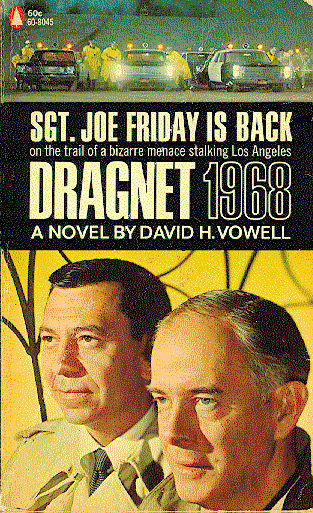
DRAGNET 1968 was not the first tie-in novel based on Jack Webb's pioneering radio and television creation, but it was the first based on the show's 1960s continuation. Actor/director Webb began DRAGNET as a 1949 radio program, bringing it to NBC-TV for an eight-season run in 1951. Enormously popular and influential on many films and television series that followed, DRAGNET returned to NBC in 1967, barely changed at all outside of its shift to color and the addition of Harry Morgan (DECEMBER BRIDE) as Joe Friday's new partner.

One of the new series' busiest writers was David H. Vowell, whose background was in news and documentaries; his environmentally conscious SAY GOODBYE received an Academy Award nomination for Best Documentary Feature in 1971. Even though it was strangely unusual for television writers to also pen the tie-in novels of their shows, Popular Library picked Vowell for DRAGNET 1968. He wrote the notorious episode "The Big High"--the one about the young couple whose baby drowns in the bathtub while they're smoking marijuana--and it's no surprise that Pot In Suburbia is also the theme of his book.

Allegedly based on actual events, like the TV show, DRAGNET 1968 is about Friday and Gannon's (the detectives played by Webb and Morgan on TV) investigation of the suicide of a fifteen-year-old girl they had found in an alley on a Sunday morning. What we know that the cops don't is that she had been a guest at Frank Coffee's pot party the night before, where an acid trip spurred her to scratch bloody streaks into her face and arms with her fingernails. Wanting to be rid of her, Frank's guest Stuart Allen (a typically-for-DRAGNET unsympathetic gay character) dumps her in the alley for the cops to find.

Only 132 pages plus an appendix, DRAGNET 1968 is unusual in that it doesn't stick to the detectives' point of view, which was the show's style. Vowell puts us in the head of not only Allen and Coffee, but also Frank's teenage son Bob, whose exposure to his parents' casual drug use sets him up for trouble of his own.

Frankly, this material is less interesting and not what anyone buying a DRAGNET novel wants to read. The series thrived on the matter-of-fact portrayal of police methods, and when Vowell sticks Friday and Gannon's plodding, the book works well. Maybe Vowell didn't think he could stretch the investigation to book-length, though I wish he had tried.

The other problem is that the plot may be interesting enough for a half-hour TV episode, but it's more than a little lackadaisical for a novel. The cover blurb of "a bizarre menace stalking Los Angeles" is not really representative of the book's focus on a middle-aged businessman who drops acid in his living room.

Monday, August 15, 2011

Hung By The Thumbs

I think I'm about done with Pinnacle's Dakota series. 1975's CHAIN REACTION, the fifth in Gilbert Ralston's series, is so dull that I could hardly finish it. Really, I spent the last chapter and a half speed-reading, even though this is where the allegedly thrilling climax occurred.

Ralston spent the 1960s and the first part of the 1970s as one of television's busiest writers, penning episodes of major dramas and adventures like HAWAII FIVE-0, I SPY, GUNSMOKE, STAR TREK, and THE ALFRED HITCHCOCK HOUR. He also penned the screenplays for WILLARD and its sequel BEN, which were based on his novel about A Boy and His Rat.

By the time he created Dakota, a Native American private eye, Ralston appears to have left Hollywood behind to churn out cheap paperback novels. Unfortunately, CHAIN REACTION reads like a rejected MANNIX script. It lacks excitement and mystery, the cast of characters is ridiculously and confusingly large, and many scenes exist of filler dialogue telling us stuff we either already know or don't care about. Sort of if a writer was trying to stretch a 50-minute screenplay to a 180-page manuscript.

CHAIN REACTION starts promisingly about the murder of an Indian woman who is found in an abandoned house, tortured and hung by her thumbs until death. Her teenage daughter enlists the help of local private dick Dakota, who drags his best pal and the victim's two brothers to Oakland to investigate. Precious little action and lots of driving around occur.

I liked the first Dakota adventure okay, but two others that followed left me wanting.

Thursday, August 11, 2011

Episode Guide: Walking Tall

This is an updated version of a post on my old Tripod blog dated 4/17/06.

The cinematic saga of Buford Pusser began in the winter of 1973, when the now-defunct Cinerama Releasing Corporation released WALKING TALL, a crude, simplistic, violent R-rated drama about an ex-Marine and pro wrestler who returned to the Tennessee county of his childhood and single-handedly wiped out organized crime. Joe Don Baker played Pusser, who was elected sheriff of McNairy County after a severe beating by hoodlums left him scarred and near death.

WALKING TALL struck a major chord with rural audiences, who turned it into one of the year’s most talked-about and financially successful films. Pusser planned to portray himself in the 1975 sequel, but he was killed in a mysterious auto accident, and 6’6” Bo Svenson was enlisted to play the lawman who “walks tall and carries a big stick” in two movies and a short-lived NBC television series.

WALKING TALL, the series, premiered the same month that Ronald Reagan was inaugurated as the 40th U.S. President, which may have been too soon. The Reagan administration’s black-and-white views on law and order were an influence on dozens of violent, high-octane Hollywood action movies, many of them starring macho men like Arnold Schwarzenegger, Sylvester Stallone, and Chuck Norris. But when NBC debuted WALKING TALL on January 17, 1981, audiences were still in the sensitive grip of the Carter era and perhaps weren’t quite prepared for a single-minded law enforcer who eschewed the civil rights of the accused if they stood in the way of what he considered to be justice.

Svenson, a familiar face to TV audiences from schlocky TV-movies like GOLD OF THE AMAZON WOMEN and SNOWBEAST, probably felt right at home with Sheriff Buford Pusser’s badge and “pacifier” (his term for the hefty four-foot club he carried in the back seat of his police car) in hand again. The show’s premise was just like that of the WALKING TALL movies in which Svenson had starred. He again was a widower who lived in McNeal (changed from McNairy) County, Tennessee with his father Carl (Walter Barnes, taking over for Noah Beery and Forrest Tucker), son Michael and daughter Dwana. McNeal was a small rural community where everybody knew everybody else, which didn’t make it as difficult as you would think for some of its citizens to get into trouble with the law and run afoul of Buford’s temper.

NBC scheduled WALKING TALL for 8:00pm Central on Saturday nights. Its CBS rival, the shortlived FREEBIE AND THE BEAN (also an action-oriented spinoff of a successful film), was no competition, but both series were slammed in the ratings by THE LOVE BOAT, which formed a Saturday-night juggernaut with FANTASY ISLAND for several years on ABC. After five episodes, the show was pulled, only to reappear six weeks later at 9:00pm on Tuesdays, where another smash ABC series, HART TO HART, buried it, this time for good. Only seven episodes of WALKING TALL were made, and all of them are available on DVD from Columbia/Tri-Star. Because I believe that no TV series should be forgotten, what follows is a somewhat comprehensive WALKING TALL episode guide. Print it out and keep it next to your remote.

WALKING TALL
Bo Svenson as Sheriff Buford Pusser
Walter Barnes as Carl Pusser
Harold Sylvester as Deputy Aaron Fairfax
Courtney Pledger as Deputy Joan Litton
Jeff Lester as Deputy Grady Spooner
Heather McAdam as Dwana Pusser
Rad Daly as Michael Pusser

Music: Edd Kalehoff
Cinematographer: William Gereghty
Editors: Bob Fish, Richard Freeman, Rod Stephens
Production Designer: Stan Jolley
Associate Producer: Stephen Cragg
Producer: Mel Swope
Executive Producer: David Gerber

“The Killing of McNeal County’s Children”
January 17, 1981
Writer: Stephen Downing
Director: Alf Kjellin
Guest Cast: Robert Englund, Charles McDaniel, Eric Stoltz, Whit Bissell.

Pusser investigates when two teenagers become brain-damaged after a few puffs of some powerful new PCP cigarettes. He threatens pusher Bobby Joe Wilson (Englund, later Freddy Krueger in A NIGHTMARE ON ELM STREET) and is nearly killed when Wilson’s home lab explodes, but still fails to stop the ring led by oily businessman Oliver Moss (McDaniel). Even Buford’s environmentally dubious strategy of assaulting Moss’ trucks and dumping their chemical contents onto the highway makes little dent in the drug’s onslaught of the local high school. It gets personal after two classmates (one is played by future star Stoltz) drug Michael Pusser’s drink with angel dust, which leaves him perched on the school roof thinking he can fly.

“The Protectors of the People”
January 24, 1981
Writer: Donald R. Boyle
Director: Daniel Haller
Guest Cast: Charles Napier, Jesse Vint, William Windom, William Sanderson, Otis Young, Dey Young.

This episode may have the show’s best guest stars, and Boyle (the show’s executive story editor) gives them an incendiary topic to bite into. McNeal runs afoul of the Ku Klux Klan, mainly in the personage of vile Napier (the great character actor with the toothy grin), sadistic Sanderson (NEWHART) and store owner Vint (FORBIDDEN WORLD). In their repulsive desperation to make the county all-white, they attack a white teenage girl while disguised in blackface and then blow up a store owned by black businessman Otis Young (THE LAST DETAIL). It all gets terribly out of control when Pusser’s black deputy Aaron (Harold Sylvester) is framed for raping a white woman.

“Kidnapped”
January 31, 1981
Writer: Paul Savage
Director: John Florea
Guest Cast: Chuck Connors, Edward Albert

Theo Brewster (Connors in a “special cameo appearance”) is shot by a guard during his commission of a bank robbery and taken into custody to Pusser’s jail, where he lies on life support. His sons--also his fellow bank robbers--plot to break him out by taking a local family and Buford’s father hostage.

“Hitman”
March 31, 1981
Writer: Robert E. Swanson
Director: Alf Kjellin
Guest Cast: Merlin Olsen, L.Q. Jones

Not a terribly original concept, but strong direction, particularly during the final act, and good performances make the episode worthwhile. NBC sportscaster and former Los Angeles Ram Olsen, just a few months before starring in his own NBC drama, FATHER MURPHY, is Webb McClain, an old friend of Buford’s who returns to McNeal County to renew their relationship. Unbeknownst to Pusser, however, McClain is an assassin who has been hired by mobster Jones to murder Buford. Svenson and Olsen play the tension perfectly, giving the incredulous idea necessary weight.

“Company Town”
April 7, 1981
Writer: Lee Sheldon
Director: Harvey S. Laidman
Guest Cast: Ralph Bellamy, Lane Bradbury, Art Hindle, Claude Earl Jones

Leaving his regular supporting players behind, Pusser travels to a mining town to investigate the disappearance of a miner who had been riling his employers with talk about low wages and unsafe working conditions. Learning of other missing mining workers with similar rabble-rousing backgrounds, Buford follows the trail of bodies all the way up to the mine’s owner, James Clausen (Bellamy), and his hot-headed son Stuart (Hindle).

“Deadly Impact”
April 14, 1981
Writer: Gregory S. Dinallo
Director: Alexander Singer
Guest Cast: Gail Strickland, Ken Swofford, Richard Herd, James Whitmore Jr.

Credit director Singer and guest star Strickland for pulling off a late-in-the-game story twist that provides this episode with an effective dramatic punch. It smells like SILKWOOD when chemical plant employee Strickland suspects her boss of authorizing illegal dumps of toxic wastes into the nearby river. After she’s nearly run off the road, Pusser protects her from further attempts on her life by putting her up with Carl and the kids at his house, where his relationship with her turns from professional to personal.

“The Fire Within”
June 6, 1981
Writer: Lee Sheldon
Director: Phil Bondelli
Guest Cast: James MacArthur, Ed Nelson, Lance LeGault, Anthony Edwards, John McLiam, Richard Venture

MacArthur, a veteran of eleven seasons on HAWAII FIVE-0, exchanges his badge for a collar in this “special guest star” role as Father Adair, a new priest who takes the confession of a dying criminal. His vows prevent him from telling Pusser any information about what the man was involved with, namely a gunrunning operation masterminded by McNeal County real-estate agent Ed Campbell (Nelson). Look for future ER star Edwards as a horny teenager.

After WALKING TALL’s quick cancellation, star Svenson continued to rack up an army of television and film credits. Many of them were in exploitation movies such as NIGHT WARNING (in which he played a homophobic cop) and the Italian THUNDER WARRIOR (he also reunited with Charles Napier in the Fred Olen Ray ALIEN-ripoff DEEP SPACE), but his best TV performance of the era was a memorable turn in MAGNUM, P.I.’s third-season premiere as Ivan, a KGB agent who had tortured Thomas Magnum (Tom Selleck) in Vietnam and murdered Magnum’s friend Mac in Hawaii. The final confrontation between Magnum and Ivan was quite a corker and is probably the series’ finest moment.

Brian Dennehy played Buford Pusser in A REAL AMERICAN HERO, a CBS movie that aired in 1978, The Rock starred in a 2004 WALKING TALL remake that had nearly nothing to do with the original films or the Buford Pusser legend, and Kevin Sorbo (HERCULES) played Pusser in two direct-to-video sequels to the Rock movie.

The seven one-hour television episodes on DVD are nothing like TV crime drama at its finest, but its realistic location shooting (all in Southern California, it appears), fine actors, sharp action scenes, and committed, passionate lead performance by Bo Svenson, who could usually be counted on for one deeply felt monologue per show, make it an appealing curiosity for cop-show fans.

Monday, August 08, 2011

The Apple

Note: this post is one of a series of STAR TREK episode reviews originally written for the alt.tv.startrek.tos newsgroup. For more information, please read this post.

THE APPLE
Episode 40 of 80
October 13, 1967
Teleplay: Max Ehrlich and Gene L. Coon
Story: Max Ehrlich
Director: Joseph Pevney

The U.S.S. Enterprise visits Gamma Trianguli VI, a planet populated by naïve pacifist natives who worship Vaal, a stone dragon carved into a hill. As with many false gods encountered by Captain Kirk (William Shatner) during his space journeys, Vaal turns out to really be a sophisticated computer constructed by a previous civilization. And, as per usual, Kirk outsmarts it, blows it up, and forces the locals to learn to stand on their own two feet.

“The Apple” (no points for figuring out the plot’s Garden of Eden allusion) is not one of STAR TREK’s finest moments. The makeup on the namby-pamby aliens is silly, the “stone god” is clearly made of papier-mâché, Ehrlich and Coon’s climax isn’t very climactic, and, as all TREK fans know, Kirk breaking the Prime Directive is never a good thing.

On the other hand, the episode is packed with action and death (four “red shirts” die horribly!), stuff blows up real good, and director Pevney cast some gorgeous women. Well, it’s better than nothin’. Spock (Leonard Nimoy) breaks a very phony-looking Styrofoam rock in two, but Jay Jones playing a red-shirted security guard does one hell of a stunt tripping on an exploding rock. Reportedly, the stunt was a little too dangerous, and Jones was hurt (but not seriously) in the explosion.

Obviously, the main point of interest is guest star David Soul in one of his first television acting jobs, one year before signing on as a regular on HERE COME THE BRIDES. After that western went off the air, Soul co-starred with Arthur Hill on OWEN MARSHALL, ATTORNEY AT LAW before achieving superstardom as one half of STARSKY AND HUTCH. Soul’s role as Makora is fairly minor, and it’s hard to gauge from watching what kind of acting ability or screen charisma he may have had in 1967.

The main guest star, as Akuta, leader of the Vaalians, is Keith Andes, who had been a regular on several series, including THAT MAN DAWSON and GLYNIS, and had appeared in films too. Basically, Andes was a sturdy but still leading man type, basically on par with the Richard Carlsons. My favorite Andes credit, however, is his performance as the voice of Hanna-Barbera superhero Birdman (“Birrrrrrrrrrrrrrrrdmaaaaannn!”), who, with his eagle sidekick Avenger, battled evildoers on Saturday mornings during the late 1960s. Later, those shows were repurposed and satirized on Cartoon Network as HARVEY BIRDMAN, ATTORNEY AT LAW with Gary Cole (A SIMPLE PLAN) revoicing the character.

California native Celeste Yarnall, playing Ensign Chekov’s love interest, is gorgeous—certainly one of the most beautiful actresses to appear on STAR TREK. Today an artist and an ardent believer in holistic health care for pets, Celeste was a busy actress in films and television who is likely best known today for starring as THE VELVET VAMPIRE (for which she performed nude scenes) and with John Ashley in the Philippines in BEAST OF BLOOD. I’m still waiting to see EVE, in which she plays a white jungle goddess in a tiny fur bikini. Celeste is generously available to her fans on Facebook.

Sunday, August 07, 2011

The Men from Mobius

I've written a lot here about Trashy Movies. Now I've taken my act on the road, so to speak. Pop on over to By John Charles, where I took part in a four-way discussion with John and fellow Mobius Home Video Forum veterans William Wilson and Mark Tinta about trash cinema, present and past. Among the topics: Brian DePalma, those Cannon cousins Menahem Golan and Yoram Globus, Jim Wynorski vs. Andy Sidaris, the overuse of CGI, and, of course, the beloved Roger Corman.

Yeah, it's long, but substantive. And John has pictures!

Friday, August 05, 2011

Take On The Whole Goddamn Government

James Caan’s only film as a director is an earnest adaptation of Leslie Waller’s non-fiction book about a blue-collar worker who spends eight years looking for his children. HIDE IN PLAIN SIGHT is a promising directorial debut, and it’s a shame Caan stopped at one (his actor son Scott of HAWAII FIVE-0 has directed two features).

Caan, who made this between COMES A HORSEMAN and CHAPTER TWO, plays Tom Hacklin, a Buffalo, New York factory worker who loses contact with his children when his ex-wife (Barbara Rae) and her mobster husband (Robert Viharo) are relocated by the Federal Witness Protection Program. The U.S. Government gives Hacklin the runaround when he attempts to uncover his kids’ whereabouts, so, supported by his new wife (Jill Eikenberry) and his well-meaning lawyer (Danny Aiello), he determines to find them himself.

This is the sort of material, as written by Spencer Eastman (KANSAS), that usually plays like a made-for-TV movie, but a passionate performance by Caan and a fascinating subject elevate HIDE IN PLAIN SIGHT to the level of good solid drama. As a director, Caan favors long master and medium shots that allow for greater realism in the storytelling. His and cinematographer Paul Lohmann’s (SILENT MOVIE) naturalistic approach and widescreen camerawork are like peering through a window into Tom Hacklin’s life. An opening three-and-a-half-minute crane shot adds nothing to the plot, but nicely sets up the film’s atmosphere and introduces us to Hacklin’s hard-working background.

Where HIDE IN PLAIN SIGHT lapses is in its telescoping of actual events from eight years to less than two. I understand why Caan and Eastman felt they had to make the true story more cinematic (including the addition of climactic violence that never happened to the real guy), but the downside is that the movie’s episodic nature drains some of the suspense and obscures a few important plot points. I don’t think it’s a serious problem, and Caan’s directorial debut does more things right than wrong. Leonard Rosenmann composed a sparse score, though not sparse enough for the director, who thought music would interfere with the movie’s verite approach and opposed MGM’s edict to include it.

Tuesday, August 02, 2011

Blood Justice

I'm frequently amazed at how sloppy the editors of Belmont Tower's Marksman paperbacks were. In some of them, author Frank Scarpetta (most likely either Peter McCurtin or Aaron Fletcher) actually calls leading man Phillip Magellan by the wrong name. In book #5, HEADHUNTER, published in 1973, the story appears to pick up right at the conclusion of #4. Since Scarpetta makes little attempt to catch the reader up with the events of that story, you can be forgiven for spending the first few chapters of HEADHUNTER wondering what the hell is going on.

Magellan, having wiped out a bunch of Mafioso in St. Thomas, arrives in Puerto Rico with several suitcases full of drugs and weapons. I think he's planning to stay just temporarily on his way back to the United States, but he's mugged by some crooks on the lookout for naive tourists, then his romantic relationship with Terri White, who seems to have been introduced in the previous book, hits a snag when she is raped.

By this point, the Marksman figures, "What the hell, I'm here anyway, I might as well kill all the Mafia here too." The rest of HEADHUNTER's 159 pages is Magellan kidnapping, torturing, and killing bad guys in Scarpetta's blunt-nosed style that involves the heavy use of exclamation points outside of dialogue. I think I read HEADHUNTER in about two hours, which is meant to be a compliment, I think.