Tuesday, October 30, 2012

They Saved Hitler's Brain

THE DEATH OF THE FUHRER is one of the greatest adventure novels ever written. It's probably the only book in which the hero fucks Adolf Hitler and later performs brain surgery on himself.

According to the original hardcover edition, which was published by St. Martins in 1972, author Roland Puccetti was born in Oak Park, Illinois--one-time home of Frank Lloyd Wright, Edgar Rice Burroughs, and Ernest Hemingway--and "read philosophy at Illinois University." There is no such place as Illinois University. Perhaps the leaf meant the University of Illinois, from whose library I checked out this amazing work of fiction. Honestly, I wouldn't be surprised if everything about Puccetti, who also "went to live in Tahiti as a kind of intellectual vagabond" and translated the poems of Garcia Lorca while taking a doctorate in philosophy at the Sorbonne, is bullshit.

Whomever Puccetti is, he has one whale of an imagination. Our hero is Karl Gisevius, a physician who by chance hears the dying words of a Russian doctor who was part of the team that invaded Hitler's bunker at the end of World War II. The man claims Hitler's brain was missing. Gisevius miraculously believes the guy and convinces his editor (he's the science editor of a Paris newspaper) to send him to Berlin to check it out.

Gisevius miraculously (I could use that word a lot when describing events in THE DEATH OF THE FUHRER) enters the bunker by slithering down an old air vent and stumbles upon clues that not only back up the dead man's story, but indicate the surgery may have been performed by none other than Willi Tranger, an old school rival of Gisevius'--fencing rivals who gave each other facial scars during a particularly nasty match.

Tranger, a sadistic SS doctor during the war, is holed up with a bunch of former Nazis in an old Spanish castle. Gisevius miraculously (never mind) infiltrates the group by jumping his motorcycle over the stone wall and claiming his throttle was busted! Tranger believes him and introduces him to the group, including a gorgeous blonde Baroness who's the only woman living in the castle.

Let me just get straight to it. The Baroness eventually seduces Gisevius, and while they're wildly making love in her room, right at the point of orgasm, she screams, "Ich bin Der Fuhrer!" Realizing in a split second that Tranger has transplanted Hitler's brain into the Baroness, he pulls out of her and plunges a knife into her chest, killing her.

That's page 123 of a 223-page book. The plot gets even stranger, if you can believe it. Tranger eventually captures Gisevius and implants a metal box in his brain that the evil doctor can control remotely. He can make him happy or sad in an instant, hungry, even horny enough to screw a couch!

Gisevius escapes the trap and makes his way to the doctor's office, WHERE HE CUTS OPEN HIS SKULL, TAKES THE BOX OUT, DECAPITATES A GUARD WITH A SURGICAL SAW WHILE THE TOP OF HIS BRAIN IS EXPOSED ("If I so much as leaned forward, the cerebrospinal fluid encasing my brain would spill out; I could imagine the sticky liquid dripping over into my face and blinding me), AND SEWS HIS HEAD BACK TOGETHER AGAIN.

Needless to say, Hitler's brain is still friggin' alive, there's a castle deathtrap, a climactic fencing duel, characters carrying around the brain like a football, a massive Bondian exploding compound, and a but-did-it-really-happen ending. Holy shit.

There are no words to explain the wonderfulness of THE DEATH OF THE FUHRER.

Sunday, October 28, 2012

Marvel Comics: The Untold Story

I really enjoyed Sean Howe's dense and candid history of Marvel Comics, which was just released earlier this month by HarperCollins. Billing itself on the inside cover as "an unvarnished, unauthorized behind-the-scenes account" of The House That Stan and Jack Built, MARVEL COMICS: THE UNTOLD STORY benefits from Howe's tenacious research and his zeal for truth, even if it sometimes shows Marvel and its employees in a negative light.

Now, those of you with a heavy interest in comic book history--those who eagerly anticipate each issue of Roy Thomas' breezy blast-from-the-past publication ALTER EGO and lament TwoMorrows' late, great magazine COMIC BOOK ARTIST (for my money, the best and best-researched magazine about comic books there ever was)--may find THE UNTOLD STORY occasionally redundant. Yet Howe spins the tale in such detail and such a fair-minded voice that I didn't mind hearing the stories again.

Marvel, of course, was not always Marvel. It was originally Timely Comics when pulp magazine publisher Martin Goodman started the company in 1939. In 1941, he hired his wife's teenage cousin, Stanley Martin Lieber, to edit the comic books. Lieber, who anticipated a career writing important novels, credited his comic book work under the name "Stan Lee."

Howe covers the early Timely/Atlas years well enough, but the book really picks up steam when Marvel did: 1961, the year FANTASTIC FOUR #1 was published. The company--and the comic book industry--would never be the same.

While Lee, the vivacious public face of the company, created an ebullient public image for himself and Marvel, coining corny phrases like "Face front!" and "Excelsior!" and leaving readers with the idea that Marvel's army of writers, artists, and production staff hung out together all day in the amusement park of a Bullpen, the company was also home to fragile egos, including those of Spider-Man co-creator Steve Ditko and particularly The King, superstar artist Jack Kirby, who teamed with writer/editor Lee to create nearly every important superhero Marvel had in its stable, but never received what he thought to be proper credit for his work.

After Lee was kicked upstairs to an upper-management position in the early 1970s (and later sent to California, where he tried for decades to interest Hollywood in adapting Marvel properties for the large and small screens), twentysomething Roy Thomas was named Editor, ushering in a New Wave of long-haired, dope-smoking, free-wheeling artists and writers that stretched the boundaries of what kinds of stories could be told in four-color stories. As Marvel's readers aged up towards college level, the company's creators aged down from middle-aged men like Lee and artist John Romita to far-out youngsters like Steve Englehart (who wrote a Captain America story in which a barely disguised Richard Nixon committed suicide in the White House) and Steve Gerber, whose unique Howard the Duck led the way to creators suing Marvel for ownership of their creations.

Howe's story bogs down in later chapters, as the narrative shifts from the comic books' creators and editors to the boardrooms, following Marvel's many subsequent sales to New World Pictures, Revlon CEO Ron Perelman, and Disney, to name a few corporate entities. I found these stories--important though they are to Marvel's history--to be less gripping than the more human aspects, such as the job-related stress that (may have) brought early deaths to some personnel, such as nice-guy editor Mark Gruenwald.

Howe seems to have interviewed just about everyone who was anyone at Marvel Comics with notable absences being the hermetic Ditko (who hasn't been photographed since the 1960s!) and the mercurial Shooter, who passed up the opportunity to counter the many, many stories about his inflexibility, his ego, and his penchant for pissing off everyone who worked under him. Howe's attention to detail and Marvel's own fascinating rags-to-riches growth from a fledgling division of a company that devoted most of its resources to publishing "men's sweat" magazines to a multi-billion-dollar enterprise mark MARVEL COMICS: THE UNTOLD STORY as a must-read for comic enthusiasts.

Thursday, October 25, 2012

The City On The Edge Of Forever

Note: I apologize for the lack of posts lately. Life has gotten in the way over the last month, as well as Blogger's pesky new interface, which is much, much worse than the old way of writing, saving, and publishing blog posts. I hope to get back on the blogging horse on a regular basis soon.

Note 2: this post is one of a series of STAR TREK episode reviews originally written for the alt.tv.startrek.tos newsgroup. For more information, please read this post.

THE CITY ON THE EDGE OF FOREVER
Episode 28 of 80
April 6, 1967
Writer: Harlan Ellison
Director: Joseph Pevney

The winner of a Hugo Award for Best Dramatic Presentation, this stunning hour is not only most likely the best episode of the original STAR TREK series, it may well be the best STAR TREK episode ever.

Dr. McCoy (DeForest Kelley) goes temporarily mad and uses a mysterious time portal called the Guardian of Forever to transport himself to the slums of New York City during the Great Depression. As a result of some action he undertook in the past, McCoy changed history, and the only way to fix the universe is for Captain Kirk (William Shatner) and Mr. Spock (Leonard Nimoy) to use the Guardian of Forever to return a few days before McCoy and stop him.

To survive in the 1930s, Kirk and Spock (who wears a watchcap to conceal his pointed ears) take jobs at a mission run by social worker Edith Keeler (Joan Collins). Kirk falls madly in love with Edith, which turns out to be one of science fiction’s most memorably doomed romances.

Ellison’s original script was radically rewritten by story editor Gene Coon, series creator Gene Roddenberry, and script polishers D.C. Fontana and Steven Carabatsos, as it was deemed too expensive to film and presented the Enterprise crew acting out of character. I like what they did with Ellison’s teleplay, and certainly the ending that was televised works much better than Ellison’s would have (you can read Harlan’s in his 1995 book THE CITY ON THE EDGE OF FOREVER: THE ORIGINAL TELEPLAY THAT BECAME THE CLASSIC STAR TREK EPISODE).

His idea was for Kirk to contemplate letting Edith live by disregarding the facts that millions would die, the world would be dominated by fascism, and he, Spock, and McCoy would never get home. Kirk would have tried to rescue Edith from the speeding truck, only to have the logical Mr. Spock prevent it. While that would definitely have been dramatic, I think Roddenberry et al. was right in thinking that it would have tarnished our picture of the heroic Captain Kirk. While Kirk was by no means drawn in simple black-and-white, it would seem way out of character for him to act this way. The needs of the many outweigh the needs of the few...or the one.

Also, while Spock's comforting of Kirk on board the Enterprise sounds like it would have been a great scene, it's hard to beat the power of the televised coda: Kirk staring off in grief and saying simply, "Let's get the hell out of here." That says as much as anything Spock could have said in Ellison's original.

Was this really the first time the word "hell" was used in this context in a dramatic network TV series?

This episode doesn't seem to have had an effect on Joan Collins. When she mentioned this guest shot in her autobiography, she got many basic facts of the episode wrong, including the name of her character!

Did Kirk and Keeler sleep together? I think it's implied they did. After walking to her home, there are a couple of dissolves, then Kirk comes in to his room where Spock is working on his machinery. Jim seems in an awfully darn good mood, doesn't he?

Director Joseph Pevney and the crew seem to have known they had a terrific story here. The sets, cinematography, even the special effects planet shots seem to have been assembled with special care. It was worth it. And the finale is one of the most wrenching in TV history. Shatner's performance in portraying Kirk's grief proves he has often been unfairly maligned as an actor.

Wednesday, September 26, 2012

Spidey's Greatest Challenge

THE AMAZING SPIDER-MAN premiered on CBS in 1978 with a two-part episode that was later released in syndication and on videocassette as a TV-movie titled THE DEADLY DUST.

Bland Nicholas Hammond plays Peter Parker, a college student and newspaper photographer who gained superpowers as the result of a radioactive spider bite and decided to fight crime while clad in red-and-blue tights and a full facemask. University protestors steal five kilos of plutonium and build an atomic bomb. Arms dealer White (Robert Alda) then steals their bomb and takes it to Los Angeles, where he plans to explode it and blow up the President unless the U.S. gives him $50 billion in gold. Meanwhile, Parker dodges a super-hot reporter (Joanna Cameron) who’s getting all up in Spider-Man’s business.

The curvy Cameron was already famous among prepubescent boys for playing the Mighty Isis on Saturday mornings, and I’m sure many of them tuned in to see her flirting in prime time with their friendly neighborhood Spider-Man. The excuses used to get Cameron into revealing outfits are hilarious (CBS promos used a lot of bikini shots), and her character even questions why she’s wearing them.

I’ll give credit to producers Robert Janes (who also wrote the episodes) and Ron Satlof for staging a couple of cool stunts, including Spidey dangling from a helicopter and the opening sequence of him rescuing a jumper. But let’s blame them for the sloppy filmmaking too. Subtle changes in the Spider-Man costume from pilot to first episode means the frequent use of stock footage doesn’t match, and the Los Angeles locations look nothing like New York City.

THE DEADLY DUST played theaters in foreign markets as SPIDER-MAN STRIKES BACK. Janes’ (THE FALL GUY) script is okay, setting aside the fact that it bears no resemblance to the Marvel Comics Spider-Man. Satlof (MCCLOUD) handles the action just fine. Simon replaces David White as Daily Bugle boss J. Jonah Jameson, joining series regulars Chip Fields as his secretary and Michael Pataki as police captain Barbera.

Friday, September 14, 2012

Great TV Episodes: Tempest In A Texas Town

This post introduces a new feature to this blog: reviews of outstanding episodes of classic television series.


JUDD FOR THE DEFENSE
Tempest in a Texas Town
September 8, 1967
ABC
Story: Paul Monash
Teleplay: Harold Gast and Leon Tokatyan
Director: Harvey Hart

JUDD FOR THE DEFENSE ran only two seasons on ABC from 1967 to 1969. Why wasn’t it more popular?

Its timeslot wasn’t bad—Fridays at 9:00pm Central facing THE CBS FRIDAY NIGHT MOVIES both seasons and NBC’s THE BELL TELEPHONE HOUR/NBC News Specials the first season and the weakly rated STAR TREK in its third and last season during JUDD’s second season. It received a decent amount of acclaim, earning an Emmy nomination for Outstanding Dramatic Series and star Carl Betz an Emmy Award for Outstanding Lead Actor in a Dramatic Series in its second year. And it opened each week with an exciting animated main title anchored by Alexander Courage’s theme, one of only two he wrote for a TV drama (STAR TREK being the other).


Judging just from JUDD’s first episode, it wasn’t the quality of the drama that kept viewers away. “Tempest in a Texas Town” takes flamboyant defense attorney Clinton Judd (Betz) back to his hometown to defend a young man on charges of murdering two teenage girls. The script by producer Harold Gast and Leon Tokatyan (LOU GRANT) from a story by JUDD creator Paul Monash (PEYTON PLACE) won the 1968 Edgar Award for Best Episode on a TV Series. Chock-a-block with strong characterizations and a twisty plot, “Tempest” was a fine choice.

Judd, a slick-talking combination of Texas-bred Percy Foreman and F. Lee Bailey, is not roundly welcomed back in little Amos, Texas, where his sheriff father was murdered on the town square by a man who was acquitted of an earlier killing. The man’s attorney was Clinton Judd.

Judd’s client is Brandon Hill, played by the enigmatic and charismatic Christopher Jones, who had recently essayed the title role in ABC’s single-season THE LIFE AND TIMES OF JESSE JAMES. Jones, whose brief Hollywood career included a starring turn in WILD IN THE STREETS and a brief marriage to actress Susan Strasberg, vanished from the public eye after co-starring in David Lean’s RYAN’S DAUGHTER. Hill has a beef against Amos because of his late father, an inventor who was laughed at by the town for being a crackpot. He’s insolent and brash, and Jones plays him on the edge so that it’s not clear whether or not he’s also a killer.

Hill’s crime is the murder of two teenagers, which allegedly occurred by beating them with a shovel and then burying the bodies with it. However, the girls were never found, which doesn’t deter District Attorney Ed Tanner (Pat Hingle, burdened by a foot cast and cane that may be from a real injury) from putting the young Hill on trial for their deaths. And it seems as though Tanner may have a strong case after an eyewitness, an elderly ranch hand named Aldo Reese (Russell Thorson), testifies that he saw the entire crime take place.

Judd, whose sense of fair play dictates he must give his client, guilty or innocent (“I’m a lawyer, not a judge.”), his best, tears apart Reese during cross-examination—an action that scars Judd, because Reese was the only man in town who came to his father’s aid after he was shot down. Even better for Judd’s case is the mid-trial appearance of one of the alleged victims, Terry Ann Brendler, played by Fox contract player Patti Petersen, who later changed her name to Heather Young and became a regular on ABC’s LAND OF THE GIANTS.

Gast and Tokatyan have more twists up their sleeves, but I won’t give them away except to say “Tempest in a Texas Town” ends on an uncharacteristically bleak note for 1967 episodic television. Harvey Hart (BUS RILEY’S BACK IN TOWN) directs with strength, pushing in tight on Betz during the star’s juicy monologues. Betz, fresh off eight years as Donna Reed’s husband on her eponymous sitcom, obviously relished the chance to sink into dramatic material.

“Tempest” was the first JUDD FOR THE DEFENSE filmed and aired. Stephen Young (PATTON) joined the series as Judd’s young legman, Ben Caldwell, and the two men tackled cases involving racism, draft dodging, parental rights, heart transplants, snake pits, witchcraft, mental retardation, and other hot-button issues of the late 1960s. None of these helped the ratings, and it’s possible asking viewers to immerse themselves in controversial subjects contributed to the series’ low ratings.

Nonetheless, JUDD FOR THE DEFENSE was a triumph for Carl Betz and executive producer Paul Monash. And “Tempest in a Texas Town” is an hour of television both could be proud of.

Monday, September 10, 2012

With Great Power

Columbia Pictures released SPIDER-MAN as a theatrical feature overseas in 1978 and later in the U.S. on VHS. Aside from silent bits on the PBS kiddie show THE ELECTRIC COMPANY, this CBS pilot marks the first live-action appearance of Steve Ditko and Stan Lee’s Marvel Comics creation on film. Don’t look for Spider-Man to battle any colorful supervillains, however, as the plot and those of the series that followed are interchangeable with other cop shows of its day.

Nicholas Hammond, who was one of the Von Trapp kids in THE SOUND OF MUSIC, is uninteresting as Peter Parker, a college student who is bitten by a radioactive spider in his science lab and receives superpowers, such as the ability to walk up walls. Director E.W. Swackhamer (LAW & ORDER) shows this using the laughable visual effect of Hammond crawling on a blue screen with a photo of a house superimposed on it. Later shots using a stuntman on wires are a lot better.

Jeff Donnell (IN A LONELY PLACE) is Parker’s aunt May. David White (BEWITCHED) is Daily Bugle editor J. Jonah Jameson, to whom freelance photojournalist Parker reports, and Hilly Hicks (ROLL OUT) is Jameson’s assistant, Joe Robertson. They’re the only characters from the comics to make the transition to the small screen, and only Jameson continued with the series (though played by a different actor).

New York City is plagued by Edward Byron (Thayer David), a megalomaniacal New Ager who hypnotizes ordinary citizens and forces them to commit bank robberies. He threatens to force ten people to commit suicide unless the mayor pays him $50 million. Parker designs a red-and-blue costume and mechanical web shooters to investigate. Alvin Boretz (N.Y.P.D.) had been writing for television for three decades when he got this assignment, but it’s clear he didn’t have a grip on the Spider-Man character or his universe. Considering co-creator Lee was the script consultant, this is unforgivable.

There’s nothing at all “larger than life” about this film, except maybe Michael Pataki’s humorously hammy turn as Captain Barbera, a sarcastic cigar-chomping cop on the case. Even the fight scenes, which should have been the highlight—how do you screw up Spider-Man battling a trio of samurai?—are dull. Twelve months passed before CBS aired the first AMAZING SPIDER-MAN episode in 1978, a year in which it also had WONDER WOMAN and THE INCREDIBLE HULK on its prime-time schedule.

Monday, August 27, 2012

Paperback Fanatic

I recently finished the latest issue of THE PAPERBACK FANATIC, which publisher Justin Marriott graciously sent for review. I was particularly intrigued by issue #23 because of the extended article by Joe Kenney, proprietor of the essential men's adventure novel blog Glorious Trash, about two paperback series I've covered here many times: the Marksman and the Sharpshooter.

It's pretty clear from reading these often-sloppy books that some of the Sharpshooters were intended to be part of the Marksman series, usually because poor proofreading would result in the wrong character name being printed. Joe does his best to get to the bottom of the surprisingly complicated and interesting history of the two men's action series, as well as some of the real names behind the authors' pseudonyms.

Also covered is author Len Levinson, who wrote about five dozen quickies, usually under other names (I really must read the tantalizing SHARK FIGHTER), and contributes an autobiographical article. Other pieces spotlight the late Ray Bradbury, the LADY OF L.U.S.T. series, literary werewolves, and Edgar Wallace. The digest-sized magazine is 86 pages (including covers) and features a lot of full-color photos of deliciously gnarly paperback covers.

Thursday, August 23, 2012

Minute By Minute...Mile By Mile

30-year-old David Janssen, already a familiar face to audiences from 77 episodes of RICHARD DIAMOND, PRIVATE DETECTIVE, stars as a rural police officer in MGM's RING OF FIRE (1961), a thrilling B-picture shot on location in Oregon and Washington.

Verisimilitude was the order of the day for director Andrew L. Stone (CRY TERROR), who filmed in tiny Vernonia, Oregon (population 2000) and used the townspeople as extras. The miniature and optical effects are good (Stone incorporates footage of a real forest fire), and it sure looks as though the stars are very close to real flames. Even the (real) barn where the police interrogate a suspect is perfect.

Sgt. Steve Walsh (Janssen) and his colleague Joe Pringle (Joel Marston) pick up a trio of juvenile delinquents in the downtown café on a charge of robbing a filling station the night before. On the way to the police station, Frank (Frank Gorshin, later the Riddler on BATMAN), Roy (James Johnson), and Bobbie (Joyce Taylor) overpower the cops using a pistol stashed in Bobbie’s shapely waistband and force them to drive out to the Olympic Mountains. Leaving Pringle cuffed to a tree, the teens ditch their four-wheeled transportation and head into the forest on foot, taking Walsh as a guide and hostage.

Shooting completely on location was probably hell on Stone’s production schedule, but the effort was worth it. William H. Clothier’s (THE ALAMO) color photography is wonderful, and Stone’s insistence on realism hikes up the suspense. RING OF FIRE’s biggest action sequence finds Janssen and Taylor trying to save the town from a roaring fire by herding the citizens onto an abandoned train and across a blazing bridge, and it’s a real corker of a climax.

Janssen hits the right notes as a lawman used to dealing with drunks and speeders, rather than armed psychos. In one sequence, sexy jailbait Bobbie (though actress Taylor was in reality just a year younger than Janssen) tries to vamp Walsh into letting her go free. Instead of playing Walsh as a man tempted, Janssen goes for confused—during training, nobody taught me how to react to a young girl who ignores my gun and tries to kiss me! It’s an interesting choice that says a lot about Steve Walsh and how far over his head he may be on his own with three fugitives.

MGM also had ATLANTIS, THE LOST CONTINENT, which co-starred Taylor, and one wonders whether it ever played a twinbill with RING OF FIRE. To sell the thrilling climax, Stone destroyed a real train and trestle, and the remains of the locomotive and two passenger cars still lay at the bottom of that gorge more than fifty years later. RING OF FIRE eschews a musical score to enhance the realism, though Duane Eddy (“Rebel Rouser”) composed and performed the title song, which was released as a 45 on MGM Records with “Bobbie” on the flip side.

Thursday, August 16, 2012

Forced Vengeance

The busy pre-WALKER Chuck Norris played his seventh lead role in five years in MGM’s FORCED VENGEANCE, which was shot in Hong Kong by the director of two Clint Eastwood movies. It was his second film of 1982, just behind SILENT RAGE.

He’s Josh Randall (any relation to Steve McQueen’s bounty hunter on WANTED DEAD OR ALIVE?), a Vietnam vet and butt-kicking troubleshooter for the Lucky Dragon casino. He isn’t just an employee, but also an unofficial member of the owners: elderly Sam Paschal (David Opatoshu) and Sam’s half-Jewish/half-Chinese son David (Frank Michael Liu). If your boss was gunned down at home by a local mobster named Stan Rahmandi (Michael Cavanaugh, previously in director James Fargo’s THE ENFORCER), it might not bother you, but when Rahmandi mows down the Paschals for not selling him their casino, Randall gets steamed.

He’s also being framed for the killings by a corrupt cop (Jimmy Shaw), so Randall grabs gorgeous girlfriend Claire (ANIMAL HOUSE’s Mary Louise Weller) and surviving Paschal daughter Joy (Camila Griggs) and hides them at the dumpy apartment of his old ‘Nam buddy Leroy (stunt legend Bob Minor). Screenwriter Franklin Thompson wisely notes in Norris’ narration the futility of hiding two beautiful women in Hong Kong without somebody noticing. They aren’t even safe at the local cathouse!

Once Joy and Claire are safely ensconced at Leroy’s (so he thinks), Randall bounces around Hong Kong with a big price on his head ($100,000), dodging bullets, nunchakus, knives, and flying feet from every two-bit street hood and hitman in the city. Eventually, he makes his way to Rahmandi’s yacht to settle a score and learn the identity of the Mr. Big bankrolling Rahmandi’s power play.

FORCED VENGEANCE zips right by at a nice clip, despite Norris’ obvious liabilities as a performer. Rexford Metz’s camera captures the crowded Hong Kong very well, and William Goldstein’s imaginative score provides local color without lapsing into “Asian” music. For a Norris film, especially considering the family-friendly rep he established in the 1990s, the subject matter is surprisingly rough, presenting a pair of rapes, some grisly deaths, and a horrible broken back resulting in paralysis.

To compensate, Thompson sprinkles amusing one-liners into the script, which Norris doesn’t exactly recite with comic timing that will remind you of Rodney Dangerfield, but they do lighten the load. Unintentional laughs may come from the spotty narration, which lets us “read” Chuck’s thoughts (“Asshole.” “Damn. My best hat.”). Norris had done this previously in THE OCTAGON (“My brother…brother…brother…”), so maybe he thought this was his “thing.”

Norris was just about to hit his peak as a major movie star. He moved to Orion to make his two best films—LONE WOLF MCQUADE and CODE OF SILENCE—but he then signed an exclusive deal with Cannon to star in what may be his mostly fondly remembered pictures, including the MISSING IN ACTION trilogy and THE DELTA FORCE. I have a soft spot for the early Norris works though: three for American Cinema found him battling sinister CIA operatives (GOOD GUYS WEAR BLACK), a super-karate serial killer (A FORCE OF ONE, which also boasts Clu Gulager), and a ninja army running a terrorist training camp (THE OCTAGON). Chuck fought druglord Christopher Lee’s army in AN EYE FOR AN EYE’s Bondian climax and an indestructible Frankenstein monster/zombie in SILENT RAGE, an interesting hybrid of martial arts and mad-scientist horror that hit theaters just three months before FORCED VENGEANCE.

Monday, August 13, 2012

Nobody Leans On Sharky's Machine

Burt Reynolds stars in 1981's SHARKY'S MACHINE as Sharky, a tough narcotics cop in Atlanta who gets hosed by the department after a drug bust goes bad. He is transferred to the black hole of Vice, which is headquartered in the precinct basement and plays host to the city’s worst pimps, hookers, dopers, and lowlifes.

Sharky’s new boss, Lieutenant Friscoe (Charles Durning), and his new partners were once among the best cops in the city, but years of being humiliated, frustrated, and burned out have turned them into jelly. So when they get a chance to do some real police work on a case with an opportunity for them to make a difference, Sharky and his “machine” leap at it.

Slimy pimp Victor Scorelli (Vittorio Gassman) and gubernatorial candidate Thomas Hotchkins (Earl Holliman) are in cahoots, but there’s no evidence against them. Sharky puts an illegal round-the-clock surveillance on one of Scorelli’s girls, a classy thousand-buck-a-night hooker named Dominoe (Rachel Ward). Sharky’s initial discomfort in watching her night and day turns into love, and the case becomes a personal one after Scorelli’s crazed cokehead brother Carlo (Henry Silva) blasts her face off with a shotgun.

Reynolds’ most mature work as a director, SHARKY’S MACHINE stays pretty faithful to William Diehl’s source novel (BORN INNOCENT’s Gerald DiPego wrote the screenplay), though much of Diehl’s rich plot was lost in whittling it down to a two-hour running time. Some of the pieces, such as the exact nature of Scorelli and Hotchkins’ relationship, don’t fit together. It seems as though Reynolds was more interested in the characters and action setpieces anyway. He may have fallen too much in love with his cast, allowing the story to get away from him in favor of extemporaneous character-building moments among colleagues. It’s a violent movie, but Reynolds nicely leavens the brutality with humor.


While it’s a good thing that these scenes work, they do tend to drag down the pace during Act Two. Brian Keith (FAMILY AFFAIR), Bernie Casey (REVENGE OF THE NERDS), and Richard Libertini (THE IN-LAWS) deliver fantastic banter with Reynolds and Durning that plays more Wambaugh than Diehl. Casey and Reynolds in particular share two wonderful scenes, one in which Casey describes how he used Zen to face down death and a later one that pays it off. John Fiedler (THE BOB NEWHART SHOW) and James O’Connell (DEATH HUNT) play the rest of Sharky’s machine. Action highlights include a shootout on a city bus, two expertly choreographed fights between Sharky and ninjas (!) in tight quarters, and a suspenseful stalking on the top floors of the Peachtree Plaza Hotel.

With Burt wearing his shorter “serious” toupee, one can infer SHARKY’S MACHINE meant a lot to him. To Warner Brothers (which produced it) and Orion (which released it) too. As a big Christmas release, it did okay business, but not as big as expected. This may have affected Reynolds a few years later when he adapted Elmore Leonard’s STICK, but veered away from it in favor of lowbrow humor and action beats that more closely adhered to his movie star persona.

Sunday, August 05, 2012

The Snow Queen

In his Black Samurai series and his Narc series (which he penned under the name Robert Hawkes), author Marc Olden demonstrated a terrific talent for creating intimidating over-the-top villains. It has been said that an adventure or an action piece is only as strong as its bad guy, which is perhaps why the Black Samurai and Narc series are among the top echelon of men's adventure novels.

In THE DELGADO KILLINGS, the fourth of Olden/Hawkes' Narc books (published by Signet in October 1974), the villain even gets his name in the title. He's Raul Delgado, "a fifty-two-year-old Cuban cocaine dealer grossing fifty million dollars a year" who is also facing a high-profile trial that could put him away for a long time. His strategy to beat the rap is to ensure no one is alive to testify against him. Possessing a list of the government's witnesses against him, Delgado hires Victor Poland, an ex-cop turned hitman to murder them. Oh, and also to kill John Bolt, the D-3 agent (Department of Dangerous Drugs!) who arrested him.

It's a testament to Olden's skills that Delgado is not the most interesting character in THE DELGADO KILLINGS. Poland is smarter and more ruthless, and as an ex-cop, he has access to inside information to use against his targets that not even his millionaire boss can get. Olden seems to have more fun writing the bad guys than he does his hero Bolt. Bolt is a fairly standard action hero--single, handsome, dedicated to crimefighting with no hobbies, family members, friends, or outside interests to get in his way. Bolt is tough and intelligent and is certainly written as the man to root for, but we learn more about Delgado and Poland in this book than we do about Bolt in all four Narc novels to date.

Olden wraps up THE DELGADO KILLINGS with an exciting chase and shootout within the New York City subway tunnels. I think it's safe to say that Olden liked Victor Poland so much that he left open the question of the assassin's death at the end. Does that mean Poland will return in subsequent Narc novels? THE DELGADO KILLINGS leaves us with that impression. I look forward to finding out.

Wednesday, August 01, 2012

You're Shit Outta Luck

Clint Eastwood is Dirty Harry for the fifth and last time in a routine crime drama with a touch of the bizarre. After helming SUDDEN IMPACT himself, Eastwood left the direction of THE DEAD POOL in the hands of stuntman Buddy Van Horn, who also directed him in ANY WHICH WAY YOU CAN (although it’s likely Clint was always the man in charge on the set).

The screenplay by Steve Sharon by a story by Sharon, Sandy Shaw, and Durk Pearson is a bit ahead of its time with its take on media and celebrity. It also offers one of the series’ wittiest setpieces: a parody of BULLITT’s car chase involving Dirty Harry being pursued by a radio control racecar containing a bomb. The Dirty Harrys have always contained wry humor—usually Eastwood wisecracks—but THE DEAD POOL’s jokes are broader, such as a mean takeoff on Clint-hating film critic Pauline Kael and Harry’s use of a gigantic harpoon to nail a suspect.

The murder of rock star Johnny Squares (future superstar Jim Carrey) kicks off a strange series of killings in San Francisco. It appears to be centered around the set of a cheap horror movie being directed by pretentious Brit Peter Swan (played by Liam Neeson, another future superstar) and a sick game called “Dead Pool,” in which participants predict the deaths of celebrities in hazardous occupations. San Francisco police inspector Harry Callahan (Eastwood) discovers his own name is on Swan’s list. When others on the filmmaker’s Dead Pool are also murdered, Harry, whose enemies are legion in San Francisco, has to look over his shoulder more often than he already did.

The least of the five Dirty Harry films, THE DEAD POOL suffers from a weak villain and its simplistic view of horror movies, illustrated by out-of-context clips from THE PACK, IT’S ALIVE III, and TIME AFTER TIME, three good movies (the latter isn’t even horror, but all were owned by Warner Brothers, THE DEAD POOL’s studio).

A box office flop in the summer of 1988, the film holds up as a solid police actioner with excellent photography by Jack Green (UNFORGIVEN). Green and Van Horn stage the murders like high-end slashers, including a tasteful throat-slashing that looks almost beautiful. Lalo Schifrin scores his fourth Dirty Harry (Jerry Fielding did THE ENFORCER), but it’s his weakest of the series.

Monday, July 30, 2012

Blood Out Of A Sock

TWILIGHT’s screenplay by director Robert Benton (KRAMER VS. KRAMER) and Richard Russo (THE ICE HARVEST) may play as nothing special to mystery fans, but it’s a real joy to see a veteran cast at this level tear into it.

Benton and star Paul Newman had previously teamed to make NOBODY’S FOOL, for which Newman received a Best Actor Oscar nomination, and he plays a similarly aimless character here. I suppose there’s a little bit of Lew Harper, whom Newman portrayed in 1966’s HARPER (an adaptation of a Ross Macdonald Lew Archer novel), in it too.

Harry Ross (Newman) is a private eye and ex-cop who lives in a Hollywood mansion with Catherine (Susan Sarandon) and Jack Ames (Gene Hackman), two movie stars of the 1970s. Harry did a job for the Ameses two years earlier, bringing back their teenage daughter Melanie (20-year-old Reese Witherspoon, who appears topless) from Mexico and getting shot in the groin in the process. His relationship with the Ameses is interestingly rendered. He is friendly with his landlords, who let him live rent-free (perhaps out of guilt because of his injury), yet it’s clear the rundown Harry is considered an employee.

Jack, suffering from cancer that leaves him with less than two years to live, asks Harry to run an errand for him: to deliver an envelope to a woman. As with all good pulp fiction, Harry arrives at the address to find the house empty except for an elderly ex-cop shot dead and an army of cops eager to arrest him. It all leads to adultery, dark secrets, blackmail, and new twists in the twenty-year-old disappearance of Catherine’s first husband.

James Garner (THE ROCKFORD FILES) adds to the star wattage as an old friend of both Jack Ames and Ross. Surprisingly, Newman had never co-starred in a film with Hackman, Garner, or Sarandon, which makes TWILIGHT a special treat, despite its derivative story. Cast also includes Stockard Channing, John Spencer (THE WEST WING), Margo Martindale (an Emmy winner for JUSTIFIED), Liev Schrieber, Giancarlo Esposito, and M. Emmet Walsh.

Friday, July 27, 2012

Delta Force 2: Operation Stranglehold

Cannon was on its last legs when it produced this desperate sequel to one of its biggest hits. It was titled DELTA FORCE 2: OPERATION STRANGLEHOLD in its brief theatrical run in 1990, but has since been retitled DELTA FORCE 2: THE COLOMBIAN CONNECTION on television and home video. MGM released it in over 900 theaters, but audiences had tired of Chuck Norris as quickly as they had embraced him just a few years before. The DELTA FORCE sequel opened in 11th place the same weekend DARKMAN debuted at number one.

Norris returns as Colonel Scott McCoy, who helps DEA agent Page (Richard Jaeckel) bring down a ruthless South American druglord named Ramon Cota (Billy Drago), who has a gas chamber in his house. DELTA FORCE 2 is an eminently watchable action picture, despite its box office failure, armed with fights, big explosions, and hilariously disparate acting styles (RUNAWAY TRAIN’s John P. Ryan is acting big enough for three movies, which is fair because Norris is acting for one-third of one). It’s also shockingly mean-spirited—Cota kills a baby (off camera) so he can smuggle cocaine inside its corpse.

Aaron Norris, directing his third Cannon picture, and second unit director Dean Ferrandini assemble some exciting action sequences, including a helicopter/limousine chase, a skydiving freefall, and a climactic assault upon Cota’s mountain fortress, which is guarded by dozens of goons wielding machine guns and a few missile-launching choppers. What scenery Drago doesn’t chew is eagerly pounced upon by Ryan, who is hilarious as McCoy’s superior officer. Chuck says even fewer words than usual, but his feet and fists do plenty of talking.

Tuesday, July 24, 2012

Spy Trap

Popular Library's second MISSION: IMPOSSIBLE tie-in novel is distinctively inferior to the first. Likely, it's due to Walter Wager, under his pseudonym of John Tiger, not writing it. The credited author is Max Walker, who may or may not be a real person.

CODE NAME: JUDAS' biggest problem is that it isn't much like the television series. It contains a car chase, shootouts, fistfights--all action stables that were not generally part of the TV show's repertoire. It was an extremely action-packed series, but not an especially violent one. There was violence, of course, even an occasional chase or punchout, but not as depicted by Walker.

JUDAS does open with Jim Phelps (played by cover model Peter Graves in the series) listening to a taped message and choosing his Impossible Missions Force team from dossiers. The plot takes the IMF to Geneva to find an assassin named Atlas before a group of enemy agents does. Atlas' main characterization is that he has no nose, which leads to a scene, of course, of someone pulling his face nose off.

The book also spends too much time with Phelps, forgetting that the best M:I episodes showed the team working together. Outside of Phelps and Cinnamon Carter's guise as a nightclub singer, Rollin Hand, Barney Collier, and Willy Armitage have painfully little to do.

If you're a spy fan looking for a quick read (126 pages), this 1968 novel may do the trick, but I wouldn't recommend it to MISSION: IMPOSSIBLE fans.

Saturday, July 21, 2012

Slappers Of Women And Torturers Of Old Men

The Internet Movie Database claims a 1968 release date for this Crown International film, but I’m not so sure. THEY SAVED HITLER'S BRAIN is really the 1963 turkey MADMEN OF MANDORAS with almost a half-hour of newly shot footage tacked to the beginning, probably to stretch the picture to a two-hour television timeslot.

The protracted prologue could have been filmed in 1968, judging from the hair and fashions, but it seems more likely it happened in the early 1970s. Don Hulette (BREAKER! BREAKER!), the director of the new footage (but credited only with providing “additional music”), makes little attempt to match the MANDORAS film directed by David Bradley (TWELVE TO THE MOON), except for the laughable inclusion of an Eisenhower portrait in a government office.

The opening finds government agents Vic and Toni (after the requisite “I didn’t know you were a woman” kneeslapper common to ‘50s/’60s genre cinema) investigating the murder of Dr. Bernard, the developer of G-Gas, a super nerve gas that can fell an elephant in seconds. Hulette stages the killing by having Bernard leave a top-secret government lab and get into his car, which is hilariously parked at a nearby filling station (!), just so Hulette can cut in stock footage of a different exploding car from who knows what other movie.

The actors portraying these characters are either uncredited or buried in the titles, so I won’t even guess who plays them. Doesn’t matter much anyway, because Toni and Vic, who are terrible at their jobs, are knocked off quickly, and THE MADMEN OF MANDORAS gets underway. It’s easy to differentiate between the two directors’ work (a couple of Bradley’s scenes are cut into the prologue), because MANDORAS was shot by A-list cinematographer Stanley Cortez (THE MAGNIFICENT AMBERSONS) and really looks nice.

Looks nice, but is still inept filmmaking, though the story is irresistible by fans of trashy pulp fiction. Another government agent, Phil Day (Walter Stocker), and his wife Kathy (Audrey Caire) travel to the South American country of Mandoras to find Kathy’s father, Professor Coleman (John Holland), who is the only man able to create a G-Gas antidote. They discover Nazis (“slappers of women and torturers of old men”) are planning to use the nerve gas to conquer the world and are still following the one and only Adolf Hitler (Bill Freed), whose head has been removed from his body and kept alive in a cake holder. Sometimes the Ratzis take him for a drive. He finally blows up in Bronson Canyon. This film would be amazing if it weren’t so dull.

Tuesday, July 17, 2012

The Delta Force

One of Cannon’s biggest hits teamed the studio’s biggest star—Chuck Norris—at the height of his big-screen popularity with Oscar-winning action icon Lee Marvin (THE DIRTY DOZEN) in the last film of his career.

Producer Yoram Globus and producer/director Menahem Golan cast this right-wing comic book like an Irwin Allen disaster movie with an all-star roster of fading movies stars in supporting roles. As Sandra Bernhard once asked David Letterman, “Where else can you see Hanna Schygulla co-starring with Chuck Norris?”

Filmed in Golan’s home country of Israel, his and James Bruner’s screenplay bears similarities to the hijack of TWA Flight 847 a year earlier and the raid at Entebbe Airport in 1976. Lebanese terrorists led by Abdul (Robert Forster, JACKIE BROWN) take over an Athens-to-Rome passenger jet and order the pilot (PART II WALKING TALL’s Bo Svenson) to fly it to Beirut. Colonel Nick Alexander (Marvin, looking like a Ramona Fradon drawing), leader of the U.S. Army’s great fighting force, recruits disgruntled retired Major Scott McCoy (Norris) to assist in the Delta Force’s rescue operation. The terrorists are well organized and have spread out the hostages in three different locations, including a dungeon in downtown Beirut.

Rarely has a film been both so terrible and so good in its individual parts. Golan’s revisionist fantasy is hilariously shameless in its jingoism. Americans are awesome, and everybody else sucks. A Russian passenger rambles to priest George Kennedy (you can’t rip off AIRPORT without hiring George Kennedy) for two minutes about how much he loves living in the United States. The anti-Arab prejudice is appalling, and its anti-Washington sentiments echo those of Cannon’s Vietnam wish-fulfillment action films like MISSING IN ACTION and P.O.W. THE ESCAPE.

Yet THE DELTA FORCE is undeniably well-made. Golan gives the action an aura of scope and international intrigue. After setting up the conflicts and characters in the first hour, the director goes nuts in the second with a series of crisply photographed and edited action sequences specially designed to fit into Norris’ wheelhouse, complete with scripted quips. The explosions are big, and the stunts are exciting. Who better than Marvin to bark orders and take out an important bad guy with a well-aimed head shot? There’s no denying THE DELTA FORCE’s status as a crackerjack action vehicle.

The swarthy terrorists are portrayed as one-dimensional monsters, yet Forster brings an intensity to his role as the dedicated mastermind that forces you to take his cartoon villain seriously. Although the casting seems ripe for HOLLYWOOD SQUARES jokes, none of the veterans is sleepwalking. Martin Balsam (DEATH WISH 3), Shelley Winters (THE POSEIDON ADVENTURE), Joey Bishop (OCEAN’S 11), Lainie Kazan (MY FAVORITE YEAR), Susan Strasberg (PSYCH-OUT), a young Kim Delaney (NYPD BLUE), and Schygulla (THE MARRIAGE OF MARIA BRAUN) join Kennedy and Svenson as on-board hostages and turn in effective work. Robert Vaughn (THE MAGNIFICENT SEVEN) does yeoman duty as a general sending the Delta Force into action. Alan Silvestri (BACK TO THE FUTURE) composed the cheesy synthesized score, which admittedly includes a catchy theme. Norris returned as McCoy in 1990 with DELTA FORCE 2: OPERATION STRANGLEHOLD.

Friday, July 13, 2012

Watery Grave

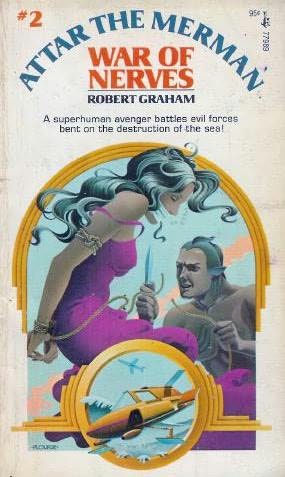
I really liked the initial Attar the Merman adventure, ATTAR'S REVENGE, and the second one, WAR OF NERVES, also published in 1975, may be even better. Unfortunately, Joe Haldeman, the acclaimed science fiction author who hated writing them under the name Robert Graham, gave up the series after these two quickies.

Attar was reared on an island off the coast of Australia where lies Aquatic Research Associates, Limited, a foundation operated by marine biologist Wallace Hamilton and funded by millionaire John Tucker. An expert in linguistics and mortal combat, Attar is able to breathe underwater, thanks to Hamilton's operation that gave him (and his late sister Essence) gills.

Attar's mission this time is to save the Atlantic Ocean from destruction at the hands of a madman named Rasputin, who has discovered a cache of nerve gas dumped in the Caribbean and plans to explode a bomb and disperse the gas unless the United States pays a ransom. On the case is Attar, as well as his brother Victor (Tucker adopted many children at birth and trained them similarly to Attar, though only Attar has gills) and his pet killer whale Grampus. And if that isn't awesome enough, know that Attar and Grampus share a telepathic bond so that they can "speak" to each other.

WAR OF NERVES is a great, pulpy read with an exciting plot and intriguing characters. It has plenty of action and violence, though nothing too graphic. The relationship between Attar and Grampus is weird, but seems normal within Haldeman's framework. The author adds tension to their relationship when Grampus rescues Attar at sea by grabbing the young man's leg with his mouth and discovers he likes the taste of human flesh.

Haldeman also tosses in a twist involving the plot's true villain and a pretty sweet finale involving Attar and his party's invasion of the baddie's Haitian stronghold. Both Attar the Merman adventures are fun, brisk, and exciting, and it's a shame Pocket Books never did others. Considering Haldeman wrote them under a pseudonym and prolific packager Lyle Kenyon Engel, one wonders why they didn't continue with a new author.

Friday, July 06, 2012

A Little Lighthouse Keeping

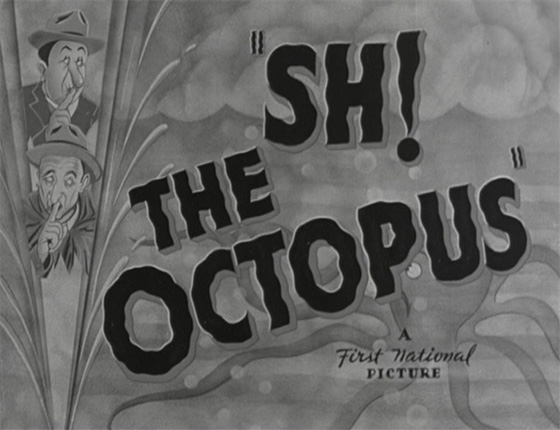
The less you know about SH! THE OCTOPUS going in, the better it works. That said, even after several viewings of this fast-paced comic mystery from Warner Brothers, I’m not tired of it.

As original and goddamned crazy as it seems, SH! THE OCTOPUS (one of cinema’s great titles) is actually a remake of the play and the film THE GORILLA, except with an octopus (natch). It definitely isn’t admired by everyone, but I love the film’s chaotic energy, striking camerawork, amusing performances by hams Hugh Herbert and Allen Jenkins, and—most of all—one of the craziest damned plots on record.

By the by, don’t bother following the plot too closely. Just allow its dreamlike qualities to soak over you, much like the thunderbumper splashing down on bumbling detectives Kelly (Herbert), whose wife is expecting a baby any minute, and Dempsey (Jenkins) the night they’re summoned to a mysterious lighthouse. What do they find there? How about a bloody corpse hanging from the top, a hook-handed old salt appropriately named Captain Hook (George Rosener), an enemy submarine, poison gas, and a multitude of secret passages and trapdoors?

And, oh yes, a giant octopus with impossibly long tentacles that emerge from the lighthouse’s hidden panels to snatch unsuspecting victims. Screenwriter George Bricker ensures that a good number of strangers just happen to drop by an abandoned lighthouse during a torrential storm to serve as cannon fodder for the murder and mayhem happening under Dempsey’s and Kelly’s clumsy noses. Almost nobody turns out to be who he or she initially claims, and although nothing in Bricker’s densely packed plot seems to make any sense, rest assured all will be explained in the twist ending.

SH! THE OCTOPUS is just straight-out fun, not to be taken the least big seriously. The cast approaches the material with exactly the right spirit, and director William McGann (who never directed another horror movie) demonstrates deft comic timing, particularly an explosion that buttons the third act. The movie is just 54 minutes long and is so frenetic that another second may well have unraveled the whole thing.

Friday, June 29, 2012

The Hypnotic Eye

William Read Woodfield, an amateur magician and expert plotter who went on to craft intricate scripts for MISSION: IMPOSSIBLE and COLUMBO, penned THE HYPNOTIC EYE with his wife Gitta Woodfield. In one of cult cinema’s great openings, a sexy blonde in slinky black lingerie walks into her kitchen, rubs shampoo in her hair, turns on the stove, and sets her own hair on fire (the visual effect involves superimposing flames over the actress’ head, and it isn’t bad).

This is the eleventh case of a woman mutilating herself, and police detective Dave Kennedy (Joe Patridge) wants to get to the bottom of it. He takes his girlfriend Marcia (Marcia Henderson) and her friend Dodie (Merry Anders) to see a stage hypnotist named Desmond (Jacques Bergerac). Dodie volunteers to be Desmond’s subject, and he makes her levitate. That night, she pours acid into a sinkful of water and burns the skin off her face.

Dave begins to suspect Desmond of planting post-hypnotic suggestions into his subjects that make them harm themselves later. Marcia takes the stage at Desmond’s next show and reveals to Dave and psychiatrist Philip Hecht (Guy Prescott) that Desmond flashes an eye in the palm of his hand to the women he puts into an onstage trance. But what is Desmond’s motive for hypnotizing women into self-mutilation?

Allison Hayes (ATTACK OF THE 50-FOOT WOMAN) portrays Justine, Desmond’s stage assistant who plays a major role in the sinister plot. She’s terrific, but she unfortunately outmatches the French-born Bergerac, who doesn’t hold the screen the way a great villain should. Quickie director George Blair, probably best known for the ADVENTURES OF SUPERMAN TV series, does a pretty good job moving the Woodfields’ story along and presenting the shocking deaths with bursts of gore that were unusual for the time period.

It isn’t just the gruesome makeup effects that contributed to the hoopla. Blair cast “The Great Imposter,” Fred Demara, who was a notable talk-show guest in those days, as well as hipsters Lawrence Lipton and Eric “Big Daddy” Nord in supporting roles. Best of all, Allied Artists released THE HYPNOTIC EYE in “HypnoMagic!” This comes into play in a scene in which Desmond hypnotizes a crowd of people in a theater, but Blair shoots it as though he’s hypnotizing the audience watching the film. You can imagine the kids in the seats having a blast following Desmond’s on-screen instructions.

THE HYPNOTIC EYE is a ludicrous horror film, but, boy, is it entertaining. Woodfield wrote it as THE SCREAMING SLEEP, and Blair directed it in two weeks on a $365,000 budget. The shock scenes are very effective, and the catwalk climax is excitingly rendered by Blair. I sure wish I had one of those HYPNOTIC EYE balloons.