Sunday, June 30, 2013

10,000 Kids On 5,000 Beach Blankets


The first of American International’s enormously popular Beach Party series, unlike the rest, gives the biggest parts to adults.

In 1963's BEACH PARTY, middle-aged director William Asher, an Emmy winner and Malibu resident, and writer Lou Rusoff take the point of view of Robert Sutwell (LOVE THAT BOB Cummings), a bearded anthropologist, and his stacked assistant Marianne (Dorothy Malone), who stake out the Malibu beaches and spy on local teenagers to study their sex habits. Future Beach Party pictures would, of course, concentrate on the teenagers—notably Frankie (Frankie Avalon) and Dolores/Dee Dee (Annette Funicello)—with adults in supporting roles as comic relief.

Frankie rents a beach house for the summer with ideas of sharing with Dolores, but she doesn’t trust her sex-mad boyfriend and invites all their friends to stay with them. Rusoff, who died tragically before BEACH PARTY was released, provides little more plot than this. Frankie and Dolores fight, try to make one another jealous, break up, and get back together. Eric Von Zipper (Harvey Lembeck) and his clowny biker gang show up to make trouble. Lembeck goes all out for slapstick laughs, but his act would grow old in future films.

Slightly more realistic than later Beach Party entries—the kids smoke (pot?) and drink beer—BEACH PARTY coasts on its bouncy pop and rock tunes by Avalon, Funicello, and especially the awesome Dick Dale & The Deltones and its energetic, likable cast. Unfortunately, Oscar winner Malone (WRITTEN ON THE WIND) has too little to do, but Asher finds plenty of room for Morey Amsterdam as a beatnik bar owner, John Ashley (MAD DOCTOR OF BLOOD ISLAND), Jody McCrea (as Deadhead), Andy Romano (UNDER SIEGE), and Hungarian hip-shaker Eva Six. Vincent Price (his upcoming THE HAUNTED PALACE is plugged) makes a cool cameo, and try to spot Yvette Vickers (ATTACK OF THE 50 FOOT WOMAN) and Meredith MacRae (PETTICOAT JUNCTION).

BEACH PARTY is the first, but not the best, Beach Party movie, but it still provides a frothy good time. Asher, who directed five more, and producers James Nicholson and Samuel Arkoff had a pretty good idea what made it work and did a good job duplicating the formula. Contrary to reports, Funicello does wear a two-piece swimsuit. Les Baxter composed the score. MUSCLE BEACH PARTY was next.

Tuesday, June 25, 2013

The Deadly Spawn Are Coming

From time to time, I plan to use this space to repurpose film reviews I wrote for several local independent newspapers during the previous decade:

THE OCTOPUS: 1999-2000
CU CITYVIEW: 2002
THE PAPER: 2003-2004
THE HUB: 2005-2006

During my tenure as a professional (re: paid) film critic, I wrote about both new releases and cult classics. The date provided below is the date the newspaper issue containing the review hit the streets.

This review has been slightly edited from the original published piece.


THE DEADLY SPAWN
Rated R
Running Time 1:21
1983, Color, 16mm
Stars Tom DeFranco, Charles Hildebrand, Jean Tafler, Karen Tighe, and Richard Lee Porter

THE DEADLY SPAWN is homemade filmmaking at its most fun. It isn’t a great movie and certainly isn’t a great-looking movie. But it is a delightful example of what can happen when a group of friends with specialized filmmaking talents decide to band together and make the kind of movie they’d like to see.

Writer/director Douglas McKeown, special effects director John Dods, and executive producer Tim Hildebrand, well-known in fantasy circles for painting the iconic STAR WARS one-sheet with his twin brother Greg, teamed up every weekend for more than two years to shoot this labor of love, an entertaining low-budget homage to the creature features of the 1950s. Filming went on for so long that the camera is unable to disguise the growth spurt of its star, Charles Hildebrand (Tim’s son), who was eleven years old when production began and a gangly thirteen when he shot his final scenes.

A typical suburban New Jersey family awakens one rainy morning to discover alien spawn hatched from a crashed meteorite growing in their basement, chomping on everyone they encounter. Eleven-year-old Charles (Charles Hildebrand, in whose home much of THE DEADLY SPAWN was shot) is a misunderstood fan of monster movies who figures out how to stop the rampaging horde. Who says those late-night TV viewings of CREATURE FROM THE BLACK LAGOON could serve no useful purpose?


Fortunately for us, Charles doesn’t get his brainstorm until after the aliens have eaten most of his household and some of his brother Pete's (Tom DeFranco) friends. The whole film takes place within the same day, and includes a memorable massacre of a houseful of middle-aged vegetarian women who accidentally chop one of the spawn up in a blender.

Dods’ cool monster attacks are the best reason to see THE DEADLY SPAWN. Ranging from shadowy cardboard puppets (literally) to a full-size creature with rubber cement dripping off its teeth, the spawn may never look completely realistic, but their low-tech impact packs more of a punch than a whole kettle of modern CGI effects. By creating all of the monsters entirely on the set and allowing the actors to interact directly with them, McKeown and Dods are able to inject extra tension into the scary scenes, unlike in today's horror films where actors normally are looking at a green screen.

It's also fun to watch THE DEADLY SPAWN just to figure out how the filmmakers managed some of the special effects. They effectively mix miniatures, rear projections, forced perspective, puppets, fire effects (accidentally, when the spawn caught on fire during the shot), and other techniques, making the feature something of a training film for budding low-budget filmmakers. It's frequently gory (the spawn biting the face off one of its victims is an astonishing triumph of makeup effects), but never gross or offensive, mainly due to the lighthearted tone and the backyard nature of the production.

Filmed in 16mm (which was blown up to 35mm for its brief theatrical run) on a budget ranging from $18,000-$28,000 (there are several reported figures), THE DEADLY SPAWN still manages to resemble a professional film, despite a couple of sloppy performances, an out-of-focus shot or two, and one shot where the cameraman sticks his fingers into the lens. Despite its amateur pedigree, THE DEADLY SPAWN did play theatrically in 1983 as RETURN OF THE ALIENS: THE DEADLY SPAWN, as distributor 21st Century tried to fool people into thinking it was a sequel to ALIEN.

Saturday, June 22, 2013

Bow To The Brilliance Of GetEven


One of the most astonishing ego trips of all time, GETEVEN (sic) is inept in every department, right down to its semantically confused title. I bet the food at the craft service table was crummy too.

Taking the blame is one-and-done amateur filmmaker John De Hart, a Los Angeles attorney who thought he was handsome, talented, and charismatic enough to carry an action movie. Boy, was he wrong. Not only does De Hart serve as producer, director, writer, and star of GETEVEN, he wrote himself three love scenes with naked former Playmate Pamela Jean Bryant (DON’T ANSWER THE PHONE) and jumped onto a phony-looking stage to sing an awful country-western song with all the passion and stage presence of Rockin’ Mel Slurrup.

It’s doubtful a finished script ever existed. Half the movie plays like poor improvisation and usually in excruciatingly long takes. It helps explain how De Hart convinced pros William Smith (CONAN THE BARBARIAN) and Wings Hauser (DEADLY FORCE) to sign on, since they didn’t have to spend time memorizing lines and working on characterization. Sets, costumes, sound, music, casting, and photography are the pits, but thankfully just bad enough to be hysterical under the right circumstances.

Normad (Smith) was a corrupt cop who framed partners Finney (Hauser) and Bodie (De Hart) as drug dealers and got them kicked off the force. A year later, Normad is a Superior Court judge (!) and the drug-dealing leader of a Satanic cult (!!) which once counted Bodie’s estranged girlfriend Cindy (Bryant) among its flock. Most of this backstory is not only shown (albeit on in a competent manner), but also redundantly recited by Bodie during some sunset soul-searching.

Eventually, after De Hart discovered he was making a vengeance flick with no action, no drama, and no structure, Normad gets around to sending his goons to kill Cindy, which sets Bodie off on a road to revenge (which is also an alternate title for GETEVEN). De Hart, so wooden he makes Jim Mitchum look like Ace Ventura, is a hilarious counterpart to the coked-out Hauser, who seems to be channeling Dennis Hopper’s APOCALYPSE NOW performance, rambling for minutes on end about nothing, inexplicably splashing fully clothed in a pool with two thonged beauties, and showing up at Bodie and Cindy’s wedding in an amazing orange suit.

It’s rare to see filmmaking this incompetent, and like a pearl within an oyster, it should be treasured. One of Normad’s thugs is played by an actor who was also in SAMURAI COP…and this is a step down.

Thursday, June 20, 2013

Kung Fu Girls On The Rampage

A story that could only have been told during the wild and wooly 1970s, WONDER WOMEN plays like a fake “book bonus” in a dogeared issues of FOR MEN ONLY. Combining riffs on James Bond and Fu Manchu with heavy dollops of sex, horror, and science fiction, director Robert O’Neil’s 1973 release is good-natured camp capped by a funky Carson Whitsett (BONNIE’S KIDS) score and a knowing performance by Nancy Kwan, a long way from Bill Holden and Suzie Wong.

Dr. Tsu (Kwan) is a brilliant surgeon with a private island fortress off the coast of the Philippines. Not satisfied with a mere medical career, she uses her all-girl army of kung fu fighters to kidnap the world’s greatest athletes, so she can transplant their body parts into wealthy old men. On the case: insurance investigator Mike Harber (played by producer Ross Hagen), who is hired by Lloyd’s of London to bring back a missing jai alai player.

Harber, for as much as he’s being paid (a continuity error makes it unclear), is pretty inept and plays no active part in the plot’s resolution. He takes a punch pretty well, though, and his cool personalized weapon, which is a sawed-off shotgun with a pistol grip, provides Harber’s characterization where the paucity of dialogue in Lou Whitehill’s screenplay can’t. Which is fine, because WONDER WOMEN movies. O’Neil (ANGEL) stretches his $110,000 budget far enough to create a pair of fine chase sequences and a number of fights and shootouts. Granted, the fight choreography, mainly involving weak-kicking women, is lame, but Hagen and stunt coordinator Erik Cord try to sell the action, and dressing the women in miniskirts and go-go boots forgive a lot.

Kwan (FLOWER DRUM SONG) really seems to be having a great time, as she slices into a brain while having a phone chat or extolling the merits of “brain sex,” a form of virtual reality that wears out poor Mike Harber. Her tongue slides seductively over Whitehill’s pulpy words, and her insouciant attitude towards the monstrous actions—literally, as she keeps her failed experiments, including an ape woman and a man with a light bulb jammed into his head, caged in the basement—plays nicely next to Hagen’s virile heroics.

Maria de Aragon (later to shoot second as Greedo in STAR WARS) and B-picture favorite Roberta Collins (THE BIG DOLL HOUSE) chew scenery as rivals in Dr. Tsu’s army. The PG rating keeps the kinkiness to a minimum, though O’Neil still manages to squeeze a few nipples into the frame. Sid Haig (COFFY) has a ball playing against type as an urbane accountant, and Marilyn Joi (KENTUCKY FRIED MOVIE’s Cleopatra Schwartz) plays an uncredited cameo in an absurd and confusing epilogue foolishly shot in post-production by distributor Arthur Marks. WONDER WOMEN later appeared theatrically and on television as THE DEADLY AND THE BEAUTIFUL.

Thank Fred Olen Ray and Retromedia for getting this obscure action picture (I had only seen it cropped and censored on Turner Network Television) onto a packed DVD. In addition to WONDER WOMEN at its theatrical ratio of 1.78:1, Ray moderates a technically clumsy but entertaining commentary track with director O'Neil, which unfortunately gets a bit "inside baseball" on occasion. Stuntman Cord drops by for a brief (and, again, technically clumsy) interview segment on the Special Features menu, which also offers trailers and TV spots, a radio ad, stills, deleted scenes that were added to WONDER WOMEN's international prints (they contain no nudity or exploitation, but serve to give the female characters much-needed character traits), Super 8 home movie footage taken on the set, and six minutes of Hagen starring as Mike Harber in a never-completed sequel.

If only Ray had taken as much care with the sloppy copy printed on the back cover.

Sunday, June 09, 2013

Super Women Who Kissed And Killed

It's very easy to believe this 1952 horror movie is something I dreamed up in a sweaty, delirious haze. But, no, I took my temperature and my pulse, and I'm feeling fine. So MESA OF LOST WOMEN must be a real movie.

Quite probably one of the worst films I've ever seen, MESA OF LOST WOMEN plays like a jittery delight, an ethereal neverland where normal laws of logic and physics don't apply. A land of midgets and giant spiders, mad scientists and genteel psychopaths, where the women are stacked and the audience is stumped.

According to Bill Warren's essential KEEP WATCHING THE SKIES, MESA OF LOST WOMEN was produced in 1952, but not released in Los Angeles in 1956, during the period when the infamous Edward D. Wood, Jr. was flooding theaters with his peculiar style of cinematic ineptitude. MESA even feels like something Wood might have concocted on the back of a cocktail napkin in a dive on Sunset. In fact, the maddening musical score composed for the picture by Hoyt Curtin later turned up on the soundtrack of Wood's JAIL BAIT.

Once you've heard Curtin's repetitive Mexican-guitar-and-pounding-piano opus, you aren't likely to forget it, as it drowns the picture in a cacophony of noise that sounds as though it were performed by a pair of monkeys locked in a junior high school band room. An interesting footnote is that Curtin ended up at Hanna-Barbera, composing themes and scores for some of the most famous animated series in television history, including THE FLINTSTONES, THE JETSONS, JONNY QUEST, and SCOOBY-DOO, WHERE ARE YOU?

MESA OF LOST WOMEN stars Jackie Coogan (that's right--Uncle Fester!) as Dr. Aranya ("That's Spanish for spider!"), a mad scientist living atop Mesa Zarpa, perched 600 feet above the Mexican desert. For some idiotic reason, Aranya is attempting to breed humans with spiders in order to create a master race to do his bidding. For an even more idiotic reason, the experiments transform the men into mute midgets, whereas the women become sexy Amazons with long fingernails. 

Aranya summons a fellow scientist, Masterson (Harmon Stevens), to his laboratory in order to share his secrets with the scientific community. The results drive Masterson mad, however, and he is sentenced to a mental hospital and lobotomized. Somehow, he escapes and shows up at a cantina, where Tarantella (Tandra Quinn) is performing a steamy spider dance. Masterson shoots her and kidnaps a millionaire, his golddigging fiancĂ©, his Chinese servant, and Masterson's male nurse. 

Masterson takes his captives to their airplane and forces pilot Grant Phillips (Robert Knapp) to fly them to Mesa Zarpa, where, uh, where not much happens, really. The nurse and the millionaire are killed (off-screen) by a giant spider, and the rest of the party ends up in Aranya's underground lab. Masterson recovers his sanity long enough to send Phillips and his new squeeze on their way safely, and then blow the lab all to hell, destroying Aranya's mad dream and himself in the process.

All of this happens in about 68 minutes and is actually more compressed than that. MESA opens with a prologue that has nothing to do with the rest of the movie, showing Tarantella planting a kiss of death on an unassuming male victim and then incomprehensible narration written by co-director Herbert Tevos (who doesn't appear to have made another picture) and delivered by Lyle Talbot (JAIL BAIT), another reminder of the Wonderful World of Ed Wood. Talbot rambles deliciously about "hexapods" and the perils of Muerto Desert--"the desert of Death."

Although a handful of minor B-movie actors signed on to Tevos and co-director Ron Ormond's lunacy, including Allan Nixon (PREHISTORIC WOMAN) and Richard Travis (Lou Gehrig in THE BABE RUTH STORY), the only performer you're likely to recognize is Coogan, who later played the eccentric Uncle Fester on THE ADDAMS FAMILY. A famous child actor, Coogan had not yet made many waves in his adult career, except for starring in an obscure syndicated series with the unlikely title of COWBOY G-MEN. He doesn't appear to be enjoying MESA very much, basically walking through the (probably) two days he spent on the set. Sporting thick eyeglasses, a goatee, and a mole, he almost looks as though he's trying to hide, thankful for the house payment he was able to make that month because of his MESA paycheck. Coogan went on to appear in a couple of Albert Zugsmith productions, including the magnificent HIGH SCHOOL CONFIDENTIAL as a drug kingpin, and even produced and directed an obscure espionage B-flick under his own Coogan Films banner before hitting it big opposite John Astin and Carolyn Jones on THE ADDAMS FAMILY.

Friday, June 07, 2013

.38 Magnum

His name is Stoner. Mark Stoner. He's a treasure hunter and a salvage expert based in Key West, but THE SATAN STONE, the second Stoner adventure penned by Ralph Hayes, is set in Africa.

Published by Manor in 1976, THE SATAN STONE starts out with a different character carrying the first two chapters. McMillan, a so-called partner at a South African diamond mine run by the fat, corrupt De Villiers, is cheated of his final payment. Hey, what can he do about it, seeing as De Villiers' vicious right-hand man Graaf has no qualms about torturing and killing anyone who even slightly threatens his boss.

So McMillan decides to steal the largest diamond he's ever seen. Easily a million-dollar gem. But there's no way to get it out past Graaf's security, so he stashes it beneath a bulldozer. McMillan avoids being killed by one of Graaf's men and makes it to Nairobi, where he runs across his old friend Mark Stoner. And eventually--with some fast talking--convinces Stoner to infiltrate De Villiers' camp and somehow emerge with the gigantic gem.

Air Force veteran Hayes does a nice job spinning this tough-guy yarn, which may remind one somewhat of the 1976 action film KILLER FORCE. The macho shenanigans and action sequences are rendered in an exciting manner, just like a pulpy short story out of a sweaty men's magazine. The climax finds Stoner stranded in the desert and pursued by some of De Villiers' men...who are slightly less dangerous than the pack of killer baboons who attack him!

I liked the one Hunter novel Hayes wrote, and this is a good one too. Hayes also wrote the Cominsec series and a few Nick Carter adventures.

Wednesday, May 29, 2013

A Baby Born In Hell


Horror star Christopher Lee tried to film an adaptation of Dennis Wheatley’s 1953 novel TO THE DEVIL A DAUGHTER for several years, and it turned out to be Hammer’s last horror picture of the 20th century. 

The film of TO THE DEVIL A DAUGHTER is surprisingly sleazy for a Hammer film with an on-camera murder of a newborn baby, a naked Lee (actually his longtime stunt double Eddie Powell) going doggie-style in an orgy, a bloody rubber puppet fetus crawling around, and the sexualization of young Nastassja Kinski (TESS), who performs a full-frontal nude scene at the age of fourteen.

In the film’s favor are its intriguing premise, strong production values (it was filmed mostly on location in Germany), good photography, and strong performances, particularly by Lee, who likely relished playing this character, and Denholm Elliott (RAIDERS OF THE LOST ARK) as a weak-willed lapsed cultist.

Against the film, however, are a confusing screenplay credited to Christopher Wicking (SCREAM AND SCREAM AGAIN) and John Peacock (but heavily rewritten during shooting by THE DUELLISTS’ Gerald Vaughan-Hughes), a miscast Richard Widmark (who seems reticent), and a terrible ending that gives every evidence of being improvised on the set by a director with his hands flung into the air.

Widmark is American John Verney, a horror writer living in London, who is caught up in a master plan by ex-communicated priest Father Michael (Lee) to baptize nun Catherine (Kinski, whose casting came at the behest of the German financiers) in the blood of a baby on her eighteenth birthday and bring to life a demon called Astaroth. Catherine’s father (Elliott) had signed her over to Michael’s Satanic cult when she was born, but has developed cold feet as she approaches Judgment Day and asks Verney the occult expert to save her.

TO THE DEVIL moves along well enough under the direction of Peter Sykes (DEMONS OF THE MIND), and with a better script might well have sent Hammer out with a bang; the studio’s next and last film (until being resurrected in the late 2000s) was the desultory Hitchcock remake THE LADY VANISHES.

Watch the trailer, and see what you think.

Monday, May 20, 2013

The Circus Is Coming To Town

One of Hammer’s best horror films of the 1970s stars none of the studio’s familiar performers (Peter Cushing, Christopher Lee, Ralph Bates, Victoria Carlson, Michael Ripper et al.). While packed with more than its fair share of nudity and gore, it’s also very exciting and creates a few interesting twists on traditional vampire lore.

Like Hammer’s DRACULA A.D. 1972 the same year, VAMPIRE CIRCUS gets off to a strong start with a bloody and pulse-pounding pre-credits sequence. When Professor Mueller (Laurence Payne) spots his younger wife Anna leading one of the village children into the castle of Count Mitterhouse (Robert Tayman), he organizes a lynch mob to storm the castle, rescue the child, and destroy Mitterhouse, who’s rumored to be not only a serial killer of children, but also a vampire. Mueller kills the Count, who curses the townspeople on his deathbed and swears to destroy the next generation of villagers.

Fifteen years later, it appears the Count’s prophecies have come true. The village is riddled with plague, and the King’s soldiers have cordoned it off. No one goes in or out, except a small traveling circus which somehow manages to break through the roadblock. Besides the gypsy woman (Adrienne Corri) who appears to be running the show, the performers include a midget clown, male-and-female twin acrobats, a strongman played by David Prowse (STAR WARS’ Darth Vader), a tiger woman, and Emil (Anthony Corlan), who appears to be able to turn into a black panther. More bloody murders occur, as it becomes clear to the audience—if not to the villagers—that not only are the circus performers bloodsuckers, but also Emil is the cousin of Count Mitterhouse and plans to revive his kin’s corpse.

While VAMPIRE CIRCUS contains enough crosses, wooden stakes, and vampire bats to please purists, the “next generation” of horror fans certainly will find much to like. These vamps can float through the air, transform into cat creatures, and, of course, mesmerize the beautiful young women of the village. Dripping with unusual touches (like a very sexy dance involving a naked woman painted in tiger makeup), period style, and enough heavy dollops of sensuality and raw violence to push the “R” rating of the day, VAMPIRE CIRCUS makes Hammer’s Dracula series appear almost quaint. Even the Hammer films (such as THE SATANIC RITES OF DRACULA) that were made later seem old-fashioned compared to this audacious entry. Director Robert Young bookends the film nicely with action setpieces that open and close the film, and his cast of veteran character actors, young leading men, and fetching ingĂ©nues perform flawlessly.

Sunday, May 19, 2013

Hard To Play God Doing Five To Life, Man


1972's THE CAREY TREATMENT was a job of work for Blake Edwards (THE PINK PANTHER), who neither wrote nor produced this medical thriller based on an early novel by Michael Crichton: the Edgar-winning A CASE OF NEED, which he wrote under the name Jeffery Hudson. No writer wanted to take credit for this film, because credited screenwriter James P. Bonner is actually the trio of Irving Ravetch and Harriet Frank Jr. (HUD) and John D.F. Black (SHAFT). Edwards hated the film too. I like it, as swinging physician James Coburn (OUR MAN FLINT) bounces from clue to clue, suspect to suspect, hanging in there during the plot turns and chases.

Newly arrived in Boston for a new job as a pathologist at a swanky hospital, Dr. Peter Carey (Coburn) turns amateur sleuth after his friend and colleague David Tao (James Hong) is accused of killing a fifteen-year-old girl during an illegal abortion. He uncovers most of his leads through bullying and wisecracks, but Coburn is such a charming performer that he can get away with anything (to a wealthy, flirty housewife who claims she’s much too young to be the mother of her teenage stepdaughter, Coburn grins that Cheshire grin and laconically answers, “If you say so”).

Look, no one’s saying THE CAREY TREATMENT isn’t ludicrous—it sure as hell is, and it’s a little sloppy in the post-production department too (Edwards reportedly split or was fired after shooting was completed). It gives Coburn the opportunity to be groovy and hip and cool, which hardly any movie star did better. It also provides a good scene or two for its talented supporting actors, such as Pat Hingle (great in his initial volley with Coburn), Jennifer O'Neill, Dan O’Herlihy, Alex Dreier (also interesting in his single scene), Regis Toomey, Robert Mandan, John Hillerman, Ed Peck, and Michael Blodgett. Another indication Edwards left the project early: score by Roy Budd, not Henry Mancini.

Monday, May 13, 2013

Light Years Beyond Tomorrow

Can’t get enough crazy Italian science fiction like STARCRASH? Don't miss 1979's THE HUMANOID, one of many Italian ripoffs of STAR WARS to haunt movie theaters in the 1970s. A good-natured astronaut named Golob (7’4” Richard Kiel, in between Bond films) is transformed into a hulking, growling, mindless, indestructible “humanoid” by renegade scientist Kraspin (Arthur Kennedy). In the employ of malevolent dictator Graal (Ivan Rassimov), a megalomaniac garbed in black armor with plans to rule the galaxy, Kraspin plans to create an entire army of humanoid killing machines to aid in Graal’s conquest.

Luckily, Kraspin veers from Graal’s order to murder Earth’s leader, “Great Brother,” and sends Gorob to destroy pretty Barbara Gibson (MOONRAKER's Corinne Clery), who was responsible for the mad scientist’s exile to an insane asylum. Barbara and her “pupil,” a young Chinese boy named Tom-Tom (Marco Yeh), force the evil and hatred from Gorob’s mind, transforming him back into a gentle giant, albeit one who retains his super-strength and invulnerability. Joining forces with hot-shot warrior Nick (Leonard Mann), Barbara, Gorob, Tom-Tom, and Gorob’s robot dog Robodog (!) invade Graal’s planetary base and blow everything up in the name of justice and goodness.

Oh, yeah. When Kraspin isn’t fiddling with his humanoid “serum” or raving about revenge against Barbara, he’s killing topless women in a transparent iron maiden and draining their blood to keep Graal’s future queen, the busty Lady Agatha (Barbara Bach, who appeared with Kiel in THE SPY WHO LOVED ME), eternally young.

THE HUMANOID is ridiculous, hilarious, and utterly unpredictable. Just when you think director Aldo Lado couldn't pull anything new out from under his hat, suddenly Graal starts firing blue blasts from his hands or heavenly angels with crossbows drop out of the sky at Tom-Tom’s command to pull the good guys out of a tough spot. It’s also fun laughing at the obvious STAR WARS riffs. Most of the characters are drawn directly from George Lucas’ movie (with Kiel playing the Chewbacca part), even though Antonio Margheriti’s visual effects pale next to their precursor. Heck, they pale next to the STAR WARS HOLIDAY SPECIAL.

Kiel probably never got top billing again, and does his best in another “monster” role. He isn’t a good enough actor to make Gorob very sympathetic, although he’s likable enough in his pre-humanoid scenes. Clery’s job is to be gorgeous, which she accomplishes quite well. As usual, the villains receive the bulk of the script’s color and meaty dialogue, and Kennedy and Rassimov leap into it like finely sliced ham. Ennio Morricone was tapped for the score, which lacks melody and sounds as though it were composed in a hurry—sort of like the special effects. Filmed in Rome as L’UMANOIDE, THE HUMANOID may not have received a U.S. theatrical release, as it didn’t receive an MPAA rating and doesn’t seem to have been reviewed by VARIETY.

Saturday, May 11, 2013

Star Trek, "The Conscience Of The King"

Note: this post is one of a series of STAR TREK episode reviews originally written for the alt.tv.startrek.tos newsgroup. For more information, please read this post.

THE CONSCIENCE OF THE KING
Episode 13 out of 80
December 8, 1966
Writer: Barry Trivers
Director: Gerd Oswald

The U.S.S. Enterprise transports a Shakespearean repertory company, and Captain Kirk (William Shatner) comes to suspect that its leader, Anton Karidian (Arnold Moss), may well be a notorious thought-dead dictator named Kodos the Executioner, whose past crimes include the slaughter of members of Kirk’s family.

The acting in this episode is among the best of the series. The confrontation between Moss and Shatner is absolutely riveting, and Barbara Anderson, who plays Moss’ psychotic daughter Lenore, is pretty terrific in a difficult role. Anderson moved on to regular roles on IRONSIDE and MISSION: IMPOSSIBLE. The byplay between DeForest Kelley and Leonard Nimoy is great, and really does a lot to show the friendly yet adversarial relationship between Spock and McCoy. “Conscience” is an old-fashioned tale of revenge and murder, and there isn't much action in it, but the strong performances and clever script by Barry Trivers holds it together.

Again, Shatner shows his strength as a performer by making Kirk fallible and human without sacrificing any of his heroic qualities. It was rare for a '60s TV hero to suffer bouts of vengeance and obsession, yet Kirk often did, while still holding the audience's sympathy. This is a great actor and a great character.

McCoy must have still been drunk while making his medical log entry. Surely he could have figured that Riley would be able to hear his every word. Maybe he should lay off the "hard stuff" for a couple of days.

Director Gerd Oswald said in a FILMFAX interview that Shatner was a bit difficult to work with. I think "pain-in-the-ass" was the term Oswald used to describe Shatner. Not too surprising, considering what his costars have said about him since. Oswald did a ton of OUTER LIMITS episodes, and his feature film AGENT FROM H.A.R.M. was on MYSTERY SCIENCE THEATER 3000.

Do phasers have safety features? Just wondering...

Joseph Mullendore's music is pretty good. I especially like the cue he wrote to accompany Kirk and Spock's search for the overloaded phaser. I don't recall if this turned up as a recurring cue, but it should have. Pretty suspenseful.

Kirk makes a direct reference to the "ship's theater" in this episode. I guess it seems likely that the Enterprise would have a theater (it doesn't seem to take up much space), but I wonder how often it gets used. You think the crew members have their own little theater group?

Saturday, May 04, 2013

The Cutter

From time to time, I plan to use this space to repurpose film reviews I wrote for several local independent newspapers during the previous decade:

THE OCTOPUS: 1999–2000
CU CITYVIEW: 2002
THE PAPER: 2003–2004
THE HUB: 2005–2006

During my tenure as a professional (re: paid) film critic, I wrote about both new releases and cult classics. The date provided below is the date the newspaper issue containing the review hit the streets.

This review has been slightly edited from the original published piece.


THE CUTTER (2006)
Running Time 1:32
Rated R
Directed by Bill Tannen
Stars Chuck Norris, Joanna Pacula, Daniel Bernhardt, Bernie Kopell
Originally published March 31, 2006

35 years after memorably fighting Bruce Lee in the Rome Colosseum in RETURN OF THE DRAGON, Chuck Norris is as famous now as he ever has been. Conan O’Brien’s LATE NIGHT jabs at Norris’ long-running WALKER, TEXAS RANGER TV series and the spoofy list of “Chuck Norris Facts” that have been making the Internet rounds (“When Chuck Norris does a pushup, he isn’t lifting himself up, he’s pushing the Earth down.”) have pulled the chopsocky star back into the national spotlight, five years after WALKER left the airwaves. Taking advantage of the new buzz, which reveals Norris as a man with a sense of humor, Nu Image has released the first major Chuck Norris film in a decade.

THE CUTTER was filmed in Spokane, Washington with director Bill Tannen, with whom Norris worked on HERO AND THE TERROR, an unexceptional serial-killer thriller that came near the end of the star’s exclusive contract with Cannon in the 1980’s. “Unexceptional” also describes THE CUTTER, which may have been made with Norris’ middle-aged WALKER target audience in mind, since only a couple of cast members appear to be under the age of forty.

The intriguing opening finds Dirk (played by Daniel Bernhardt, a Swiss Van Damme-lookalike who starred in three BLOODSPORT sequels), an assassin and master of disguise, swooping down to an archeological dig in the Sinai, murdering all the treasure hunters and swiping the priceless Breastplate of Aaron right off a dusty mummy’s chest. The breastplate is encrusted with perfect gems that must be cut into smaller pieces for sale on the black market. Dirk takes the stolen artifact to Spokane, where he kidnaps Isaac Teller (Bernie Kopell, “Doc” from THE LOVE BOAT), an elderly diamond cutter and Auschwitz survivor, and forces the old man to work his craft on the spectacular gems. Isaac resists, giving his niece Elizabeth (Joanna Pacula, GORKY PARK) time to hire John Shepherd (Norris), a private detective who specializes in kidnap cases.

Writer Bruce Haskett’s plot doesn’t grow much from there, stringing together a few mildly effective chases and fight scenes between easy-to-follow clues and investigative techniques familiar to Walker’s family-friendly audience. Shepherd is, of course, a “lone wolf” who doesn’t bow to authority, represented in THE CUTTER by Parks, an officious FBI agent played by Nu Image regular Todd Jensen. Marshall Teague, who played the heavy in both the first and last WALKER episodes, and LOIS & CLARK’s Tracy Scoggins (still shapely in her fifties) are friendly Spokane cops. Handsome Dean Cochran, the star of Nu Image’s SHARK ZONE and AIR MARSHAL, provides some light as a comic-relief lawyer. Executive producer Aaron Norris (Chuck’s brother) is a hitman. 80-year-old German character actor Curt Lowens (WEREWOLF IN A GIRLS’ DORMITORY) is a welcome sight. Lowens specialized in playing Nazis, and he does so again in THE CUTTER, adding dramatic weight to an otherwise unassuming action picture as Colonel Speerman, the officer who murdered Isaac’s family in Auschwitz and is the brains behind the current caper.

Chuck Norris was 65 when he shot THE CUTTER, and it’s to his disadvantage that he worked so hard in an unsuccessful attempt to look younger. Sporting a strangely colored hairpiece and what appears to be a surgically enhanced face, Norris now has looks to match his typically unnatural acting performance. It’s odd that he has not improved as an actor over the last three decades—one would think that doing anything everyday for thirty years would make you better at it—but his martial arts skills have also, understandably, deteriorated over time. Even with son Eric Norris, THE CUTTER’s stunt coordinator, looking out for the star’s best interests, it’s obvious that Chuck is being heavily doubled in the fight sequences.

With his looks, action skills, and acting ability fading, what’s next for Chuck Norris? I hate to say it, but if THE CUTTER is an indication of what Norris fans can expect, perhaps he should stop now. Not that THE CUTTER is awful—Tannen’s hackneyed direction does Barkett’s routine script no favors, but the movie is no worse than a typical WALKER episode. It certainly espouses WALKER’s (and Norris’) core American values of right over wrong. Old-fashioned, perhaps, but never out of style.

NOTE: The MPAA, in its infinite idiocy, has granted THE CUTTER an R rating for “violence.” This is a ridiculous decision with absolutely no merit. THE CUTTER is devoid of sex, nudity and gore and features very mild profanity and action scenes that could air uncut on network television. It’s a helluva lot less violent than many PG-13 movies, and is a perfect example of the influence that the major studios hold over the MPAA ratings board.

Sunday, April 28, 2013

Great TV Episodes: City Of Passion

HUNTER
"City of Passion"
November 7, November 14 & November 21, 1987
NBC
Teleplay: Charlotte Huggins & Thomas Huggins (Part 1); Dallas L. Barnes (Part 2 & 3)
Based on the Novel by Dallas L. Barnes
Director: James Whitmore Jr.

HUNTER's magnum opus, the three-part "City of Passion," based on a novel by real-life police detective Dallas Barnes, aired early in the series' fourth season. But the series almost didn't make it that far.

Low ratings and massive pummeling by critics that labeled HUNTER a crude DIRTY HARRY ripoff nearly got the show cancelled during its first season in 1984. However, Brandon Tartikoff, then the head of NBC Entertainment, allowed the show to find its legs by moving it to a Saturday timeslot, where it became a ratings hit for the rest of the 1980s.

Fred Dryer, a former Los Angeles Ram who narrowly lost the leading role of Sam Malone on CHEERS to Ted Danson, starred as Rick Hunter, who very much was influenced by Clint Eastwood during the show's first season. He even had a throwaway catch phrase, "Works for me," which Dryer usually delivered after blasting a bad guy. Hunter was, as all great TV detectives are, a maverick cop who shot first, shouted "Freeze!" later, and never balked at destroying whatever public and private property he needed to in order to capture a criminal.

Knowing this wouldn't do on a weekly basis, series creator Stephen J. Cannell (THE ROCKFORD FILES) Frank Lupo gave Hunter a partner--a woman who could bring out Dryer's softer side on-screen. Stepfanie Kramer played Dee Dee McCall, who was vulnerable and sexy, but also tough enough to earn the nickname "The Brass Cupcake" from her colleagues on the force.

Despite a rotating cast of variably apoplectic commanding officers (including John Amos, John Shearin, James Whitmore Jr., and Bruce Davison, who all barked at Hunter for crashing another car until the calmer Charles Hallahan joined the regular cast in the third season), Hunter and McCall burned rubber and broke the rules to entertain audiences for seven seasons (except Kramer, who departed after six).

By the fourth season, HUNTER--while not exactly shying away from gun battles and car chases--had become a more mature series that was marked with humor, strong characters, and a charming platonic relationship between Hunter and McCall that was a triumph of Dryer and Kramer's personal chemistry. This upgraded approach was reflected in its elegiac opening titles (see below), and HUNTER finished in the Top 20 in the Nielsens that season for the first time. A perfect representation of the stories HUNTER was telling that year was the epic "City of Passion," the series' lone three-part episode.

"City of Passion"'s sprawling narrative is indicative of its literary origins. Married couple Charlotte Huggins (billed as Charlotte Clay) and Thomas Huggins, HUNTER's story editors (and kin to executive producer Roy Huggins), and Dallas L. Barnes adapted Barnes' novel for television and spun three intertwining tales in rich detail. The strongest story teams up Hunter and McCall with Sex Crimes detectives Kitty O'Hearn (Shelley Taylor Morgan, MALIBU EXPRESS) and Brad Navarro (CHIPS star Erik Estrada) to track down a serial rapist (Fred Coffin, HARD TO KILL) whose most recent attack culminated in murder. Notable for his size 14 feet, the rapist is tagged "Bigfoot" by the detectives and is clearly the creation of Barnes, who had earlier penned the unintentionally hilarious "Big Foot," also about a rapist nicknamed Bigfoot, for a 1982 T.J. HOOKER.

Meanwhile, Hunter pokes into the case of a teenage prostitute named Stacey (FREDDY'S DEAD: THE FINAL NIGHTMARE's Lezlie Deane), who contacts police with a harrowing tale of being kidnapped by Satanists who performed a blood ritual on her friend. McCall's spare time involves a political clash with Commander Cain (Arthur Rosenberg), her boss Charlie Devane's (Hallahan) boss, who pulls heavy strings in an attempt to coerce Dee Dee into dropping solicitation charges against the Governor's father-in-law, Superior Court judge Warrick Unger (BRADY BUNCH dad Robert Reed, who spent much of his post-BRADY career playing scumbags). The manner in which these subplots intersect add layers of menace to both.

It also gives the stars meatier material to play than their usual cops-and-robbers shenanigans. For Kramer, "City of Passion" is a callback to the second-season two-parter "Rape & Revenge," in which McCall was raped in her home by a foreign government official with diplomatic immunity. In part two of "City of Passion," the Bigfoot Rapist attacks McCall in her home. She fights him off, but tells her physician (Rosemary Forsyth) that she won't report the attack because of the shame and ostracism she suffered from her colleagues the last time. Because she's refusing to report a felony, she declines to tell even Hunter about Bigfoot's attack in order to protect his career.

Barnes' novel, which I haven't read, must have provided the screenwriters and producers Stu Segall and Jo Swerling Jr. with enough material for three parts, because "City of Passion" doesn't feel padded. They called on James Whitmore Jr., HUNTER's most prolific director (with 23 one-hours), to helm the epic, and he came through with a strong effort. The episode lacks the series' usual action beats for the most part, but Whitmore engineers a good deal of suspense in the rape sequences, particularly the harrowing scene that opens part one. The Satanic rituals, overflowing with candles and blood and men in robes, could easily have looked laughable, but Whitmore (a semi-regular in HUNTER's first three seasons) has a strong handle on the material and films them as horror, rather than crime drama.

"City of Passion" was HUNTER's peak in quality, as well as chronology, as the three-parter aired as episodes 70, 71, and 72 of a 152-episode run. To say it was all downhill from there isn't fair, as HUNTER turned out several more good shows in its fourth, fifth, and sixth year. The seventh season was something of a mess with Darlanne Fluegel (TO LIVE AND DIE IN L.A.) and then Lauren Lane (THE NANNY) failing to fill Kramer's high heels as Hunter's new partners.

The series managed to have an almost unprecedented appeal even more than a decade after it was cancelled. Three reunion movies led to a return of HUNTER on a weekly basis in 2003, again on Saturday nights on NBC. Backstage complications and NBC's inept promotion caused the new HUNTER to be cancelled after only three episodes, so it never got a chance to produce an epic to compete with "City of Passion."

Saturday, April 27, 2013

Enter A World Of Sea Monkeys, X-Ray Spex, And Count Dante

If only this book had existed in 1979, it would have saved a lot of kids a lot of grief and their parents a lot of checks for 97 cents.

Remember all those tantalizing ads you saw in the comic books you read as a kid? Sell GRIT. See the bones in your hand with these X-ray glasses. Amaze your friends with this flying disc. 100-piece toy soldier set. Count Dante, the deadliest man alive! I never once sent away for any of these items, no matter how amazing they appeared in the ads. But I did always wonder about the kids who did and what they received. Thanks to author Kirk Demarais, we now know.

Through the magic of eBay and the examination of other people's collections, Demarais managed to get his hands on many of these items and published them in his book MAIL-ORDER MYSTERIES: REAL STUFF FROM OLD COMIC BOOK ADS! It's pretty much a must-read if you remember any of those ads, and it's laid out in a colorful, entertaining way that breezes by in a couple of hours at the most.

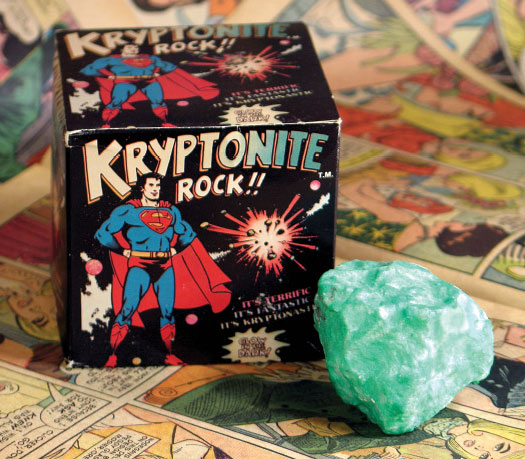
Who would have guessed that the famed Kryptonite Rock was not a green chunk of the planet Krypton that fell to Earth and contained the power to kill Superman, but was actually a regular old rock painted green? Okay, we all did (and I still wonder who was dumb enough to shell out $2.50 for that one), but I wasn't exactly sure what sending away for the X-Ray Spex, the life-size Moon Monster, the Spud Gun, the Trick Baseball, or the ever-present Sea Monkeys would actually bring you. Demarais' book is the best way I know, other than tracking down these objects yourself, to finding out.

Unsurprisingly, most of it is shit. The Flashing Eyes (cost: 50 cents) is merely a sloppily Xeroxed paper telling you how to place tin foil on your eyelids. The Life-Like Lady's Legs wouldn't fool a dog, much less the victim of the hilarious practical joke you wanted to play. The 7-11 Magic Dice might fool a dog, but not the pal you hoped to dupe into gambling away his lunch money. And the "working laser pistol?" Ha!

Still, some of Demarais' discoveries turned out to be not so bad after all, and it's fun turning the pages of MAIL-ORDER MYSTERIES to find out what was a ripoff and what wasn't. At the very least, it's a joy to relive these wonderful ads again, their purple copy and tantalizing illustrations designed to part little children with their allowance bringing back good memories. Or maybe I think they're good because I didn't blow a buck on the 7-foot Monster Ghost (a trash bag, a balloon, and fishing line).


Wednesday, April 24, 2013

The Eyes Of Goldfoot Are Upon You


AIP must have figured beach movies were out and spy movies were in back in 1965, so it created a silly spy spoof for its contract star Vincent Price, best known then for the studio’s Edgar Allan Poe horror films he made with director Roger Corman.

In DR. GOLDFOOT AND THE BIKINI MACHINE (!), Frankie Avalon and Dwayne Hickman (THE MANY LOVES OF DOBIE GILLIS) return from SKI PARTY, strangely enough playing characters with the same names, even though the script by Robert Kaufman and Elwood Ullman makes no attempt to tie the films together and, heck, the actors have switched characters anyway!

Price is great as Dr. Goldfoot (he wears golden genie shoes), but Norman Taurog’s trite direction lets him down. Goldfoot and his inept assistant Igor (the painfully unfunny Jack Mullaney of MY LIVING DOLL) shepherd a plot to create gorgeous bikini-clad robots and send them into the world to seduce wealthy men into signing over their fortunes to them. Bumbling secret agent Craig Gamble (Avalon) falls for one, Diane (played well by the delectable Susan Hart), who swindles playboy Todd Armstrong (Hickman).

Though not technically a Beach Party movie, most of GOLDFOOT’s cast will look familiar to fans. Regulars Salli Sachse, Patti Chandler, Sue Williams, Mary Hughes, Marianne Gaba, Luree and Laura Nicholson make up a good portion of Goldfoot’s robot army, as well as Deanna Lund (LAND OF THE GIANTS) and—believe it or not—a black woman (Issa Arnal) and an Asian (China Lee). Audiences probably also cheered the cheeky cameos by Annette Funicello, Harvey Lembeck, Aron Kincaid, and Deborah Walley. Goldfoot’s lair appears to be recycled sets from AIP’s horror films, adding another layer of fun for fans.

GOLDFOOT isn’t great, though it looks brilliant next to its execrable Italian-produced sequel, DR. GOLDFOOT AND THE GIRL BOMBS, which teamed Price with a leadfooted Italian comedy duo. Outside of Price, who is a joy, BIKINI MACHINE doesn’t catch fire until Frankie and Dwayne invade Goldfoot’s lair in the third act. The closing credits (and a theater marquee) promise THE GIRL IN THE GLASS BIKINI, which came out as THE GHOST IN THE INVISIBLE BIKINI.

Saturday, April 13, 2013

Terror In The Flesh

From time to time, I plan to use this space to repurpose film reviews I wrote for several local independent newspapers during the previous decade:

THE OCTOPUS: 1999–2000
CU CITYVIEW: 2002
THE PAPER: 2003–2004
THE HUB: 2005–2006


During my tenure as a professional (re: paid) film critic, I wrote about both new releases and cult classics. The date provided below is the date the newspaper issue containing the review hit the streets.

This review has been slightly edited from the original published piece.

CABIN FEVER
Rated R
Running Time 1:34
Originally published September 19, 2003

What is it about CABIN FEVER that so many others see and I don’t? After seeing it at last year’s Toronto Film Festival, Lionsgate Entertainment reportedly shelled out more dough (in the “high seven figures”) to distribute it than they had ever spent before. The hipsters at FILM THREAT and THE VILLAGE VOICE are going ga-ga over it without really explaining why director/producer/co-writer Eli Roth is “the real shit” or why the film “isn’t really horror” (which it obviously is). Even geek guru Peter Jackson (THE LORD OF THE RINGS) has been quoted as calling it “brilliant.“ To paraphrase Carleton Young in THE MAN WHO SHOT LIBERTY VALANCE, perhaps this is a case where “when the hype becomes fact, print the hype.” Because the only thing “brilliant” about CABIN FEVER are the lights used to photograph the woody North Carolina locations.

Here’s the premise: five college students attempt to vacation at a remote cabin in the forest, only to encounter fear and death in a non-human form. What a great idea…when Sam Raimi created it in THE EVIL DEAD more than twenty years ago, when he also had the marvelously expressive Bruce Campbell to anchor the supernatural evil in some sort of relatable reality, instead of wimpy BOY MEETS WORLD castoff Rider Strong. On their way to the cabin, the five encounter several eccentric and possibly racist backwoods types at the general store, including blond-maned wolf boy Dennis, whose passion for pancakes is matched only by his tendency to bite strangers (the influence of David Lynch, for whom Roth worked). The other influences are there too: DELIVERANCE, LAST HOUSE ON THE LEFT, THE TEXAS CHAIN SAW MASSACRE, NIGHT OF THE LIVING DEAD, THE THING. CABIN FEVER feels as though Roth had a checklist of his favorite horror movies with him on the set and crossed off each title as he ripped off…uh, that is, paid homage to…it.

In so doing, Roth created perhaps the most unlikable cast in recent horror history. Our five protagonists include virginal Paul (Strong), who has a crush on chaste cocktease Karen (Jordan Ladd, Cheryl’s lookalike daughter); sex-crazed couple Jeff (Joey Kern) and Marcy (Cerina Vincent); and gun-toting, beer-swigging lunk Bert (James DeBello). Each character acts exactly as you would expect them to act, given that their antecedents lie in so many other past horror movies with a teen slant. Why couldn’t the blonde Ladd play the horny girl and the brunette Vincent the virgin? Wouldn’t it have been more interesting to make the slight Strong an obnoxious lout and the hulking DeBello the “sensitive one?”

Of course, this would require imagination, a trait decidedly lacking in Roth’s approach to material older than most of his cast. When I originally read Roth’s claims that CABIN FEVER was as much a comedy as a horror film, I anticipated he would be somehow satirizing in SCREAM-like fashion horror-movie clichĂ©s. If he is, it’s the most subtle application of satire I’ve ever seen because I couldn’t find it. And I looked. Brother, did I look.

On their first night at the cabin, the youths are assaulted by a stranger covered in blood, the victim of a flesh-eating virus contaminating the forest. They chase the poor guy away, but his infectious influence remains behind. Which of the five will get sick next? How will the others react? If you’re guessing “sensitively,” “intelligently,” or “logically,” you must go directly to Movie Jail and forfeit 200 Junior Mints.

Let’s give the devilish Roth his due and acknowledge what CABIN FEVER does right. Scott Kevan’s cinematography is crisper than this low-budget movie probably deserves, imbuing the forest’s brown richness with a foreboding beauty. Nathan Barr, with the assistance of Lynch maestro Angelo Badalamente, provides a brooding musical soundscape punctuated by ominous fly-buzzing. The gooey makeup effects by KNB are suitably gruesome. And Giuseppe Andrews as a party-loving deputy contributes one of the funniest supporting performances of the year.

But it’s what Roth does wrong that sinks the picture. Even setting aside the massive plot holes that plague the ending (like why aren‘t more people affected by the virus?), it’s pretty clear that whatever ideas Roth had evaporate an hour or so into the picture, as he piles on one superfluous climax after another, presumably figuring that one will finally wrap things up in a suitably ironic fashion. Oh, and speaking of that. The final “twist” proves that Roth watches more than just horror movies. He has also seen DIRTY MARY CRAZY LARRY.

Wednesday, April 03, 2013

A Journey That Begins Where Everything Ends

From time to time, I plan to use this space to repurpose film reviews I wrote for several local independent newspapers during the previous decade:

THE OCTOPUS: 1999–2000
CU CITYVIEW: 2002
THE PAPER: 2003–2004
THE HUB: 2005–2006

During my tenure as a professional (re: paid) film critic, I wrote about both new releases and cult classics. The date provided below is the date the newspaper issue containing the review hit the streets.

This review has been slightly edited from the original published piece.


THE BLACK HOLE (1979)
Rated PG
Running Time 1:37

Walt Disney’s first PG-rated feature is often confusing, childish, and scientifically laughable, and at the time of its original release, it was loudly bashed by critics. However, the movie also boasts outstanding sets and Oscar-nominated cinematography and visual effects, and, if you don’t think about it too much, is a lot of fun.

THE BLACK HOLE was Disney’s riskiest venture to date: a $20 million science-fiction epic combining philosophical themes about God and mankind’s search for a better existence with the company’s typically juvenile approach. Released just two weeks after STAR TREK: THE MOTION PICTURE, it seems to have been lost in the box-office shuffle, although it was considered one of Disney’s all-time biggest moneymakers.

An Earth exploration vessel, the Palomino, manned by Captain Robert Forster (JACKIE BROWN) and his crew—gung-ho first mate Joseph Bottoms (HOLOCAUST), twitchy scientist Anthony Perkins (PSYCHO), psychic Yvette Mimieux (THE TIME MACHINE), and cynical journalist Ernest Borgnine (ESCAPE FROM NEW YORK)—encounters the Cygnus, a massive spaceship that was believed to have been lost 20 years earlier.

Its commander, legendary scientist Dr. Hans Reinhardt (JUDGMENT AT NUREMBURG’s Maximilian Schell), claims to be the only survivor. His ship is run by robots, including his ominous bodyguard Max, which has buzzsaws for hands. The Cygnus is perched just beyond an immense black hole. Reinhardt has invented a groundbreaking anti-gravity field that he believes will allow him to pass through the black hole safely and rule whatever universe lies on the other side. To do this, he needs the Palomino crew to guide him, whether they want to or not.

Basically a space-age remake of Disney’s classic 20,000 LEAGUES UNDER THE SEA with Schell in the James Mason/Captain Nemo role, THE BLACK HOLE features enough colorful special effects and action to keep one entertained. Admittedly, the simple dialogue by Jeb Rosebrook and Gerry Day and the token “cute” robots with painted-on square eyes, V.I.N.CENT (voiced by Roddy McDowall) and Old B.O.B. (Slim Pickens), will probably annoy most adults, although they aren’t nearly as obnoxious as Jar Jar Binks. The familiar cast has done good work elsewhere, but there are no strong characters or meaty words in the script for them to get into, and as a result, the actors are left to their own unfettered devices.

The real reason to see THE BLACK HOLE is for its marvelous Victorian-style sets designed by Disney vet Peter Ellenshaw (who was also in charge of the miniatures) and the frequently stunning visual effects. Today’s audiences, used to cartoony CGI effects that are considered cutting-edge, may be surprised at the work on display here. Using matte paintings, models, animation, and even wirework, the Disney effects artists have created a real feast for the eyes (the colossal fireball blasting its way down a Cygnus corridor is very cool). John Barry’s outstanding orchestral score was the first to be recorded digitally.

THE BLACK HOLE originally came out during an exciting resurgence in filmed science-fiction which roughly lasted from 1977–1984, and was overlooked in favor of STAR WARS, STAR TREK II: THE WRATH OF KHAN, BLADE RUNNER, THE TERMINATOR, and others. Although THE BLACK HOLE isn’t as good as any of those films, its old-fashioned visual thrills are too impressive to ignore.

Tuesday, March 26, 2013

It's Been Sleeping For 2000 Years


Released theatrically in 1985 with the generic but evocative title CREATURE, THE TITAN FIND is one of many ALIEN rip-offs of the 1980s about gooey space monsters with big teeth that chomp on astronauts with paper-thin personalities.

The second film by writer/director William Malone (whose next film was THE HOUSE ON HAUNTED HILL fourteen years later), THE TITAN FIND does a nice job creating a mood and delivering cheap violent thrills on a $750,000 budget. The miniature work and production design by future Oscar winners Robert Skotak (ALIENS) and Dennis Skotak (THE ABYSS) are very good, as are the many gore effects by Bruce Zahlava (DEAD HEAT). Really, the goo is the best reason to watch—faces are ripped off, heads explode, and blood splashes everywhere.

An American research team travels to Titan, one of Jupiter’s moons, to investigate some ancient artifacts that left a previous expedition dead. They discover their West German rivals have beaten them there, but have all been brutally murdered. That is, except for one: creepy Hans Hofner (Klaus Kinski, who leads the league in creepy German portrayals), who informs the new arrivals they’re being stalked by a 200,000-year-old creature that subsists on human blood and can control the dead using squishy control devices attached to the back of the corpses’ heads.

Besides Kinski (NOSFERATU), whose star-billed role as a lascivious, sandwich-chomping astronaut is really just a five-day cameo, the only satisfactory performances are given by pretty Wendy Schaal (THE ‘BURBS) as a brainy scientist (who is forced by the script to do some pretty idiotic things) and Stan Ivar (LITTLE HOUSE ON THE PRAIRIE) as the ship’s captain. You’ll instantly recognize Lyman Ward, who plays the arrogant corporate lackey who’s responsible for the party’s trouble, as Matthew Broderick’s clueless dad in FERRIS BUELLER’S DAY OFF. Co-writer Alan Reed is actually Robert Short, the visual effects artist who won an Academy Award for BEETLEJUICE. The orchestral score by Thomas Chase and Steve Rucker makes the action seem more exciting than it actually is, and helps to lend a “big-budget” feel to the proceedings.

It was nice to finally see THE TITAN FIND in its original 2.35:1 aspect ratio, so that the Skotaks' imaginative low-budget sets and Malone's widescreen framing are shown off to their best advantage. If I understand the situation correctly, Malone was set to self-distribute THE TITAN FIND on DVD with special features. Days before he was to sign copies at Dark Delicacies in Burbank, California, it was announced that THE TITAN FIND would be postponed so it could be distributed by a major independent company, presumably Synapse. Malone's DVD signing was cancelled, but he agreed to sell the copies he had already printed and sold via pre-order through the Dark Delicacies site. Which explains why I own the DVD with Malone's autograph on the cover. I don't know how many of these DVDs made it out--Dark Delicacies no longer offers it--but it's possible I own a rare collector's item (which you can see at right).

The original negatives of THE TITAN FIND no longer exist, so Malone's personal answer print in Panavision widescreen was used to create the DVD. It looks and sounds just fine, though certainly the upcoming Synapse version will be better. It is not the theatrical cut, because trims were made to the film before it hit theaters as CREATURE, but I'll leave it to the VIDEO WATCHDOG gang to determine the differences (though I do think the exploding head is longer on Malone's DVD).

Malone could have used a moderator to help him through his audio commentary, but he has a candid memory and explains pretty much everything you could want to know about the movie. Unsurprisingly, he didn't get along with Klaus Kinski (nobody did), and tells a few stories about the mercurial actor's five days on the set. He also points out the props he borrowed from earlier science fiction movies, including FORBIDDEN PLANET, THE ANDROMEDA STRAIN, and THE FLY. Malone moves before the camera for a short interview segment, as are actors Diane Salinger and Stan Ivar (who have their own Kinski memories). The DVD is also loaded with production stills (including a VARIETY box office chart placing CREATURE in the week's Top 10!) and Robert Skotak's conceptual art.

Malone describes THE TITAN FIND as the movie that directors usually pretend they never made early in their careers. He's quite fond of THE TITAN FIND, however, as he should be. It's trash, but it's entertaining trash clearly made by filmmakers who cared.

Thursday, March 21, 2013

Random Comic Book Splash Page: Tower Of Shadows #8

For whatever reason, Marvel was never as successful at producing four-color mystery/horror/science fiction comic books as DC was. DC's genre titles like HOUSE OF MYSTERY, TALES OF THE UNEXPECTED, GHOSTS, and WEIRD WAR TALES ran for years, but Marvel had trouble keeping alive any book that didn't have superheroes in it.

Editor Stan Lee did try, however, many times. One of his efforts was TOWER OF SHADOWS, which chugged away for nine issues and a King-Size Special from 1969 to 1971. Despite words and art by top-notch comic book professionals, including Jim Steranko and Neal Adams, TOWER was a poor seller.

Among the book's triumphs was "Sanctuary!", which was both written and drawn by the legendary Wally Wood for TOWER OF SHADOWS #8.

TOWER lasted only one more issue before it converted to CREATURES ON THE LOOSE and presented new stories featuring King Kull, Gullivar Jones, Thongor, and Man-Wolf. CREATURES was cancelled after #37, and the conclusion of its delirously insane Man-Wolf arc was described in a text page in that issue by writer David Anthony Kraft.

Tuesday, March 19, 2013

Dolph Vs. Stone Cold

Action heavyweights Steve Austin (THE CONDEMNED) and Dolph Lundgren (the original PUNISHER), who appeared together in THE EXPENDABLES, schedule a rematch in THE PACKAGE. Believe it or not, it actually squeezed into a single theater last month just a few days before its release on DVD and Blu-ray. “Stone Cold” Steve Austin may be a big shot in the wrestling ring, but he’s little better than a hunk of redwood on film, and he comes off even worse next to Dolph’s chiseled charisma.

Austin plays Tommy Wick, an enforcer who collects debts for loan shark Big Doug (Eric Keenleyside). Tommy’s wife (Kristen Kerr) wants him to settle down and take a job as a bar bouncer, but, Doug pays well, provides health benefits (!), and lets Tommy work off his incarcerated little brother Eddie’s (a miscast Locklyn Munro, also in Austin’s RECOIL) debt. He can settle that debt with one last job: deliver a book-sized package to The German (Lundgren), a sophisticated epicurean whom a lot of people try to kill. You and I, having seen other movies, know this job isn’t the milk run Doug promises, but Tommy somehow doesn’t. Before he knows it, guys with large guns are chasing him all over the Pacific Northwest.

Austin’s dull presence aside, THE PACKAGE is an entertaining B-picture, mostly because of Lundgren’s charm, but also because director Jesse V. Johnson (THE LAST SENTINEL) keeps the action, bits of well-placed humor, and a couple of plot surprises chugging along. He favors letting large men with large fists pound them into faces, which benefits the clumsy Austin, though THE PACKAGE has no shortage of ammunition fired. Former kickboxing pro Jerry Trimble, who used to star in films exactly like this one in the 1990s (like LIVE BY THE FIST and ONE MAN ARMY), has a flashy fight scene with Austin, and audiences anticipating a showdown between the two stars won’t be disappointed.