Scientists Dan Scott (Jack Kelly, who went from this to MAVERICK) and Richard Bach (Albert Dekker, who played mad scientist DR. CYCLOPS in 1940) live platonically with their elderly maid Hannah (Blossom Rock, Grandmama on THE ADDAMS FAMILY) in a mansion with a lab in Los Angeles. This may actually be the least believable element of SHE DEVIL, which 20th Century Fox released on its Regal Films label for exploitation movies as a co-feature with KRONOS.
Stanley G. Weinbaum’s short story “The Adaptive Ultimate” starred Zachary Scott and Peter Hensen when it was adapted as an episode of SCIENCE FICTION THEATER, Richard Derr and Lola Albright as a TALES OF TOMORROW, and Richard Hart as a STUDIO ONE. So it was already a well-worn tale on television when Carroll Young (JUNGLE JIM) and Kurt Neumann (THE FLY) adapted it for Regal. Dr. Scott believes he has created a serum that can cure all diseases, punctures, broken bones, and other ailments. He wants to test it on humans, but Dr. Bach isn’t sure that’s ethical.
However, one patient, Kyra Zelas (Mari Blanchard), a terminal tuberculosis patient with no family, friends, or income, interests Bach, and he okays the injection of Scott’s serum. It works. She’s up and walking around Beverly Hills in no time, and the two doctors invite her to move in with them and Hannah. They don’t yet realize Kyra has also changed into a stone cold killer who can mentally change the color of her hair (director of photography Karl Struss achieves this without cutting or visual effects by using lens filters).
The worst of Neumann’s four science fiction films as a director, SHE DEVIL basically just plods along with Kyra vamping the men around her to get all the nice things she’s always dreamed of and poor lovesick sap Scott falling for her. It isn’t the fault of Blanchard (ABBOTT & COSTELLO GO TO MARS), who looks smashing as a blonde and acts believably as a murderous trollop. It’s merely that the story’s stakes aren’t high enough. Kyra is dangerous, but she isn’t that dangerous. Bach and Scott don’t even kick her out of the house, and Scott remains in love with her even after she has killed two people.
Plus, SHE DEVIL is just sloppy. Neumann expects the audience to believe that just changing her hair color makes Kyra unrecognizable to others. When she forces her new husband (John Archer) to drive over a cliff, Neumann cuts to a stock shot of a car backing over the cliff. Blanchard made a few more movies and plenty of television episodes before dying of cancer in her 40s.
Monday, May 10, 2021
Friday, March 26, 2021
World Without End
Writer/director Edward Bernds was better known for comedies starring the Three Stooges and the Bowery Boys, but he also made occasional forays into science fiction (SPACE MASTER X-7, QUEEN OF OUTER SPACE). He directed WORLD WITHOUT END, a time travel adventure, for Allied Artists in Technicolor and CinemaScope. Despite the advanced technical specs, Bernds does little with the camera to provide visual excitement, and the scenes of the rocketship barreling through outer space are cribbed from Monogram’s earlier release FLIGHT TO MARS.
A flight from Mars opens WORLD WITHOUT END, as four astronauts played by Hugh Marlowe (EARTH VS. THE FLYING SAUCERS), Rod Taylor (THE TIME MACHINE), Nelson Leigh (CREATURE WITH THE ATOM BRAIN), and Christopher Dark (SUDDENLY) return to the Iverson Ranch 500 years after they left it. Nuclear war has devastated the Earth’s surface, and the survivors, who are mainly hot young chicks in short skirts and middle-aged men jealous of the glamorous astronauts, live in an underground city. Apparently only Caucasians survived “the big blow.” Above live “mutates:” hideously deformed beasts who attack the astronauts on sight.
The opposite of sophisticated 1950s sci-fi like FORBIDDEN PLANET and THIS ISLAND EARTH, Bernds’ film is akin to MISSILE TO THE MOON, CAT-WOMEN OF THE MOON, and other silly films about stiff Earthmen stumbling onto futuristic civilizations populated by horny women looking for mates. It allows Australia native Taylor to use his natural accent, but the performances are stiff, and the actors playing the future Earthmen look silly in their costumes and skullcaps. Nothing is sillier than the foam spiders that “attack” our heroes in a cave.
Allied Artists released WORLD WITHOUT END on a double bill with INDESTRUCTIBLE MAN. Noted character actors Paul Brinegar (RAWHIDE) and Strother Martin (COOL HAND LUKE) are “underground people,” and Herb Vigran has lines in an early scene as a reporter. Considering the similarities between the two films, Rod Taylor must have felt deja vu when he starred in THE TIME MACHINE four years later.
A flight from Mars opens WORLD WITHOUT END, as four astronauts played by Hugh Marlowe (EARTH VS. THE FLYING SAUCERS), Rod Taylor (THE TIME MACHINE), Nelson Leigh (CREATURE WITH THE ATOM BRAIN), and Christopher Dark (SUDDENLY) return to the Iverson Ranch 500 years after they left it. Nuclear war has devastated the Earth’s surface, and the survivors, who are mainly hot young chicks in short skirts and middle-aged men jealous of the glamorous astronauts, live in an underground city. Apparently only Caucasians survived “the big blow.” Above live “mutates:” hideously deformed beasts who attack the astronauts on sight.
The opposite of sophisticated 1950s sci-fi like FORBIDDEN PLANET and THIS ISLAND EARTH, Bernds’ film is akin to MISSILE TO THE MOON, CAT-WOMEN OF THE MOON, and other silly films about stiff Earthmen stumbling onto futuristic civilizations populated by horny women looking for mates. It allows Australia native Taylor to use his natural accent, but the performances are stiff, and the actors playing the future Earthmen look silly in their costumes and skullcaps. Nothing is sillier than the foam spiders that “attack” our heroes in a cave.
Allied Artists released WORLD WITHOUT END on a double bill with INDESTRUCTIBLE MAN. Noted character actors Paul Brinegar (RAWHIDE) and Strother Martin (COOL HAND LUKE) are “underground people,” and Herb Vigran has lines in an early scene as a reporter. Considering the similarities between the two films, Rod Taylor must have felt deja vu when he starred in THE TIME MACHINE four years later.
Friday, January 29, 2021
Night School
The director of CHITTY CHITTY BANG BANG ended his career with the atrocious SEXTETTE (starring a stuffed Mae West) and this minor slasher movie filmed in Boston. Paramount released Ken Hughes' NIGHT SCHOOL on a double bill with the slasher spoof STUDENT BODIES, but you’d be hard-pressed to decide which film is funnier.
NIGHT SCHOOL is certainly the duller, and hardly anyone would remember it if not for its 24-year-old star, Rachel Ward, making her first feature. The English actress quickly appeared in SHARKY’S MACHINE and DEAD MEN DON’T WEAR PLAID before THE THORN BIRDS, which aired on ABC a year and a half after NIGHT SCHOOL vanished from theaters, made her a brief household name.
Not much about her performance in NIGHT SCHOOL indicates success in Ward’s future, though she’s certainly beautiful (and isn’t shy about revealing her body). Producer Ruth Avergon also provided the screenplay about a mysterious killer in a leather jacket and motorcycle helmet who decapitates young women and deposits their heads in containers of water. Leonard Mann, usually the star of Italian thrillers (THE HUMANOID), plays the Boston detective in charge of the case. His main suspect is anthropology professor Drew Snyder (AMERICAN HORROR STORY), who is boffing his live-in teaching assistant (Ward).
Hughes, perhaps unsurprisingly for a filmmaker with British classics like CROMWELL and THE TRIAL OF OSCAR WILDE on his resume, seems unsuited for bloody horror and unwilling to get into it. Keeping the murders off-camera lowers the interest of horror fans, but NIGHT SCHOOL is too dull, stiffly acted, and light on characterization for more refined thriller fans. The only suspense is the revelation of the killer’s identity, but Avergon’s script provides too few suspects to make a real game of it. Ward made another cheap horror flick, THE FINAL TERROR, but it didn’t get released until after she was famous. Composer Brad Fiedel (THE TERMINATOR) and director of photography Mark Irwin (SCREAM) also went on to better things.
NIGHT SCHOOL is certainly the duller, and hardly anyone would remember it if not for its 24-year-old star, Rachel Ward, making her first feature. The English actress quickly appeared in SHARKY’S MACHINE and DEAD MEN DON’T WEAR PLAID before THE THORN BIRDS, which aired on ABC a year and a half after NIGHT SCHOOL vanished from theaters, made her a brief household name.
Not much about her performance in NIGHT SCHOOL indicates success in Ward’s future, though she’s certainly beautiful (and isn’t shy about revealing her body). Producer Ruth Avergon also provided the screenplay about a mysterious killer in a leather jacket and motorcycle helmet who decapitates young women and deposits their heads in containers of water. Leonard Mann, usually the star of Italian thrillers (THE HUMANOID), plays the Boston detective in charge of the case. His main suspect is anthropology professor Drew Snyder (AMERICAN HORROR STORY), who is boffing his live-in teaching assistant (Ward).
Hughes, perhaps unsurprisingly for a filmmaker with British classics like CROMWELL and THE TRIAL OF OSCAR WILDE on his resume, seems unsuited for bloody horror and unwilling to get into it. Keeping the murders off-camera lowers the interest of horror fans, but NIGHT SCHOOL is too dull, stiffly acted, and light on characterization for more refined thriller fans. The only suspense is the revelation of the killer’s identity, but Avergon’s script provides too few suspects to make a real game of it. Ward made another cheap horror flick, THE FINAL TERROR, but it didn’t get released until after she was famous. Composer Brad Fiedel (THE TERMINATOR) and director of photography Mark Irwin (SCREAM) also went on to better things.
Tuesday, January 19, 2021
Red Heat (1988)
Yes, Virginia, there once was a very small window of time in which husky comic actor Jim Belushi (THE PRINCIPAL) was not only a major Hollywood action star, but one who received equal billing with superstar Arnold Schwarzenegger (COMMANDO). Both actors are cast according to type in RED HEAT, a raucous action comedy directed by the man who helped create the genre with 48 HRS.: Walter Hill. It opened at #1 (the same weekend BULL DURHAM and THE GREAT OUTDOORS opened), but was not one of Arnold’s biggest hits. But, hell, neither was THE TERMINATOR.
Schwarzenegger is Ivan Danko, a tight-lipped Moscow cop with a dangerous reputation for kicking bad guy ass, even naked in the snow. Belushi is Art Ritzik, a laidback slob and Chicago cop whose clowning rubs the ultra-serious Danko the wrong way. Their common goal is Viktor Rosta (ACTION JACKSON’s Ed O’Ross), a druglord who escapes Danko’s clutches in Russia, but ends up in Chicago. The two cops tear hell out of half the Windy City in pursuit of Rosta...if they don’t kill each other first!
Action fans eager for a chase or shootout every ten minutes and plenty of smart talk will find RED HEAT worthwhile. The story is more formulaic than might be expected from credited writers Hill, Harry Kleiner (BULLITT), and Troy Kennedy Martin (EDGE OF DARKNESS), but in the steady hands of action craftsman Hill, the film is fast, funny, foul-mouthed, and full of interesting character actors. Peter Boyle (TAXI DRIVER) has the thankless role of Belushi’s boss. Laurence Fishburne (THE MATRIX) shows up as an uptight cop, Gina Gershon (BOUND) is a dancer, Pruitt Taylor Vince (BEAUTIFUL GIRLS) is a hotel clerk, Brion James (BLADE RUNNER) is an informant, and Peter Jason (ARACHNOPHOBIA) is a television host.
In the grand tradition of Sean Connery playing an Irish cop in THE UNTOUCHABLES and a Spaniard in HIGHLANDER, Schwarzenegger makes no effort at a Russian accent. RED HEAT did, however, shoot one day in Moscow’s Red Square — the first American production to do so — so there’s novelty value in seeing Arnold there. If you watch a lot of action movies, you may recognize the bus chase, which the studio sold as stock footage to independent movies that couldn’t afford to shoot their own.
Schwarzenegger is Ivan Danko, a tight-lipped Moscow cop with a dangerous reputation for kicking bad guy ass, even naked in the snow. Belushi is Art Ritzik, a laidback slob and Chicago cop whose clowning rubs the ultra-serious Danko the wrong way. Their common goal is Viktor Rosta (ACTION JACKSON’s Ed O’Ross), a druglord who escapes Danko’s clutches in Russia, but ends up in Chicago. The two cops tear hell out of half the Windy City in pursuit of Rosta...if they don’t kill each other first!
Action fans eager for a chase or shootout every ten minutes and plenty of smart talk will find RED HEAT worthwhile. The story is more formulaic than might be expected from credited writers Hill, Harry Kleiner (BULLITT), and Troy Kennedy Martin (EDGE OF DARKNESS), but in the steady hands of action craftsman Hill, the film is fast, funny, foul-mouthed, and full of interesting character actors. Peter Boyle (TAXI DRIVER) has the thankless role of Belushi’s boss. Laurence Fishburne (THE MATRIX) shows up as an uptight cop, Gina Gershon (BOUND) is a dancer, Pruitt Taylor Vince (BEAUTIFUL GIRLS) is a hotel clerk, Brion James (BLADE RUNNER) is an informant, and Peter Jason (ARACHNOPHOBIA) is a television host.
In the grand tradition of Sean Connery playing an Irish cop in THE UNTOUCHABLES and a Spaniard in HIGHLANDER, Schwarzenegger makes no effort at a Russian accent. RED HEAT did, however, shoot one day in Moscow’s Red Square — the first American production to do so — so there’s novelty value in seeing Arnold there. If you watch a lot of action movies, you may recognize the bus chase, which the studio sold as stock footage to independent movies that couldn’t afford to shoot their own.
Saturday, December 19, 2020
State And Main
Writer-director David Mamet (GLENGARRY GLEN ROSS) adapts his trademark rat-a-tat-tat style to screwball comedy for this rollicking swipe at Hollywood movie-making. Fast-talking director Walt Price (William H. Macy) and his crew invade sleepy Waterford, Vermont to make a period piece called THE OLD MILL. Problem is there’s no old mill in Waterford anymore (it burned down in 1960—those troublesome teenage arsonists!), so it’s up to first-time screenwriter Joseph White (Philip Seymour Hoffman as the romantic lead) to make some script accommodations.
Other Waterford invaders include leading man Bob Barrenger (Alec Baldwin), whose proclivity for teenage girls got the crew kicked out of their former location; female lead Claire Wellesley (Sarah Jessica Parker), who demands an extra $800,000 to pop her top on camera; and profane producer Marty Rossen (David Paymer). Adjusting to the Hollywood gang’s frantic ways are befuddled mayor Bailey (Charles Durning) and his trophy wife (Patti LuPone); saucy teen Carla (Julia Stiles); and sweet bookstore owner Ann (Rebecca Pidgeon), who falls for Joseph against the wishes of her arrogant lawyer fiance Doug (Clark Gregg).
Although satirizing Hollywood has been done to death on screen (Alan Alda’s SWEET LIBERTY was also about a film crew invading a small New England town), STATE AND MAIN feels fresh due to its razor-sharp dialogue and terrific acting. Macy comes off best as the alternately fawning and ferocious filmmaker, delivering lines like “It’s not a lie. It’s a gift for fiction.” with aplomb. Baldwin has fun sending up his own image, while Hoffman and Pidgeon lend the film its heart. STATE AND MAIN doesn’t seem to come up much in discussions of Mamet’s filmmaking career, making it probably his most underrated feature. “Go, you Huskies.”
Other Waterford invaders include leading man Bob Barrenger (Alec Baldwin), whose proclivity for teenage girls got the crew kicked out of their former location; female lead Claire Wellesley (Sarah Jessica Parker), who demands an extra $800,000 to pop her top on camera; and profane producer Marty Rossen (David Paymer). Adjusting to the Hollywood gang’s frantic ways are befuddled mayor Bailey (Charles Durning) and his trophy wife (Patti LuPone); saucy teen Carla (Julia Stiles); and sweet bookstore owner Ann (Rebecca Pidgeon), who falls for Joseph against the wishes of her arrogant lawyer fiance Doug (Clark Gregg).
Although satirizing Hollywood has been done to death on screen (Alan Alda’s SWEET LIBERTY was also about a film crew invading a small New England town), STATE AND MAIN feels fresh due to its razor-sharp dialogue and terrific acting. Macy comes off best as the alternately fawning and ferocious filmmaker, delivering lines like “It’s not a lie. It’s a gift for fiction.” with aplomb. Baldwin has fun sending up his own image, while Hoffman and Pidgeon lend the film its heart. STATE AND MAIN doesn’t seem to come up much in discussions of Mamet’s filmmaking career, making it probably his most underrated feature. “Go, you Huskies.”
Friday, September 25, 2020
Demonstone
R. Lee Ermey (FULL METAL JACKET) is radically cast against type as a foul-mouthed Marine (“I got more pesos in my pocket than a big horse can shit.”), and a visibly drunk Jan-Michael Vincent (WHITE LINE FEVER) is his partner in DEMONSTONE, an action movie with supernatural elements shot in the Philippines.
Director Andrew Prowse’s background as an editor (his credits include THE SIEGE AT FIREBASE GLORIA for director Brian Trenchard Smith, who receives a producing credit here) came in handy when staging DEMONSTONE’s action sequences with stunt coordinator Patrick Statham (LIVE FREE OR DIE HARD). Surprisingly, given the participation of writer Frederick Bailey (SILK) and producer Clark Henderson (ANDROID), as well as the film’s story, tone, and Manila production, Roger Corman had nothing to do with DEMONSTONE. The prolific Charles Fries, who jumped between film (TROOP BEVERLY HILLS) and television (THE MARTIAN CHRONICLES) productions with equal aplomb, was DEMONSTONE’s executive producer and theatrical distributor.
An Australian co-production with producer Antony Ginnane (TURKEY SHOOT), DEMONSTONE puts Ermey and Vincent on the trail of a killer. The suspect is fellow Marine Tony McKee (Pat Skipper, Scully’s brother on THE X-FILES), but the murders are too vicious and gory to have been committed by one person.
The real killer is Sharon (Nancy Everhard, fresh off DEEPSTAR SIX), a television reporter possessed by a long-dead monk who placed a curse on the descendants of the tribal chief who burned him alive. Because said descendant is Belfardo (Joonee Gamboa), a corrupt senator, and the victims are in his circle, the admiral (FOXY BROWN’s Peter Brown) is on Ermey’s back to solve the case. Ermey is probably ad-libbing half of his profanities. Somehow, not a single bamboo hut is blown up. You should watch DEMONSTONE anyway.
Director Andrew Prowse’s background as an editor (his credits include THE SIEGE AT FIREBASE GLORIA for director Brian Trenchard Smith, who receives a producing credit here) came in handy when staging DEMONSTONE’s action sequences with stunt coordinator Patrick Statham (LIVE FREE OR DIE HARD). Surprisingly, given the participation of writer Frederick Bailey (SILK) and producer Clark Henderson (ANDROID), as well as the film’s story, tone, and Manila production, Roger Corman had nothing to do with DEMONSTONE. The prolific Charles Fries, who jumped between film (TROOP BEVERLY HILLS) and television (THE MARTIAN CHRONICLES) productions with equal aplomb, was DEMONSTONE’s executive producer and theatrical distributor.
An Australian co-production with producer Antony Ginnane (TURKEY SHOOT), DEMONSTONE puts Ermey and Vincent on the trail of a killer. The suspect is fellow Marine Tony McKee (Pat Skipper, Scully’s brother on THE X-FILES), but the murders are too vicious and gory to have been committed by one person.
The real killer is Sharon (Nancy Everhard, fresh off DEEPSTAR SIX), a television reporter possessed by a long-dead monk who placed a curse on the descendants of the tribal chief who burned him alive. Because said descendant is Belfardo (Joonee Gamboa), a corrupt senator, and the victims are in his circle, the admiral (FOXY BROWN’s Peter Brown) is on Ermey’s back to solve the case. Ermey is probably ad-libbing half of his profanities. Somehow, not a single bamboo hut is blown up. You should watch DEMONSTONE anyway.
Tuesday, July 28, 2020
Bear Island
Except for Cannon’s little-seen RIVER OF DEATH, released to a handful of theaters in 1989, BEAR ISLAND was the last adaptation of an Alistair MacLean novel to play on the big screen. It was the 13th of MacLean’s novels to be turned into a film (though WHERE EAGLES DARE was written as a novel and a screenplay at the same time), beginning with 1961’s THE GUNS OF NAVARONE. Amazingly, despite MacLean’s enormous popularity during the 1960s and 1970s, he seems to be a forgotten author today. A pity, as his best thrillers still hold up.
Director Don Sharp (THE FACE OF FU MANCHU), who rewrote MacLean’s PUPPET ON A CHAIN screenplay and directed second unit on it, must have thought 1971’s BEAR ISLAND didn’t hold up well. He, along with David Butler (VOYAGE OF THE DAMNED) and Murray Smith (SCHIZO), made a lot of changes in the BEAR ISLAND screenplay. Whereas the novel told the story of moviemakers shooting a production on remote Bear Island, well above the Arctic Circle, the film turns the doctor protagonist Christopher Marlowe into an American named Frank Lansing (Donald Sutherland), one of several United Nations scientists who travel to Bear Island to study climate change.
Everyone seems to be harboring a secret, and some of the scientists are murdered. Lansing, surrounded by snow, ice, and suspicion, investigates and comes to believe the violence has something to do with the abandoned German U-boat base located on Bear Island. And that leads to Lansing’s secret: his late father was the captain of that U-boat during World War II, and family legend is that a cache of Nazi gold is hidden on Bear Island. Well, it’s not all that secret, because it seems everyone on the island is posing as someone else as an excuse to search for the treasure.
Sharp was an effective action director, and his BEAR ISLAND setpieces are the best part of the film. It was not a hit, which is why future MacLean adaptations were scrapped, nor was it critically praised. Second unit director Vic Armstrong (JOSHUA TREE) also contributes to the fine stuntwork. The script takes shortcuts with characterization and throws in an unlikely romance between Lansing and a humorless psychologist played by Vanessa Redgrave, but the actors’ chemistry is as icy as the Bear Island winter. It’s fun to watch the all-star cast, including Richard Widmark (MADIGAN), Christopher Lee (HORROR OF DRACULA), Lloyd Bridges (TV’s SEA HUNT), and Barbara Parkins (VALLEY OF THE DOLLS), wrestle with their accents.
Director Don Sharp (THE FACE OF FU MANCHU), who rewrote MacLean’s PUPPET ON A CHAIN screenplay and directed second unit on it, must have thought 1971’s BEAR ISLAND didn’t hold up well. He, along with David Butler (VOYAGE OF THE DAMNED) and Murray Smith (SCHIZO), made a lot of changes in the BEAR ISLAND screenplay. Whereas the novel told the story of moviemakers shooting a production on remote Bear Island, well above the Arctic Circle, the film turns the doctor protagonist Christopher Marlowe into an American named Frank Lansing (Donald Sutherland), one of several United Nations scientists who travel to Bear Island to study climate change.
Everyone seems to be harboring a secret, and some of the scientists are murdered. Lansing, surrounded by snow, ice, and suspicion, investigates and comes to believe the violence has something to do with the abandoned German U-boat base located on Bear Island. And that leads to Lansing’s secret: his late father was the captain of that U-boat during World War II, and family legend is that a cache of Nazi gold is hidden on Bear Island. Well, it’s not all that secret, because it seems everyone on the island is posing as someone else as an excuse to search for the treasure.
Sharp was an effective action director, and his BEAR ISLAND setpieces are the best part of the film. It was not a hit, which is why future MacLean adaptations were scrapped, nor was it critically praised. Second unit director Vic Armstrong (JOSHUA TREE) also contributes to the fine stuntwork. The script takes shortcuts with characterization and throws in an unlikely romance between Lansing and a humorless psychologist played by Vanessa Redgrave, but the actors’ chemistry is as icy as the Bear Island winter. It’s fun to watch the all-star cast, including Richard Widmark (MADIGAN), Christopher Lee (HORROR OF DRACULA), Lloyd Bridges (TV’s SEA HUNT), and Barbara Parkins (VALLEY OF THE DOLLS), wrestle with their accents.
Thursday, June 11, 2020
The Satan Bug
A great cast of character actors and a crackerjack premise for suspense are the highlights of THE SATAN BUG, which is based on Alistair MacLean’s excellent 1962 novel. Transplanting the action from rural England to Los Angeles, screenwriters James Clavell (KING RAT) and Edward Anhalt (THE BOSTON STRANGLER) otherwise stick pretty closely to the book as far as the plot goes. However, the telling of the tale leaves a bit to be desired. Though beautifully photographed by three-time Oscar winner Robert Surtees (BEN-HUR), THE SATAN BUG is dramatically inert with more middle-aged white guys in conservative suits standing around than a GOP convention.
Former government agent Lee Barrett (ROUTE 66 star George Maharis) is recruited by his ex-boss Cavanaugh (Richard Bull) and General Williams (Dana Andrews) to investigate the murder of a scientist and the disappearance of another at top-secret Station Three, where deadly biological agents are developed. Barrett learns the Satan Bug — a virus that could destroy all life on Earth in a couple of months — is missing, probably taken by a madman who will threaten the world with it.
Frank Sutton (GOMER PYLE, USMC) and Edward Asner (LOU GRANT) are heavies working for the villain. Richard Basehart (VOYAGE TO THE BOTTOM OF THE SEA), Simon Oakland (PSYCHO), John Anderson (5 CARD STUD), Henry Beckman (HERE COME THE BRIDES), Harold Gould (RHODA), and James Hong (CHINATOWN) work at Station Three. Anne Francis (FORBIDDEN PLANET) has little to do, but serves the film as its only female and the only character wearing color.
The talky script fails to generate much excitement, as do the drab Maharis and director John Sturges, otherwise a master director of thrillers (BAD DAY AT BLACK ROCK, THE GREAT ESCAPE). A sequence with Maharis and two government men (one played by STAR TREK’s James Doohan) trapped in an abandoned shack with a fatal virus packs the movie’s biggest thrill. The climax is a dud, though it offers some gorgeous views of the relatively new Dodger Stadium.
Former government agent Lee Barrett (ROUTE 66 star George Maharis) is recruited by his ex-boss Cavanaugh (Richard Bull) and General Williams (Dana Andrews) to investigate the murder of a scientist and the disappearance of another at top-secret Station Three, where deadly biological agents are developed. Barrett learns the Satan Bug — a virus that could destroy all life on Earth in a couple of months — is missing, probably taken by a madman who will threaten the world with it.
Frank Sutton (GOMER PYLE, USMC) and Edward Asner (LOU GRANT) are heavies working for the villain. Richard Basehart (VOYAGE TO THE BOTTOM OF THE SEA), Simon Oakland (PSYCHO), John Anderson (5 CARD STUD), Henry Beckman (HERE COME THE BRIDES), Harold Gould (RHODA), and James Hong (CHINATOWN) work at Station Three. Anne Francis (FORBIDDEN PLANET) has little to do, but serves the film as its only female and the only character wearing color.
The talky script fails to generate much excitement, as do the drab Maharis and director John Sturges, otherwise a master director of thrillers (BAD DAY AT BLACK ROCK, THE GREAT ESCAPE). A sequence with Maharis and two government men (one played by STAR TREK’s James Doohan) trapped in an abandoned shack with a fatal virus packs the movie’s biggest thrill. The climax is a dud, though it offers some gorgeous views of the relatively new Dodger Stadium.
Friday, April 24, 2020
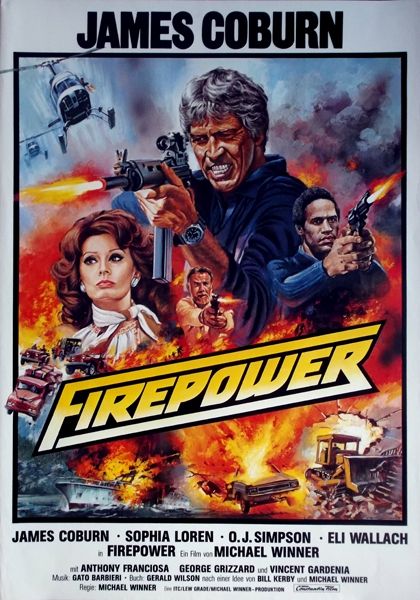
Firepower (1979)
FIREPOWER is a deliriously silly international thriller with an affecting cast of middle-aged movie stars and one of the most absurdly convoluted storylines I’ve ever attempted to decode. At one point, when director Michael Winner (DEATH WISH) and screenwriter Gerald Wilson (THE STONE KILLER) get trapped in a corner, they reach into their rear ends and pull out an exact double of James Coburn’s character, who is never seen or heard from again.
If nothing else, Winner knows how to grab an audience’s interest. Before the main titles have started to unspool, Winner kills off a chemist, the husband of Sophia Loren’s Adele Tasca, in an explosion and then guns down the chemist’s brother and a bunch of hoods at the funeral parlor. It’s an effective formula that works for Winner. When the plot starts to get confusing, blow up something or kill a bunch of guys to wake everybody up.
Adele believes the man responsible for her husband’s murder is the mysterious Karl Stegner, a wealthy recluse in Antigua who’s wanted by American authorities, but can’t be extradited, and nobody knows what the hell he looks like anyway. The Feds, with FBI agent Frank Hull (Vincent Gardenia) in charge, want flower-loving merc Jerry Fanon (Coburn) to go get Stegner, so they bribe retired mobster Sal Hyman (Eli Wallach) to convince Fanon to do the job. See what I mean about convoluted? Why couldn’t Hull just ask Fanon directly? Probably because Sir Lew Grade at ITC wanted to squeeze another star, Wallach, into the production somewhere.
Fanon takes along heist man Catlett (O.J. Simpson) as backup. Neither seems to be the brains of the outfit, as their plan involves setting Stegner’s house on fire and then running inside the abandoned blaze to find clues. The piling on of twists over doublecrosses grows silly after awhile, but FIREPOWER is always watchable for its star power and its harrowing stunt sequences involving airplanes, helicopters, automobiles, boats, bulldozers, whatever it takes. Trying to follow the plot is more effort than it’s worth.
If nothing else, Winner knows how to grab an audience’s interest. Before the main titles have started to unspool, Winner kills off a chemist, the husband of Sophia Loren’s Adele Tasca, in an explosion and then guns down the chemist’s brother and a bunch of hoods at the funeral parlor. It’s an effective formula that works for Winner. When the plot starts to get confusing, blow up something or kill a bunch of guys to wake everybody up.
Adele believes the man responsible for her husband’s murder is the mysterious Karl Stegner, a wealthy recluse in Antigua who’s wanted by American authorities, but can’t be extradited, and nobody knows what the hell he looks like anyway. The Feds, with FBI agent Frank Hull (Vincent Gardenia) in charge, want flower-loving merc Jerry Fanon (Coburn) to go get Stegner, so they bribe retired mobster Sal Hyman (Eli Wallach) to convince Fanon to do the job. See what I mean about convoluted? Why couldn’t Hull just ask Fanon directly? Probably because Sir Lew Grade at ITC wanted to squeeze another star, Wallach, into the production somewhere.
Fanon takes along heist man Catlett (O.J. Simpson) as backup. Neither seems to be the brains of the outfit, as their plan involves setting Stegner’s house on fire and then running inside the abandoned blaze to find clues. The piling on of twists over doublecrosses grows silly after awhile, but FIREPOWER is always watchable for its star power and its harrowing stunt sequences involving airplanes, helicopters, automobiles, boats, bulldozers, whatever it takes. Trying to follow the plot is more effort than it’s worth.
Friday, October 11, 2019
Robert Forster: An Interview
Although he often refers to his career as a "five-year surge" followed by a "25-year downhill slide," actor Robert Forster has been appearing steadily in television and motion pictures since the late 1960s, when he made his film debut opposite Marlon Brando and Elizabeth Taylor in John Huston's REFLECTIONS IN A GOLDEN EYE. After a few promising follow-ups, Forster disappeared from mainstream features for constant work in television, including the title roles in the TV series "Banyon" and "Nakia," and low-budget exploitation. Films like ALLIGATOR, VIGILANTE, HOLLYWOOD HARRY and STUNTS may be unfamiliar to general audiences, but Forster became a genre fan favorite for his consistently solid performances, often containing brooding heroics and a wise-guy blue-collar sense of humor, in films that were often not worthy of his presence. The pendulum clicked back the opposite direction in 1997, however, when Quentin Tarantino cast Forster in the role of lonely bail bondsman Max Cherry in JACKIE BROWN, which earned Forster an Academy Award nomination. Since then, Forster has worked almost non-stop in a great number of films, ranging from major studio pictures like SUPERNOVA and ME, MYSELF & IRENE to indie fare such as OUTSIDE OZONA and DIAMOND MEN.
In April 2002, Forster appeared at Roger Ebert's Overlooked Film Festival in Champaign-Urbana, Illinois, where Ebert was introducing DIAMOND MEN, an outstanding drama co-starring Donnie Wahlberg (TV's "Blue Bloods") and directed by Daniel Cohen. As an occasional freelance writer for a local zine called Micro-Film, I sought out Forster for an interview. Because Micro-Film's emphasis is on independent film, most of our half-hour together consisted of talk about DIAMOND MEN and HOLLYWOOD HARRY, an oddball comedy produced and directed by Forster in the mid-1980s, although we did touch on a few other subjects as well.
I certainly wish I had more time with the man. In person, Forster seems to be a genuinely nice guy, appreciative of his fan base, politely signing autographs, shaking hands and even asking the names of everyone who stopped by to say "hello" or "I loved you in JACKIE BROWN." Whatever good things are happening to him personally and professionally these days couldn't happen to a more deserving fellow.
Marty McKee: How did you get involved with DIAMOND MEN? You seem to be doing a lot of studio pictures and then small pictures.
Robert Forster: Well, not that many studio pictures. Studio pictures are really hard to break into, so most of the things I've been doing are independent. I did ME, MYSELF & IRENE (with Jim Carrey), SUPERNOVA (a notorious SF flop released by MGM that was directed by Walter Hill, who took his name off of it, and re-edited by Francis Ford Coppola), and maybe one other picture, but most everything since JACKIE BROWN has been an independent start. Dan Cohen was a first-time writer/director who approached us with this script. I read it and my daughter (Kate) read it and my lawyer read it and everybody liked it. We were trying at that point to find pictures where there was at least a small paycheck. This was a "no paycheck," so basically we fit this in between paying jobs and made it work. It took several months. We wanted to do it in the late summer or fall (1998) and I wasn't available, so we waited until spring.
What drew you to this particular story? Because I know you get a lot of scripts.
The writing was good. And I understood the character. That's the first thing — you gotta understand what you're doing. If you understand it, then it's like falling off a log. I understood JACKIE BROWN. I understood the character of Max Cherry, so it was a cinch to do. I understood this guy (his DIAMOND MEN character). My father was an old salesman. He'd been selling for 30-something years. He sold to bakers. I'd been on the road with him once or twice. He wanted me to meet his customers, so occasionally I'd go out with him, and I got a feel for what he and his life was like on the road. We liked the story and decided to do it. As I say, we slipped it in between two paying jobs. However, this, among all of them, has really risen to the top. It's little, but nice.
Did you do much research? You seem like an expert on diamonds.
Dan Cohen, whose family are diamond salesmen, gave Donnie Wahlberg and me a course. We spent several days visiting where they process them and where they set them and where they grade them. We actually took a diamond course — an abbreviated one, of course — but we learned a few things about diamonds. For instance, I remember the Four Cs: Clarity, Cut, Carat and Color. You can tell from the picture that we had enough conversation on the subject to feel confident discussing it.
You were an executive producer on DIAMOND MEN. Were you involved in Donnie Wahlberg's casting? He's very good, but he wouldn't have been my first choice for the role.
He was wonderful, and, no, I had no part in his casting. Dan Cohen did the casting. I consider that to have been one of his brilliant jobs. He cast this thing beautifully. The only reason I'm on as an executive producer is because they had no dough. So they give you a title instead.
Someone else I was so happy to see was Bess Armstrong.
She's great.
The best smile in Hollywood.
She knew what that job required. Keeping the audience unaware of her real convictions until late in the picture. To make sure the audience did not know whether she was trying to exploit my character or whether she was honest.
I know that you know a little more about independent filmmaking because you made your own, HOLLYWOOD HARRY.
The only picture I ever "made." I worked with the writer (Curt Allen) …
Who is Curt Allen?
He is a guy who wrote WALKING THE EDGE. I had worked on that picture a year or two before, and I said, "Y'know, Curt Allen is a guy who could probably help me out here," and I told him I wanted to do a picture …I'll tell you what I started with, I started with the "Banyon" suit. The chalk-stripe "Banyon" suit.
There's a photo from "Banyon" in the film, right? A publicity still?
Yep. And I said to him, "I want to do a story playing a modern detective. A broken-down detective in Hollywood who doesn't want to fall in love anymore and who's got a kid. A 12-year-old." By the time we made the picture, she was 14, but basically my daughter Kate played the kid. She told me years before this that she wanted to work (as an actress), and I said, "Honey, if I ever get an opportunity, I will put you to work."
When she was 12, I went to Cannes (with director William Lustig and co-star Fred Williamson to promote VIGILANTE at the famous Cannes Film Festival) and I realized how they made independent movies. How they sold movies and what B.S. artists they were. Very often, they just created a one-sheet poster with the title. They sell (the film on the basis of) the poster, and with the sales of the poster, they made the movie.
So I said, "I can do that. How hard could that be?" It was much harder than I imagined and I haven't produced and directed another picture since. All I can tell you is that being an actor is much, much easier. Being a producer is …augh …it's so rough. Being a director, you gotta constantly be asking yourself how to present the material. The actor has to ask himself, "What does the material mean? How will I make the audience understand it?" A director, on the other hand, has to be thinking about how to present it and the shots and so forth. I don't find that to be my strength. Dealmaking as a producer is too rough. Asking people to do for you things that you don't have enough money to pay them for. Begging people to do things for you. Making deals and a lot of paperwork and I figure, "That's not for me." So one and one only: HOLLYWOOD HARRY. Not much, but not junk.
No, it's not junk. It's a fun movie. It's also got a different Robert Forster, one we've not seen before, sort of a loosey-goosey Forster.
Yes, thank you, loosey-goosey, that's exactly correct.
I haven't seen you play much comedy.
OK, well, I did a picture called RAT IN A CAN last year. And it's now called something else. It's now called STRANGE HEARTS.
You played "Jack."
That's correct. It's as close to loosey-goosey as I have gotten in bigger pictures.
Do you still dance?
Of course!
HOLLYWOOD HARRY must have been a great labor of love. Your daughter's in the picture. Your good friend Joe Spinell …tell me about Joe.
Joe Spinell has, in the history of his career, been used as a good guy only once — in HOLLYWOOD HARRY. He has otherwise played a greasy, rotten bastard. And I knew this guy — he was a good guy. He never swore in movies, are you aware of that? You look at his old movies, and I don't think you'll ever find that he swears in movies. He always said, "No, no, you're not supposed to do that." He played rotten characters, but he never wanted to swear. He said his mother might see the picture.
You also worked with Joe in VIGILANTE, which is a good picture.
I like VIGILANTE. (Director) Bill Lustig kept me alive! He brought me to Cannes. They ran out of money while we were shooting the picture. I borrowed some money, a hundred-and-some thousand dollars, and we finished the picture. For that, they brought me to Cannes, and that's where I got my first look at how they sold movies.
Tell me about the "Hammer," Fred Williamson (Forster's co-star in VIGILANTE), whom I interviewed years ago. A colorful guy.
He is a colorful guy, and I'll tell you what. He makes (Williamson still produces and directs movies through his Po' Boy company) low-budget pictures. He makes them out of the spur of the moment real, real cheap. Every time a new actor comes, on the first day, he gives them this speech: "Now, look," he tells the new actor, "this is a low-budget production. We don't shoot a lot of takes. If it's good on the first take, we print it and move on. So just you remember this — if you do bad on that first take, you're gonna look bad in the movie." That focuses an actor's attention, I promise you.
What kind of budget and schedule did you have on HOLLYWOOD HARRY?
I did everything one step at a time. First of all, I picked an arbitrary number: $500,000. I said, "For $500,000, I can make this picture." And, of course, you can. But I didn't know where to get $500,000. I kept trying to sell the idea to prospective producers, and, finally, a couple of exhibitors — these guys had exhibited ALLIGATOR (in which Forster starred for director Lewis Teague) and made money with it in Europe — said, "Yeah, we'll work with you. What's the budget?" "$500,000," I told 'em. They said, "You come up with a third. We'll come up with two-thirds." And we made a deal.
I sold the only investment I had — the only thing I owned — which was some investment I had made some years before. I got $150,000 for it. I called these guys up in England, and I said, "OK, guys, I got my money, it's in the bank," and they didn't return my phone call. Ohhhhhh, one of those absolutely typical stories. You think you got a deal and you trust somebody and they did not come through with it. So I made HOLLYWOOD HARRY with $125,000 of that $150,000 — I had to have some money to live on. I borrowed another $10,000 from my cousin and another $25,000 from a friend, and we finished up a rough cut for approximately $160,000. Later, I had to borrow even more money to post-produce.
Each step of the way, I said, "OK, what do you do now?" By the time we got to a finished picture, I knew that I had to get it to a salesman. We got it to Cannes the following year. We sold to about five small territories. That was 1985. Later that summer, I went to work for Menahem Golan in THE DELTA FORCE (Forster played an Arab terrorist in this Chuck Norris/Lee Marvin action flick for Cannon). While we were working on DELTA FORCE, Menahem, who I had run into in Cannes, asked, "How did you do with that little picture of yours?" I said, "Oh, we sold Australia and Denmark and …" He said, "I will buy the rest of the world." This guy got me out! We sold Golan the picture. Now comes Christmas time …
How much did you sell it for?
Wait, I'll tell ya. They originally offered me $400,000. I figured, OK, that's about $75,000 profit. When I first started making this picture, I thought it was going to get me a house on the beach in Malibu. At best, I wound up with a condo in West Hollywood. I figured I was gonna grab 75-Gs on this picture for my efforts. And that was a two-year effort. Eventually, I went in to Cannon to sign the deal. By then, they kept "grinding" the deal. They take a little bit here, they take a little bit there. Finally, they found out exactly how much money I had in the picture, which was roughly $325,000. And that's exactly and only what they would give me. I had no choice. Now I was working for nothing, but at least I was gonna pay off everybody. I went in around Christmas time to sign the paperwork, and as I was signing, Golan's partner, Yoram Globus, said, "We changed the name of your picture." "Changed the name of my picture? From HOLLYWOOD HARRY to what? And why?" "Well, we had to change the name of your picture." "But why? To what?" "We're going to change it to HARRY'S MACHINE." I said, "Wait a minute, why do that? This is a beautiful title — HOLLYWOOD HARRY. It said something. And my titles (opening credit sequence) are animated. You can't change the name of the picture." He said, "Yes, well, we're going to change the name of the picture."
I was heartbroken. I was devastated. I'm signing the paperwork, I have no choice, I gotta get the $25,000 they're giving me as an advance, I had no Christmas money, I was dead broke. I'm signing the thing, I think, "Oh, God, this is what happens when you make a little movie." Later on, I discovered that Cannon had sold a package of about twenty movies, one of which was titled HARRY'S MACHINE, but they had never made it. So they bought my picture to substitute for a picture they had already sold called HARRY'S MACHINE! Wow!
I'm sure it's out of print now, but the videocassette I have is HOLLYWOOD HARRY. I think Media Home Entertainment put it out.
Yes, yes, you never saw HARRY'S MACHINE. It's HARRY'S MACHINE only in a descriptive list of the pictures that they sold. They never touched it.
Who owns HOLLYWOOD HARRY now?
I don't know who owns it now. All I know is it sold 26,000 units (videocassettes) its first quarter. That's a lot of units for a little, tiny picture.
It really is a lot of fun.
I agree.
I also want to ask you about "Banyon." Everyone I've ever spoken to about "Banyon" has fond memories of that show. Did you think that was going to be big?
I don't know. I had no idea. All I know is I loved doing it.
Joan Blondell was on that show.
Yes, indeed. She played the operator of a secretarial school, and she would give me a free secretary every week. So I always had a free, new secretary that I had to break in every week.
But it only lasted, what, thirteen weeks?
Fifteen shows. Half a season. The guy who wrote and produced and created it, Ed Adamson, died while we were shooting our first order. The show just did not survive his death.
Then a couple of years later, you played a Native American detective.
"Nakia." Good guy. Indian. Deputy sheriff. New Mexico. Contemporary. Cops-and-robbers in the desert. And the thing about that was the pilot to that was (very similar to) BILLY JACK. As is obvious. When the pilot went on the air … by then, we had already gotten an order for thirteen (hour-long episodes), and we were getting ready to shoot them. The day after the pilot showed, Tom Laughlin (the producer, writer, director and star of BILLY JACK) sued Columbia for never having purchased the rights to BILLY JACK. Whoops. What did I know?
There's another pilot you did called "The City" with Don Johnson, which looked like it could have been a pretty decent show.
Not a bad show …and it didn't go.
Do you know why it didn't work?
Ah, you never know why.
A Quinn Martin production, right? Did you ever work with Quinn Martin before?
Oh, yes, Quinn Martin produced "Banyon." He was the executive producer. He picked it up after it had been a pilot, but before it got its order. He was the one that got it its 15 episodes. Quinn Martin was a very good guy. He always overpaid his actors.
I've heard that's why he was always able to attract such extraordinary casts, including guest stars.
He always exceeded the going rate for guest actors. I don't think he paid many actors scale. He bumped it up just a little.
In THE DARKER SIDE OF TERROR, you played two roles. You played a scientist and you were cloned.
Ah, THE CLONE! It was originally called THE CLONE. It's a picture about a guy who is a scientist and Ray Milland is another scientist and he takes a bit of my blood and clones me. And now the little clone is growing up inside a tank of fluid, and when the clone is exactly my age, height and weight, somebody breaks the tank, and I come flowing out. Now there's two of me, and they dress me up the same. This is the big gimmick at the end — I am presented to the faculty. Two of us, both dressed the same. Then there is a fight and a fire in which one of us killed the other, but the audience doesn't know which one survives, and the surviving one gets in bed with the wife (Adrienne Barbeau) and she doesn't know which one survived. And I'm telling you, for many months after that was shown, people would come up to me and ask me which one survived. And I would try and explain that the actor's job is to create a possibility on both sides of that balance without tipping the action. So after I would give them this explanation about "an actor's not supposed to … " they would say (in a whispered tone), "Yeah, yeah, I know, but who really survived?"
It's an actor's dream to play two roles, isn't it?
Well, in this one, I got the opportunity to fool the audience and they were fooled.
MEDIUM COOL. Was it as adventurous for you guys to make as it looks like on-screen?
It was for me. I had no idea they asked actors to say things that weren't on the script. In this picture, there was a great deal of improvisation. Lots of scenes were improvised. So I got the realization that the actor was not only responsible for the words on the page, but for bringing a frame of reference to his material and embodying the character he's playing, so that, if necessary, you can enter any circumstance and be that character. I also realized that being yourself is oh so much easier than putting a veneer over yourself and trying to be somebody else.
At Paramount, did they bury it or did they just not get behind it or …?
Later they put it out on video. They also put it out on DVD. So it's become a little cult classic as maybe the only example of film vérité in American cinema. I can tell you one other thing about this picture, and that is that the phrase, "The whole world is watching," was coined exactly at that instant that is presented in the picture. They say, "Don't leave us! Don't leave us! The world is watching! The whole world is watching!" and it became a chant. That phrase had a lot of use during the '60s and '70s, and it was coined right then and there.
And your first nude scene in MEDIUM COOL … how many times have you performed nude?
(Laughing) I apologize …
HOLLYWOOD HARRY has one too.
HOLLYWOOD HARRY?
You've got a butt shot in HOLLYWOOD HARRY.
Yeah, well, uh …(laughing) … well, all I know is that when I first saw in REFLECTIONS OF A GOLDEN EYE (Forster's first film), a guy rides a horse naked.
Oh, that's right, I forgot that one.
I said to myself, "God, I wonder how they do that?" Probably trick photography or something. When I got out there on the set, I saw an Italian extra riding around on the horse, and I thought, "God, I don't want that guy to do it. That's my shot! I wanna be doing it." I said to (REFLECTIONS director) John Huston, "I can do that." He says (Huston impression), "Could ya, Bobby?" I said, "Yeah!" I hadn't ridden a horse, you know, not since ten-cents-a-turn around the circle when I was a kid. I'd never really ridden a horse, but I said, "I could do that." Next thing I know, the wardrobe department hands me a little cup from a jockstrap and a roll of tape. That was for my modesty. After two or three takes on that sweaty horse, the cup was gone and I stopped worrying about it. I figured if you're gonna do something like that, you just gotta do it, no reservations. If you go do it scared, you'll never, never do it right.
In April 2002, Forster appeared at Roger Ebert's Overlooked Film Festival in Champaign-Urbana, Illinois, where Ebert was introducing DIAMOND MEN, an outstanding drama co-starring Donnie Wahlberg (TV's "Blue Bloods") and directed by Daniel Cohen. As an occasional freelance writer for a local zine called Micro-Film, I sought out Forster for an interview. Because Micro-Film's emphasis is on independent film, most of our half-hour together consisted of talk about DIAMOND MEN and HOLLYWOOD HARRY, an oddball comedy produced and directed by Forster in the mid-1980s, although we did touch on a few other subjects as well.
I certainly wish I had more time with the man. In person, Forster seems to be a genuinely nice guy, appreciative of his fan base, politely signing autographs, shaking hands and even asking the names of everyone who stopped by to say "hello" or "I loved you in JACKIE BROWN." Whatever good things are happening to him personally and professionally these days couldn't happen to a more deserving fellow.
Marty McKee: How did you get involved with DIAMOND MEN? You seem to be doing a lot of studio pictures and then small pictures.
Robert Forster: Well, not that many studio pictures. Studio pictures are really hard to break into, so most of the things I've been doing are independent. I did ME, MYSELF & IRENE (with Jim Carrey), SUPERNOVA (a notorious SF flop released by MGM that was directed by Walter Hill, who took his name off of it, and re-edited by Francis Ford Coppola), and maybe one other picture, but most everything since JACKIE BROWN has been an independent start. Dan Cohen was a first-time writer/director who approached us with this script. I read it and my daughter (Kate) read it and my lawyer read it and everybody liked it. We were trying at that point to find pictures where there was at least a small paycheck. This was a "no paycheck," so basically we fit this in between paying jobs and made it work. It took several months. We wanted to do it in the late summer or fall (1998) and I wasn't available, so we waited until spring.
What drew you to this particular story? Because I know you get a lot of scripts.
The writing was good. And I understood the character. That's the first thing — you gotta understand what you're doing. If you understand it, then it's like falling off a log. I understood JACKIE BROWN. I understood the character of Max Cherry, so it was a cinch to do. I understood this guy (his DIAMOND MEN character). My father was an old salesman. He'd been selling for 30-something years. He sold to bakers. I'd been on the road with him once or twice. He wanted me to meet his customers, so occasionally I'd go out with him, and I got a feel for what he and his life was like on the road. We liked the story and decided to do it. As I say, we slipped it in between two paying jobs. However, this, among all of them, has really risen to the top. It's little, but nice.
Did you do much research? You seem like an expert on diamonds.
Dan Cohen, whose family are diamond salesmen, gave Donnie Wahlberg and me a course. We spent several days visiting where they process them and where they set them and where they grade them. We actually took a diamond course — an abbreviated one, of course — but we learned a few things about diamonds. For instance, I remember the Four Cs: Clarity, Cut, Carat and Color. You can tell from the picture that we had enough conversation on the subject to feel confident discussing it.
You were an executive producer on DIAMOND MEN. Were you involved in Donnie Wahlberg's casting? He's very good, but he wouldn't have been my first choice for the role.
He was wonderful, and, no, I had no part in his casting. Dan Cohen did the casting. I consider that to have been one of his brilliant jobs. He cast this thing beautifully. The only reason I'm on as an executive producer is because they had no dough. So they give you a title instead.
Someone else I was so happy to see was Bess Armstrong.
She's great.
The best smile in Hollywood.
She knew what that job required. Keeping the audience unaware of her real convictions until late in the picture. To make sure the audience did not know whether she was trying to exploit my character or whether she was honest.
I know that you know a little more about independent filmmaking because you made your own, HOLLYWOOD HARRY.
The only picture I ever "made." I worked with the writer (Curt Allen) …
Who is Curt Allen?
He is a guy who wrote WALKING THE EDGE. I had worked on that picture a year or two before, and I said, "Y'know, Curt Allen is a guy who could probably help me out here," and I told him I wanted to do a picture …I'll tell you what I started with, I started with the "Banyon" suit. The chalk-stripe "Banyon" suit.
There's a photo from "Banyon" in the film, right? A publicity still?
Yep. And I said to him, "I want to do a story playing a modern detective. A broken-down detective in Hollywood who doesn't want to fall in love anymore and who's got a kid. A 12-year-old." By the time we made the picture, she was 14, but basically my daughter Kate played the kid. She told me years before this that she wanted to work (as an actress), and I said, "Honey, if I ever get an opportunity, I will put you to work."
When she was 12, I went to Cannes (with director William Lustig and co-star Fred Williamson to promote VIGILANTE at the famous Cannes Film Festival) and I realized how they made independent movies. How they sold movies and what B.S. artists they were. Very often, they just created a one-sheet poster with the title. They sell (the film on the basis of) the poster, and with the sales of the poster, they made the movie.
So I said, "I can do that. How hard could that be?" It was much harder than I imagined and I haven't produced and directed another picture since. All I can tell you is that being an actor is much, much easier. Being a producer is …augh …it's so rough. Being a director, you gotta constantly be asking yourself how to present the material. The actor has to ask himself, "What does the material mean? How will I make the audience understand it?" A director, on the other hand, has to be thinking about how to present it and the shots and so forth. I don't find that to be my strength. Dealmaking as a producer is too rough. Asking people to do for you things that you don't have enough money to pay them for. Begging people to do things for you. Making deals and a lot of paperwork and I figure, "That's not for me." So one and one only: HOLLYWOOD HARRY. Not much, but not junk.
No, it's not junk. It's a fun movie. It's also got a different Robert Forster, one we've not seen before, sort of a loosey-goosey Forster.
Yes, thank you, loosey-goosey, that's exactly correct.
I haven't seen you play much comedy.
OK, well, I did a picture called RAT IN A CAN last year. And it's now called something else. It's now called STRANGE HEARTS.
You played "Jack."
That's correct. It's as close to loosey-goosey as I have gotten in bigger pictures.
Do you still dance?
Of course!
HOLLYWOOD HARRY must have been a great labor of love. Your daughter's in the picture. Your good friend Joe Spinell …tell me about Joe.
Joe Spinell has, in the history of his career, been used as a good guy only once — in HOLLYWOOD HARRY. He has otherwise played a greasy, rotten bastard. And I knew this guy — he was a good guy. He never swore in movies, are you aware of that? You look at his old movies, and I don't think you'll ever find that he swears in movies. He always said, "No, no, you're not supposed to do that." He played rotten characters, but he never wanted to swear. He said his mother might see the picture.
You also worked with Joe in VIGILANTE, which is a good picture.
I like VIGILANTE. (Director) Bill Lustig kept me alive! He brought me to Cannes. They ran out of money while we were shooting the picture. I borrowed some money, a hundred-and-some thousand dollars, and we finished the picture. For that, they brought me to Cannes, and that's where I got my first look at how they sold movies.
Tell me about the "Hammer," Fred Williamson (Forster's co-star in VIGILANTE), whom I interviewed years ago. A colorful guy.
He is a colorful guy, and I'll tell you what. He makes (Williamson still produces and directs movies through his Po' Boy company) low-budget pictures. He makes them out of the spur of the moment real, real cheap. Every time a new actor comes, on the first day, he gives them this speech: "Now, look," he tells the new actor, "this is a low-budget production. We don't shoot a lot of takes. If it's good on the first take, we print it and move on. So just you remember this — if you do bad on that first take, you're gonna look bad in the movie." That focuses an actor's attention, I promise you.
What kind of budget and schedule did you have on HOLLYWOOD HARRY?
I did everything one step at a time. First of all, I picked an arbitrary number: $500,000. I said, "For $500,000, I can make this picture." And, of course, you can. But I didn't know where to get $500,000. I kept trying to sell the idea to prospective producers, and, finally, a couple of exhibitors — these guys had exhibited ALLIGATOR (in which Forster starred for director Lewis Teague) and made money with it in Europe — said, "Yeah, we'll work with you. What's the budget?" "$500,000," I told 'em. They said, "You come up with a third. We'll come up with two-thirds." And we made a deal.
I sold the only investment I had — the only thing I owned — which was some investment I had made some years before. I got $150,000 for it. I called these guys up in England, and I said, "OK, guys, I got my money, it's in the bank," and they didn't return my phone call. Ohhhhhh, one of those absolutely typical stories. You think you got a deal and you trust somebody and they did not come through with it. So I made HOLLYWOOD HARRY with $125,000 of that $150,000 — I had to have some money to live on. I borrowed another $10,000 from my cousin and another $25,000 from a friend, and we finished up a rough cut for approximately $160,000. Later, I had to borrow even more money to post-produce.
Each step of the way, I said, "OK, what do you do now?" By the time we got to a finished picture, I knew that I had to get it to a salesman. We got it to Cannes the following year. We sold to about five small territories. That was 1985. Later that summer, I went to work for Menahem Golan in THE DELTA FORCE (Forster played an Arab terrorist in this Chuck Norris/Lee Marvin action flick for Cannon). While we were working on DELTA FORCE, Menahem, who I had run into in Cannes, asked, "How did you do with that little picture of yours?" I said, "Oh, we sold Australia and Denmark and …" He said, "I will buy the rest of the world." This guy got me out! We sold Golan the picture. Now comes Christmas time …
How much did you sell it for?
Wait, I'll tell ya. They originally offered me $400,000. I figured, OK, that's about $75,000 profit. When I first started making this picture, I thought it was going to get me a house on the beach in Malibu. At best, I wound up with a condo in West Hollywood. I figured I was gonna grab 75-Gs on this picture for my efforts. And that was a two-year effort. Eventually, I went in to Cannon to sign the deal. By then, they kept "grinding" the deal. They take a little bit here, they take a little bit there. Finally, they found out exactly how much money I had in the picture, which was roughly $325,000. And that's exactly and only what they would give me. I had no choice. Now I was working for nothing, but at least I was gonna pay off everybody. I went in around Christmas time to sign the paperwork, and as I was signing, Golan's partner, Yoram Globus, said, "We changed the name of your picture." "Changed the name of my picture? From HOLLYWOOD HARRY to what? And why?" "Well, we had to change the name of your picture." "But why? To what?" "We're going to change it to HARRY'S MACHINE." I said, "Wait a minute, why do that? This is a beautiful title — HOLLYWOOD HARRY. It said something. And my titles (opening credit sequence) are animated. You can't change the name of the picture." He said, "Yes, well, we're going to change the name of the picture."
I was heartbroken. I was devastated. I'm signing the paperwork, I have no choice, I gotta get the $25,000 they're giving me as an advance, I had no Christmas money, I was dead broke. I'm signing the thing, I think, "Oh, God, this is what happens when you make a little movie." Later on, I discovered that Cannon had sold a package of about twenty movies, one of which was titled HARRY'S MACHINE, but they had never made it. So they bought my picture to substitute for a picture they had already sold called HARRY'S MACHINE! Wow!
I'm sure it's out of print now, but the videocassette I have is HOLLYWOOD HARRY. I think Media Home Entertainment put it out.
Yes, yes, you never saw HARRY'S MACHINE. It's HARRY'S MACHINE only in a descriptive list of the pictures that they sold. They never touched it.
Who owns HOLLYWOOD HARRY now?
I don't know who owns it now. All I know is it sold 26,000 units (videocassettes) its first quarter. That's a lot of units for a little, tiny picture.
It really is a lot of fun.
I agree.
I also want to ask you about "Banyon." Everyone I've ever spoken to about "Banyon" has fond memories of that show. Did you think that was going to be big?
I don't know. I had no idea. All I know is I loved doing it.
Joan Blondell was on that show.
Yes, indeed. She played the operator of a secretarial school, and she would give me a free secretary every week. So I always had a free, new secretary that I had to break in every week.
But it only lasted, what, thirteen weeks?
Fifteen shows. Half a season. The guy who wrote and produced and created it, Ed Adamson, died while we were shooting our first order. The show just did not survive his death.
Then a couple of years later, you played a Native American detective.
"Nakia." Good guy. Indian. Deputy sheriff. New Mexico. Contemporary. Cops-and-robbers in the desert. And the thing about that was the pilot to that was (very similar to) BILLY JACK. As is obvious. When the pilot went on the air … by then, we had already gotten an order for thirteen (hour-long episodes), and we were getting ready to shoot them. The day after the pilot showed, Tom Laughlin (the producer, writer, director and star of BILLY JACK) sued Columbia for never having purchased the rights to BILLY JACK. Whoops. What did I know?
There's another pilot you did called "The City" with Don Johnson, which looked like it could have been a pretty decent show.
Not a bad show …and it didn't go.
Do you know why it didn't work?
Ah, you never know why.
A Quinn Martin production, right? Did you ever work with Quinn Martin before?
Oh, yes, Quinn Martin produced "Banyon." He was the executive producer. He picked it up after it had been a pilot, but before it got its order. He was the one that got it its 15 episodes. Quinn Martin was a very good guy. He always overpaid his actors.
I've heard that's why he was always able to attract such extraordinary casts, including guest stars.
He always exceeded the going rate for guest actors. I don't think he paid many actors scale. He bumped it up just a little.
In THE DARKER SIDE OF TERROR, you played two roles. You played a scientist and you were cloned.
Ah, THE CLONE! It was originally called THE CLONE. It's a picture about a guy who is a scientist and Ray Milland is another scientist and he takes a bit of my blood and clones me. And now the little clone is growing up inside a tank of fluid, and when the clone is exactly my age, height and weight, somebody breaks the tank, and I come flowing out. Now there's two of me, and they dress me up the same. This is the big gimmick at the end — I am presented to the faculty. Two of us, both dressed the same. Then there is a fight and a fire in which one of us killed the other, but the audience doesn't know which one survives, and the surviving one gets in bed with the wife (Adrienne Barbeau) and she doesn't know which one survived. And I'm telling you, for many months after that was shown, people would come up to me and ask me which one survived. And I would try and explain that the actor's job is to create a possibility on both sides of that balance without tipping the action. So after I would give them this explanation about "an actor's not supposed to … " they would say (in a whispered tone), "Yeah, yeah, I know, but who really survived?"
It's an actor's dream to play two roles, isn't it?
Well, in this one, I got the opportunity to fool the audience and they were fooled.
MEDIUM COOL. Was it as adventurous for you guys to make as it looks like on-screen?
It was for me. I had no idea they asked actors to say things that weren't on the script. In this picture, there was a great deal of improvisation. Lots of scenes were improvised. So I got the realization that the actor was not only responsible for the words on the page, but for bringing a frame of reference to his material and embodying the character he's playing, so that, if necessary, you can enter any circumstance and be that character. I also realized that being yourself is oh so much easier than putting a veneer over yourself and trying to be somebody else.
At Paramount, did they bury it or did they just not get behind it or …?
Later they put it out on video. They also put it out on DVD. So it's become a little cult classic as maybe the only example of film vérité in American cinema. I can tell you one other thing about this picture, and that is that the phrase, "The whole world is watching," was coined exactly at that instant that is presented in the picture. They say, "Don't leave us! Don't leave us! The world is watching! The whole world is watching!" and it became a chant. That phrase had a lot of use during the '60s and '70s, and it was coined right then and there.
And your first nude scene in MEDIUM COOL … how many times have you performed nude?
(Laughing) I apologize …
HOLLYWOOD HARRY has one too.
HOLLYWOOD HARRY?
You've got a butt shot in HOLLYWOOD HARRY.
Yeah, well, uh …(laughing) … well, all I know is that when I first saw in REFLECTIONS OF A GOLDEN EYE (Forster's first film), a guy rides a horse naked.
Oh, that's right, I forgot that one.
I said to myself, "God, I wonder how they do that?" Probably trick photography or something. When I got out there on the set, I saw an Italian extra riding around on the horse, and I thought, "God, I don't want that guy to do it. That's my shot! I wanna be doing it." I said to (REFLECTIONS director) John Huston, "I can do that." He says (Huston impression), "Could ya, Bobby?" I said, "Yeah!" I hadn't ridden a horse, you know, not since ten-cents-a-turn around the circle when I was a kid. I'd never really ridden a horse, but I said, "I could do that." Next thing I know, the wardrobe department hands me a little cup from a jockstrap and a roll of tape. That was for my modesty. After two or three takes on that sweaty horse, the cup was gone and I stopped worrying about it. I figured if you're gonna do something like that, you just gotta do it, no reservations. If you go do it scared, you'll never, never do it right.
Saturday, August 17, 2019
Action Jackson
Finally, a movie where Craig T. Nelson has a karate fight with Apollo Creed. I’m still sad we didn’t get, like, nine Action Jackson movies. Carl Weathers (ROCKY) plays Jackson like Fred Williamson Meets Apollo Creed and definitely worthy of the nickname “Action.” Somehow, ACTION JACKSON was not a hit, and Weathers ended up in television.
So, yeah, Jericho Jackson. Track star. Harvard Law grad. The Detroit Police Department busted him back down to sergeant after he tore off a pervert’s arm. Evil auto manufacturer Peter Dellaplane, portrayed deliciously by a bleached-blond Nelson (COACH), hates Jackson, because his son was the pervert.
Dellaplane wants to be the puppetmaster of the next U.S. President, so he engineers the murders of big-time union officials. Sure, that could work. He has a sexy wife, Patrice (Sharon Stone), and an even sexier mistress, a junkie nightclub singer named Sydney (Vanity, way too sexy to play junkie roles). Life is pretty good for Peter Dellaplane, the kind of rich asshole who breaks his karate teacher’s arm just for laughs.
The feature directing debut of ace stuntman Craig R. Baxley, ACTION JACKSON is farfetched, slick, often hilarious, and populated by ace character actors who bring a lot of color to their roles, such as Ed O’Ross (RED HEAT), Robert Davi (LICENSE TO KILL), Thomas F. Wilson (BACK TO THE FUTURE), and Bill Duke (PREDATOR). This movie may hold the record for macho ball-busting. A running gag is a young purse snatcher who keeps fainting in fear of the badass Action Jackson.
The performers help ground the nonsense in Robert Reneau’s (DEMOLITION MAN) screenplay in some sort of reality. Everyone plays it with the right amount of tongue in cheek, so when Weathers leaps over a speeding taxicab or swaps karate blows with Nelson after driving a sports car into his house and up the stairs to the second floor, it seems like, well, of course that’s what would happen. Joel Silver produced, which explains the constant quipping and huge explosions. Baxley blew up a lot more cars in I COME IN PEACE and STONE COLD, as perfect a trifecta of badass action flicks as any director can boast.
So, yeah, Jericho Jackson. Track star. Harvard Law grad. The Detroit Police Department busted him back down to sergeant after he tore off a pervert’s arm. Evil auto manufacturer Peter Dellaplane, portrayed deliciously by a bleached-blond Nelson (COACH), hates Jackson, because his son was the pervert.
Dellaplane wants to be the puppetmaster of the next U.S. President, so he engineers the murders of big-time union officials. Sure, that could work. He has a sexy wife, Patrice (Sharon Stone), and an even sexier mistress, a junkie nightclub singer named Sydney (Vanity, way too sexy to play junkie roles). Life is pretty good for Peter Dellaplane, the kind of rich asshole who breaks his karate teacher’s arm just for laughs.
The feature directing debut of ace stuntman Craig R. Baxley, ACTION JACKSON is farfetched, slick, often hilarious, and populated by ace character actors who bring a lot of color to their roles, such as Ed O’Ross (RED HEAT), Robert Davi (LICENSE TO KILL), Thomas F. Wilson (BACK TO THE FUTURE), and Bill Duke (PREDATOR). This movie may hold the record for macho ball-busting. A running gag is a young purse snatcher who keeps fainting in fear of the badass Action Jackson.
The performers help ground the nonsense in Robert Reneau’s (DEMOLITION MAN) screenplay in some sort of reality. Everyone plays it with the right amount of tongue in cheek, so when Weathers leaps over a speeding taxicab or swaps karate blows with Nelson after driving a sports car into his house and up the stairs to the second floor, it seems like, well, of course that’s what would happen. Joel Silver produced, which explains the constant quipping and huge explosions. Baxley blew up a lot more cars in I COME IN PEACE and STONE COLD, as perfect a trifecta of badass action flicks as any director can boast.
Saturday, June 15, 2019
Messenger Of Death
Charles Bronson worked with director J. Lee Thompson (THE GUNS OF NAVARONE) nine times, and MESSENGER OF DEATH may be the least of the lot. It was Bronson’s next-to-last collaboration with both Thompson and Cannon Films, which opened it in just 450 theaters to moribund business.
Nine women and children from the same Mormon family are murdered by a shotgun-wielding assassin. The lone surviving family member, husband and father Orville Beecham (Charles “Flat Nose Curry” Dierkop), refuses to identify the killer. Bronson plays Garrett Smith, a Denver newspaper reporter investigating the massacre, whose path leads to Orville’s father Willis (Jeff Corey) and Willis’ brother Zenas (John Ireland).
Both men hate each other passionately and blame the other for the murders. As the intrafamilial blood feud boils over into violence, Smith becomes a target for murder by mysterious employees of the Colorado Water Company, a corporation owned by one of Denver’s richest and most respected families, one with little connection, it would seem, to the wild-eyed Beecham clan.
An unusual action vehicle for Bronson, MESSENGER OF DEATH casts the stone-faced icon as a passive observer, fighting only when attacked. He doesn’t fire a gun at anyone, nor does he have much to do with identifying and apprehending the killers. In his most notable setpiece, he battles a trio of water trucks, but even there, Bronson plays the victim.
Though it’s more of a mystery thriller than action flick, MESSENGER OF DEATH is solid enough with an unusual setting and interesting supporting cast, but it doesn’t quite come together satisfactorily. Thompson and Cannon cinematographer Gideon Porath (AVENGING FORCE) do an outstanding job staging the opening massacre with dread and stark menace, using the Colorado scenery to creepy advantage.
As well, Robert O. Ragland’s score adds novelty, but MESSENGER OF DEATH is barely distinguishable from Bronson’s other Cannon pictures, except it’s classier. The screenplay by Paul Jarrico (TOM, DICK AND HARRY) holds little water, and the climax plays like MURDER, SHE WROTE with a line of red herrings gathered in a parlor waiting to be identified by a convenient witness. Themes of religious persecution and revenge add some flavor to the mystery.
Trish Van Devere (THE HEARSE), Marilyn Hassett (THE OTHER SIDE OF THE MOUNTAIN), Laurence Luckinbill (STAR TREK V: THE FINAL FRONTIER), Daniel Benzali (MURDER ONE), Gene Davis (10 TO MIDNIGHT), and Penny Peyser (THE IN-LAWS) fill out the cast. Jarrico was blacklisted during the 1950s and ended up writing spaghetti westerns in Europe, making him perhaps the perfect scribe for a tale about persecution.
Nine women and children from the same Mormon family are murdered by a shotgun-wielding assassin. The lone surviving family member, husband and father Orville Beecham (Charles “Flat Nose Curry” Dierkop), refuses to identify the killer. Bronson plays Garrett Smith, a Denver newspaper reporter investigating the massacre, whose path leads to Orville’s father Willis (Jeff Corey) and Willis’ brother Zenas (John Ireland).
Both men hate each other passionately and blame the other for the murders. As the intrafamilial blood feud boils over into violence, Smith becomes a target for murder by mysterious employees of the Colorado Water Company, a corporation owned by one of Denver’s richest and most respected families, one with little connection, it would seem, to the wild-eyed Beecham clan.
An unusual action vehicle for Bronson, MESSENGER OF DEATH casts the stone-faced icon as a passive observer, fighting only when attacked. He doesn’t fire a gun at anyone, nor does he have much to do with identifying and apprehending the killers. In his most notable setpiece, he battles a trio of water trucks, but even there, Bronson plays the victim.
Though it’s more of a mystery thriller than action flick, MESSENGER OF DEATH is solid enough with an unusual setting and interesting supporting cast, but it doesn’t quite come together satisfactorily. Thompson and Cannon cinematographer Gideon Porath (AVENGING FORCE) do an outstanding job staging the opening massacre with dread and stark menace, using the Colorado scenery to creepy advantage.
As well, Robert O. Ragland’s score adds novelty, but MESSENGER OF DEATH is barely distinguishable from Bronson’s other Cannon pictures, except it’s classier. The screenplay by Paul Jarrico (TOM, DICK AND HARRY) holds little water, and the climax plays like MURDER, SHE WROTE with a line of red herrings gathered in a parlor waiting to be identified by a convenient witness. Themes of religious persecution and revenge add some flavor to the mystery.
Trish Van Devere (THE HEARSE), Marilyn Hassett (THE OTHER SIDE OF THE MOUNTAIN), Laurence Luckinbill (STAR TREK V: THE FINAL FRONTIER), Daniel Benzali (MURDER ONE), Gene Davis (10 TO MIDNIGHT), and Penny Peyser (THE IN-LAWS) fill out the cast. Jarrico was blacklisted during the 1950s and ended up writing spaghetti westerns in Europe, making him perhaps the perfect scribe for a tale about persecution.
Sunday, October 21, 2018
Halloween (2018)
There is a good movie to be made about a Laurie Strode who survived the attack on her and her friends on Halloween night of 1978 and used it to grow into a strong, positive adult who refused to let that night forever define her. Hollywood has never wanted to make that movie. Every time Jamie Lee Curtis has returned to play Laurie, the character is a “basket case” (as she calls herself in HALLOWEEN 2018 or H40) who has never been able to escape her past.
So it goes with H40, from PINEAPPLE EXPRESS director David Gordon Green and VICE PRINCIPALS writers Jeff Fradley and Danny McBride, which ignores every other HALLOWEEN sequel. Exactly forty years after Michael Myers went on a killing spree in little Haddonfield, Illinois, he escapes custody during a prison transfer and — inexplicably — returns to Haddonfield to finish the job. Laurie is a paranoid, alcoholic, twice-divorced agoraphobe who has somehow gotten herself together well enough to construct a $10 million compound in the woods (no explanation is given as to how she accomplished this, nor how her high-security complex is so easy to infiltrate in the climax).
Laurie is estranged from her daughter Karen (Judy Greer), who lives a normal middle-class life with her nice husband Ray (a welcome Toby Huss) and their daughter — Laurie’s granddaughter — Allyson (Matichak). Other characters include Dr. Ranbir Sartain (Haluk Bilginer), Michael’s new shrink after the death of Dr. Loomis (Donald Pleasence died in 1995); British podcasters Dana Haines (Rhian Rees) and Aaron Korey (Jefferson Hall), doing a story on Myers; deputy Hawkins (Will Patton), who reveals he was there the night Myers was first arrested (a potentially intriguing character point muffed by director Green); and various cannon fodder that includes Allyson’s high school friends. Few of these characters will survive to the closing crawl.
Which is another problem with H40 and probably its biggest: it isn’t scary. Though Green and his special effects crew have figured out how to mangle the human body — Michael has grown more creative as he has reached his 60s — the killings seem perfunctory with little suspense. A couple of sequences work, one of them a lengthy tracking shot that follows Michael into a house and back onto the sidewalk, leaving death in his wake. Most of the kill scenes are predictable, including the climax set inside Laurie’s House of Booby Traps that would leave Maxwell Smart salivating.
What’s good? Most of the acting, particularly Curtis, who embraces the badass gramma role and sells her obsession with Michael, even though the Green/Fradley/McBride script leaves her hanging. As well, Greer and Matichak are believable as Curtis’ relatives, though Karen’s impatience with her mother is also underwritten. John Carpenter, of all people, agreed to score the film, collaborating with his son (with Adrienne Barbeau) Cody and his godson Daniel Davies on a familiar soundscape that fails to paper over the egregious lapses in screenplay logic and lack of suspense in Green’s direction.
While H40 succeeds in leavening the shocks with dollops of intentional humor (the little toenail-clipping boy played by Jibrail Nantambu should star in the next sequel), the film is ultimately a depressing exercise undertaken by filmmakers who don’t understand the allure of Michael Myers or, even worse, the power of Jamie Lee Curtis as Laurie Strode.
So it goes with H40, from PINEAPPLE EXPRESS director David Gordon Green and VICE PRINCIPALS writers Jeff Fradley and Danny McBride, which ignores every other HALLOWEEN sequel. Exactly forty years after Michael Myers went on a killing spree in little Haddonfield, Illinois, he escapes custody during a prison transfer and — inexplicably — returns to Haddonfield to finish the job. Laurie is a paranoid, alcoholic, twice-divorced agoraphobe who has somehow gotten herself together well enough to construct a $10 million compound in the woods (no explanation is given as to how she accomplished this, nor how her high-security complex is so easy to infiltrate in the climax).
Laurie is estranged from her daughter Karen (Judy Greer), who lives a normal middle-class life with her nice husband Ray (a welcome Toby Huss) and their daughter — Laurie’s granddaughter — Allyson (Matichak). Other characters include Dr. Ranbir Sartain (Haluk Bilginer), Michael’s new shrink after the death of Dr. Loomis (Donald Pleasence died in 1995); British podcasters Dana Haines (Rhian Rees) and Aaron Korey (Jefferson Hall), doing a story on Myers; deputy Hawkins (Will Patton), who reveals he was there the night Myers was first arrested (a potentially intriguing character point muffed by director Green); and various cannon fodder that includes Allyson’s high school friends. Few of these characters will survive to the closing crawl.
Which is another problem with H40 and probably its biggest: it isn’t scary. Though Green and his special effects crew have figured out how to mangle the human body — Michael has grown more creative as he has reached his 60s — the killings seem perfunctory with little suspense. A couple of sequences work, one of them a lengthy tracking shot that follows Michael into a house and back onto the sidewalk, leaving death in his wake. Most of the kill scenes are predictable, including the climax set inside Laurie’s House of Booby Traps that would leave Maxwell Smart salivating.
What’s good? Most of the acting, particularly Curtis, who embraces the badass gramma role and sells her obsession with Michael, even though the Green/Fradley/McBride script leaves her hanging. As well, Greer and Matichak are believable as Curtis’ relatives, though Karen’s impatience with her mother is also underwritten. John Carpenter, of all people, agreed to score the film, collaborating with his son (with Adrienne Barbeau) Cody and his godson Daniel Davies on a familiar soundscape that fails to paper over the egregious lapses in screenplay logic and lack of suspense in Green’s direction.
While H40 succeeds in leavening the shocks with dollops of intentional humor (the little toenail-clipping boy played by Jibrail Nantambu should star in the next sequel), the film is ultimately a depressing exercise undertaken by filmmakers who don’t understand the allure of Michael Myers or, even worse, the power of Jamie Lee Curtis as Laurie Strode.
Saturday, July 14, 2018
Taking A Break...But Come See Me At Letterboxd
Hello, all.
Johnny LaRue's Crane Shot has been in service since the end of 2004, first on Tripod, then here at Blogger. Originally I blogged about a variety of subjects, including politics and events in my own life. The blog eventually shifted to books/television/film, but over the past couple of years, it has been strictly film, for the most part.
Because I post regular reviews over at Letterboxed, it has seemed like an extra burden to post both there and here, particularly since I update this blog much less frequently.
So for now, I'm going to take a break from Johnny LaRue's Crane Shot. Whether it ever resumes, I just can't say right now. I will leave it standing, in case you'd like to find any old writings. But if you are interested in my film reviews, please see me over at Letterboxd, where I post something about at least 95% of the movies that I see. You don't have to "join" Letterboxd to follow me, and you can easily add my Letterboxd RSS feed to your reader.
Thank all of your for reading and commenting over the years. I hope to see you again soon.
Johnny LaRue's Crane Shot has been in service since the end of 2004, first on Tripod, then here at Blogger. Originally I blogged about a variety of subjects, including politics and events in my own life. The blog eventually shifted to books/television/film, but over the past couple of years, it has been strictly film, for the most part.
Because I post regular reviews over at Letterboxed, it has seemed like an extra burden to post both there and here, particularly since I update this blog much less frequently.
So for now, I'm going to take a break from Johnny LaRue's Crane Shot. Whether it ever resumes, I just can't say right now. I will leave it standing, in case you'd like to find any old writings. But if you are interested in my film reviews, please see me over at Letterboxd, where I post something about at least 95% of the movies that I see. You don't have to "join" Letterboxd to follow me, and you can easily add my Letterboxd RSS feed to your reader.
Thank all of your for reading and commenting over the years. I hope to see you again soon.
Friday, July 06, 2018
Night Slaves
Robert Specht (THE IMMORTAL) and Everett Chambers (COLUMBO) adapted Jerry Sohl’s 1965 Gold Medal novel NIGHT SLAVES, which was marketed as science fiction, but really isn’t. Specht and Chambers wisely dumped Sohl’s frustrating ending, but otherwise left the main plot intact. Clay (James Franciscus) and Marjorie (Lee Grant) Howard are an estranged married couple on vacation while Clay recuperates from a serious auto accident.
They visit a sleepy little town that seems normal enough. By day, at least, everybody is abnormally exhausted. At night, everyone turns into a zombie, files into trucks, and heads out of town. They always return by daylight, and nobody has any memory of the night before. Only Clay is unaffected, and nobody — especially Marjorie, who thinks the accident has scrambled Clay’s brain — believes his story.
Director Ted Post’s TWILIGHT ZONE experience came in handy when presenting NIGHT SLAVES’ off-kilter scenario of paranoia and the fear of losing one’s identity. Is Clay slipping into madness, as his wife fears, or is something spooky — and possibly otherworldly — happening in little Eldrid, California? Franciscus’ nicely modulated performance makes Clay a relatable protagonist, though the love story between Clay and a mysterious young woman played by Tisha Sterling (COOGAN’S BLUFF) is unbelievable with a treacly wrap-up (I didn’t buy it in the book either).
Sohl had no problem with the changed ending and spoke highly of the film in interviews. Shooting on the Warners backlot gives NIGHT SLAVES an artificiality that harms the story. Clay’s fear is based on not knowing what is real, but in an obviously fake western town, nothing is real. However, Post’s thoughtful unraveling of the mystery and Franciscus’ sympathetic performance work well enough to get NIGHT SLAVES past its shortcomings.
They visit a sleepy little town that seems normal enough. By day, at least, everybody is abnormally exhausted. At night, everyone turns into a zombie, files into trucks, and heads out of town. They always return by daylight, and nobody has any memory of the night before. Only Clay is unaffected, and nobody — especially Marjorie, who thinks the accident has scrambled Clay’s brain — believes his story.
Director Ted Post’s TWILIGHT ZONE experience came in handy when presenting NIGHT SLAVES’ off-kilter scenario of paranoia and the fear of losing one’s identity. Is Clay slipping into madness, as his wife fears, or is something spooky — and possibly otherworldly — happening in little Eldrid, California? Franciscus’ nicely modulated performance makes Clay a relatable protagonist, though the love story between Clay and a mysterious young woman played by Tisha Sterling (COOGAN’S BLUFF) is unbelievable with a treacly wrap-up (I didn’t buy it in the book either).
Sohl had no problem with the changed ending and spoke highly of the film in interviews. Shooting on the Warners backlot gives NIGHT SLAVES an artificiality that harms the story. Clay’s fear is based on not knowing what is real, but in an obviously fake western town, nothing is real. However, Post’s thoughtful unraveling of the mystery and Franciscus’ sympathetic performance work well enough to get NIGHT SLAVES past its shortcomings.
Saturday, June 23, 2018
Jagged Edge
Columbia released this solid courtroom thriller written by Joe Eszterhas, who was coming off hits FLASHDANCE and BLUE THUNDER (which he script-doctored without credit), and directed by Richard Marquand, who was still hot off RETURN OF THE JEDI. It opened at #2 at the box office (behind COMMANDO!), but stayed steady near the top of the charts for several weeks. It may be best remembered today for its surprise ending, which confused so many viewers that SISKEL & EBERT did a separate episode several weeks after their initial review in which Gene and Roger explained the killer’s reveal to their audience.
San Francisco publishing magnate Jack Forrester (Jeff Bridges) stands accused of slashing his wife to death in their bedroom and spelling “BITCH” on the wall in her blood. In fact, district attorney Krasny (Peter Coyote) and investigator Martin (Lance Henriksen) make no effort to look for another suspect. Forrester, of course, proclaims his innocence, and when he is arrested and formally charged, he appeals to defense attorney Teddy Barnes (Glenn Close) to defend him in court.
Forrester is wealthy, charming, handsome — hell, he’s Jeff Bridges, right? — and the divorced Teddy finds herself doing with him things no attorney should be doing with her client. And she hates the sketchy Krasny, for whom she used to work and whose ethics-skating routine she knows well. Robert Loggia (BIG) earned an Academy Award nomination for playing Sam Ransom, Teddy’s crusty investigator (what other kind is there?) with an expletive for every sentence.
What worked in a courtroom thriller in 1985 doesn’t always hold water decades later, simply because we know more about the legal process and procedures. For the most part, JAGGED EDGE’s court shenanigans lack bite. Ransom is Teddy’s detective, but he doesn’t do a helluva lot of detecting. And, frankly, Teddy is kinda dumb, rarely missing an opportunity to violate common sense. Of course, Eszterhas (who went on to BASIC INSTINCT) and Marquand are manipulating their audience to deliver thrills — that’s their job — but by stacking the deck in their favor, they make it difficult to play along with them.
San Francisco publishing magnate Jack Forrester (Jeff Bridges) stands accused of slashing his wife to death in their bedroom and spelling “BITCH” on the wall in her blood. In fact, district attorney Krasny (Peter Coyote) and investigator Martin (Lance Henriksen) make no effort to look for another suspect. Forrester, of course, proclaims his innocence, and when he is arrested and formally charged, he appeals to defense attorney Teddy Barnes (Glenn Close) to defend him in court.
Forrester is wealthy, charming, handsome — hell, he’s Jeff Bridges, right? — and the divorced Teddy finds herself doing with him things no attorney should be doing with her client. And she hates the sketchy Krasny, for whom she used to work and whose ethics-skating routine she knows well. Robert Loggia (BIG) earned an Academy Award nomination for playing Sam Ransom, Teddy’s crusty investigator (what other kind is there?) with an expletive for every sentence.
What worked in a courtroom thriller in 1985 doesn’t always hold water decades later, simply because we know more about the legal process and procedures. For the most part, JAGGED EDGE’s court shenanigans lack bite. Ransom is Teddy’s detective, but he doesn’t do a helluva lot of detecting. And, frankly, Teddy is kinda dumb, rarely missing an opportunity to violate common sense. Of course, Eszterhas (who went on to BASIC INSTINCT) and Marquand are manipulating their audience to deliver thrills — that’s their job — but by stacking the deck in their favor, they make it difficult to play along with them.
Thursday, June 14, 2018
Ghost Story (1981)
Universal shelled out $225,000 for the rights to Peter Straub’s 1979 best seller. With the casting of four Golden Age movie stars in central roles, GHOST STORY must have freaked out geezers who paid to see a Fred Astaire movie and were inundated with R-rated gore and nudity (male and female). It did pretty good business, though, for a thoughtful, slow-burning horror movie released at the height of the slasher craze.
Craig Wasson (BODY DOUBLE) plays a young college professor who returns to his snowy New England hometown to attend the funeral of his twin brother, who fell naked from a window and splatted on the ground many floors below. Wasson’s father is the mayor (Douglas Fairbanks Jr., LITTLE CAESAR), who meets with his childhood friends Melvyn Douglas (NINOTCHKA), John Houseman (THE PAPER CHASE), and Fred Astaire (THE BAND WAGON) regularly to drink brandy and tell ghost stories.
All four have recently been suffering from nightmares, and Wasson comes to suspect it has something to do with a trauma they experienced together fifty years earlier. By the climax of the story adapted by CARRIE’s Lawrence D. Cohen and directed by John Irvin (THE DOGS OF WAR), only one of the old men is left alive to face the terror that has taken the lives of his three friends.
Stealing the picture from the veterans, which ain’t easy, is an ethereal and erotic performance by Alice Krige (in CHARIOTS OF FIRE the same year) in two roles that turn out to be more closely related than the characters realize until too late. While not a total success, due partially to limp pacing and subpar visual effects (though horror makeup by THE EXORCIST’s Dick Smith is superb), GHOST STORY capably sends an occasional shudder. Moody photography by the pioneering Jack Cardiff (SONS AND LOVERS) sets the proper atmosphere, aided by Philippe Sarde’s (TESS) score and one of Astaire’s finest non-musical performances.
Patricia Neal (HUD) co-stars as Astaire’s wife, and Jacqueline Brookes (LAST EMBRACE) is Douglas’ wife. Astaire, Douglas, and Fairbanks never appeared in another feature, and Douglas, who looks frail, died before the film was released in December 1981.
Craig Wasson (BODY DOUBLE) plays a young college professor who returns to his snowy New England hometown to attend the funeral of his twin brother, who fell naked from a window and splatted on the ground many floors below. Wasson’s father is the mayor (Douglas Fairbanks Jr., LITTLE CAESAR), who meets with his childhood friends Melvyn Douglas (NINOTCHKA), John Houseman (THE PAPER CHASE), and Fred Astaire (THE BAND WAGON) regularly to drink brandy and tell ghost stories.
All four have recently been suffering from nightmares, and Wasson comes to suspect it has something to do with a trauma they experienced together fifty years earlier. By the climax of the story adapted by CARRIE’s Lawrence D. Cohen and directed by John Irvin (THE DOGS OF WAR), only one of the old men is left alive to face the terror that has taken the lives of his three friends.
Stealing the picture from the veterans, which ain’t easy, is an ethereal and erotic performance by Alice Krige (in CHARIOTS OF FIRE the same year) in two roles that turn out to be more closely related than the characters realize until too late. While not a total success, due partially to limp pacing and subpar visual effects (though horror makeup by THE EXORCIST’s Dick Smith is superb), GHOST STORY capably sends an occasional shudder. Moody photography by the pioneering Jack Cardiff (SONS AND LOVERS) sets the proper atmosphere, aided by Philippe Sarde’s (TESS) score and one of Astaire’s finest non-musical performances.
Patricia Neal (HUD) co-stars as Astaire’s wife, and Jacqueline Brookes (LAST EMBRACE) is Douglas’ wife. Astaire, Douglas, and Fairbanks never appeared in another feature, and Douglas, who looks frail, died before the film was released in December 1981.
Sunday, June 10, 2018
It's Alive (1974)
Upon its initial 1974 release, IT’S ALIVE was a box office flop, due to what director/producer/writer Larry Cohen believed to be poor marketing. It made money overseas, however, and Cohen convinced new management at Warner Brothers to re-release the film in 1977 with a new campaign. Cohen was right, as IT’S ALIVE went on to gross millions against its original $500,000 budget. Two sequels followed, both directed by Cohen (BLACK CAESAR), and a 2008 remake, which nobody gives a damn about.
Unique and in questionable taste, IT’S ALIVE is certainly the best horror movie ever made about a mutant baby who crawls about killing people. Like FRANKENSTEIN and KING KONG, the monster is humanized in the storytelling and presented with sympathy, even while it’s slaughtering.
Intelligent screenwriting presents two sides of the issue. One faction, including Los Angeles law enforcement and the baby’s father (John P. Ryan with a strong dialed-down performance), wants to destroy the killer infant. Another, led by curious scientists (including LANCER patriarch Andrew Duggan) who want to study the phenomenon, wants the baby captured alive. So does its mother (Sharon Farrell), who doesn’t see her son as a monster, but merely a confused child looking for love from its creator, just like Frankenstein’s monster.
While the concept is campy on the surface, Cohen directs his actors to play it straight, resulting in genuine chills and thought-provoking themes of intolerance, ecology, and the power of the family unit. Opening scenes are filmed in a realistic documentary style. Perhaps that was done to help the audience accept not only the outlandish concept, but also the characters’ acceptance — nobody ever questions that a mutant baby killed a whole operating room of medical personnel.
Both Ryan (DEATH WISH 4) and Farrell (LONE WOLF MCQUADE) tended to ham performances, but are properly restrained here, which helps sell the premise (give Ryan extra credit for a hell of a Walter Brennan impression). Rick Baker (AN AMERICAN WEREWOLF IN LONDON) created the monster child, which is shown infrequently (probably a wise decision on Cohen’s part, though frustrating for the viewer), and Bernard Herrmann (PSYCHO) composed the score. Ryan, Duggan, and Cohen regular James Dixon as a cop returned for the sequel, titled — what else — IT LIVES AGAIN.
Unique and in questionable taste, IT’S ALIVE is certainly the best horror movie ever made about a mutant baby who crawls about killing people. Like FRANKENSTEIN and KING KONG, the monster is humanized in the storytelling and presented with sympathy, even while it’s slaughtering.
Intelligent screenwriting presents two sides of the issue. One faction, including Los Angeles law enforcement and the baby’s father (John P. Ryan with a strong dialed-down performance), wants to destroy the killer infant. Another, led by curious scientists (including LANCER patriarch Andrew Duggan) who want to study the phenomenon, wants the baby captured alive. So does its mother (Sharon Farrell), who doesn’t see her son as a monster, but merely a confused child looking for love from its creator, just like Frankenstein’s monster.
While the concept is campy on the surface, Cohen directs his actors to play it straight, resulting in genuine chills and thought-provoking themes of intolerance, ecology, and the power of the family unit. Opening scenes are filmed in a realistic documentary style. Perhaps that was done to help the audience accept not only the outlandish concept, but also the characters’ acceptance — nobody ever questions that a mutant baby killed a whole operating room of medical personnel.
Both Ryan (DEATH WISH 4) and Farrell (LONE WOLF MCQUADE) tended to ham performances, but are properly restrained here, which helps sell the premise (give Ryan extra credit for a hell of a Walter Brennan impression). Rick Baker (AN AMERICAN WEREWOLF IN LONDON) created the monster child, which is shown infrequently (probably a wise decision on Cohen’s part, though frustrating for the viewer), and Bernard Herrmann (PSYCHO) composed the score. Ryan, Duggan, and Cohen regular James Dixon as a cop returned for the sequel, titled — what else — IT LIVES AGAIN.
Thursday, June 07, 2018
10
Enormously popular (the seventh biggest hit of 1979, snuggled between ALIEN and THE JERK) and influential (a lot of white ladies sported cornrows for awhile), the touching farce 10 boosted the career of star Dudley Moore (FOUL PLAY) and made leading lady Bo Derek (TARZAN THE APE MAN) an international superstar. The title refers to Derek’s beauty on scale of one to 10, and writer/director Blake Edwards didn’t have to work too hard to convince audiences it was true.
Moore, who replaced George Segal during shooting, is George Webber, a successful Hollywood songwriter having a midlife crisis at age 42. He spots a breathtakingly gorgeous woman (Derek, natch) and becomes so obsessed with her that he follows her on her Acapulco honeymoon just to be near her.
As played by Moore and written by Edwards (DAYS OF WINE AND ROSES), Webber’s emotional ennui is deeper than just a crush on a sexy young woman. Despite a steady partner, Sam Taylor, who is successful, talented, intelligent, and attractive (as is Julie Andrews, who plays Sam), not to mention his wealth and his four Academy Awards, George is unhappy, and his depression manifests as an obsession with sex.
But let’s not get too deep. 10 is also a film with a lot of trademark Edwards slapstick, played by Moore as well as Peter Sellers ever did, and silliness. Moore even drinks funny. One of the film’s most uproarious scenes finds an awkward Moore cringing through a terrible song (intentionally composed that way by Henry Mancini) performed by reverend Max Showalter (NIAGARA), while a doddering old blind woman shuffles around the room (and into a wall). One hilarious running gag has Moore constantly spying on his neighbor (Don Calfa) with a telescope, only to be frustrated by all the kinky sex going on over there.
The acting is terrific across the board. Moore is playing a basically unsympathetic character, but you can understand why a great woman like Sam would love him (Andrews’ performance helps in this regard as well). Robert Webber (S.O.B.) scores as George’s gay songwriting partner. Dee Wallace (CUJO) is poignant as George’s unsuccessful Mexican fling. Brian Dennehy (FIRST BLOOD) practically steals the picture as a sympathetic bartender (“I’m 37. But I look 40.”).
And then there’s Bo, who certainly was no great shakes as an actress, but in the hands of a talented director, comes across very well. It’s tough to play, in effect, the sexiest woman in the world, someone so beautiful that it drives George almost literally mad with desire. 10 is probably the only time the young Bo Derek doesn’t come across as vapid (she once admitted to David Letterman she didn’t remember the name of her high school). But then she never worked with a director like Blake Edwards either.
Moore, who replaced George Segal during shooting, is George Webber, a successful Hollywood songwriter having a midlife crisis at age 42. He spots a breathtakingly gorgeous woman (Derek, natch) and becomes so obsessed with her that he follows her on her Acapulco honeymoon just to be near her.
As played by Moore and written by Edwards (DAYS OF WINE AND ROSES), Webber’s emotional ennui is deeper than just a crush on a sexy young woman. Despite a steady partner, Sam Taylor, who is successful, talented, intelligent, and attractive (as is Julie Andrews, who plays Sam), not to mention his wealth and his four Academy Awards, George is unhappy, and his depression manifests as an obsession with sex.
But let’s not get too deep. 10 is also a film with a lot of trademark Edwards slapstick, played by Moore as well as Peter Sellers ever did, and silliness. Moore even drinks funny. One of the film’s most uproarious scenes finds an awkward Moore cringing through a terrible song (intentionally composed that way by Henry Mancini) performed by reverend Max Showalter (NIAGARA), while a doddering old blind woman shuffles around the room (and into a wall). One hilarious running gag has Moore constantly spying on his neighbor (Don Calfa) with a telescope, only to be frustrated by all the kinky sex going on over there.
The acting is terrific across the board. Moore is playing a basically unsympathetic character, but you can understand why a great woman like Sam would love him (Andrews’ performance helps in this regard as well). Robert Webber (S.O.B.) scores as George’s gay songwriting partner. Dee Wallace (CUJO) is poignant as George’s unsuccessful Mexican fling. Brian Dennehy (FIRST BLOOD) practically steals the picture as a sympathetic bartender (“I’m 37. But I look 40.”).
And then there’s Bo, who certainly was no great shakes as an actress, but in the hands of a talented director, comes across very well. It’s tough to play, in effect, the sexiest woman in the world, someone so beautiful that it drives George almost literally mad with desire. 10 is probably the only time the young Bo Derek doesn’t come across as vapid (she once admitted to David Letterman she didn’t remember the name of her high school). But then she never worked with a director like Blake Edwards either.
Sunday, June 03, 2018
The Fly (1958)
There’s something both quaint and thrilling about such a title — THE FLY. James Clavell (SHOGUN) rewrote a prize-winning short story by George Langelaan into one of the 1950s’ most familiar and most popular science fiction movies. At least two of its moments — the revelation of the monster and the chilling wrap-up (“Heelllllppp meeeeee”) — are indelibly imprinted on the brains of every fan of creature features. As directed by Kurt Neumann (ROCKETSHIP X-M) and shot by Karl Struss (KRONOS) in CinemaScope and DeLuxe color, THE FLY made so much money for 20th Century Fox that two sequels followed, as well as a 1986 remake directed by David Cronenberg (SCANNERS) and a sequel to the remake.
Al Hedison is the star in a role originally created for Michael Rennie (THE DAY THE EARTH STOOD STILL) and Rick Jason (later to star in COMBAT!). After THE FLY, Hedison changed his first name to David and became a household name backing up Richard Basehart for four seasons on VOYAGE TO THE BOTTOM OF THE SEA. Playing a scientist named Andre Delambre, Hedison is unconvincing as a French Canadian, but, more importantly, he is believable selling Clavell’s (and Langelaan’s) basic premise, which is ridiculous. For the audience to become absorbed in the drama, they have to believe in Delambre, and Fox contract player Hedison succeeds.
Andre’s wife Helene (Patricia Owens) tells the story in flashback after confessing to Andre’s brother Francois (Vincent Price) and police inspector Charas (Herbert Marshall) to killing her husband with a hydraulic press. Andre had invented a “disintegrator/reintegrator” that scrambles atoms and reassembles them elsewhere. When he tried it on himself, a common housefly was trapped inside the chamber with him, resulting in Andre being reassembled in human form, but with a fly’s head and arm!
Though a more imaginative director than Neumann could have milked the story for more suspense, the decision that the actors play the material straight maximizes the horror. Never before has the simple act of writing on a blackboard been so heartbreaking. Even though Hedison’s face is masked by a black hood, it’s his strongest dramatic moment in THE FLY. Price returned for the first sequel, RETURN OF THE FLY, with Brett Halsey playing Andre’s son.
Al Hedison is the star in a role originally created for Michael Rennie (THE DAY THE EARTH STOOD STILL) and Rick Jason (later to star in COMBAT!). After THE FLY, Hedison changed his first name to David and became a household name backing up Richard Basehart for four seasons on VOYAGE TO THE BOTTOM OF THE SEA. Playing a scientist named Andre Delambre, Hedison is unconvincing as a French Canadian, but, more importantly, he is believable selling Clavell’s (and Langelaan’s) basic premise, which is ridiculous. For the audience to become absorbed in the drama, they have to believe in Delambre, and Fox contract player Hedison succeeds.
Andre’s wife Helene (Patricia Owens) tells the story in flashback after confessing to Andre’s brother Francois (Vincent Price) and police inspector Charas (Herbert Marshall) to killing her husband with a hydraulic press. Andre had invented a “disintegrator/reintegrator” that scrambles atoms and reassembles them elsewhere. When he tried it on himself, a common housefly was trapped inside the chamber with him, resulting in Andre being reassembled in human form, but with a fly’s head and arm!
Though a more imaginative director than Neumann could have milked the story for more suspense, the decision that the actors play the material straight maximizes the horror. Never before has the simple act of writing on a blackboard been so heartbreaking. Even though Hedison’s face is masked by a black hood, it’s his strongest dramatic moment in THE FLY. Price returned for the first sequel, RETURN OF THE FLY, with Brett Halsey playing Andre’s son.
Subscribe to:
Posts (Atom)