Monday, May 02, 2011

Fate Moved Its Huge Hand

FEAR IN A DESERT TOWN, a Pocket Cardinal paperback original from 1964, is the only novel based on the hit TV series THE FUGITIVE.

Created by Roy Huggins, the ABC series starred David Janssen (RICHARD DIAMOND, PRIVATE DETECTIVE) as Richard Kimble, an Indiana pediatrician convicted and sentenced to death for the murder of his wife Helen. However, as the audience knew from the opening titles, Kimble was innocent. Freed when a train wreck unshackled him from Lieutenant Philip Gerard (Barry Morse), the detective transporting him to "the Death House," Kimble spent 120 episodes bouncing around the United States, taking odd jobs, helping people in trouble, and searching for the one-armed man he saw running from his house the night of Helen's murder.

The opening episode, written by Stanford Whitmore and airing September 17, 1963, was titled "Fear in a Desert City." Despite the paperback's claim on the cover of being an "original novel," Roger Fuller's book is based on the Whitmore teleplay, including character names and plot. Why Whitmore isn't credited, I don't know, since I'm sure any FUGITIVE fan would recognize the book's TV origin right away.

As "Desert City" is a good episode, DESERT TOWN is a good book. Part of THE FUGITIVE's appeal was its existentialism, and the underplaying Janssen was excellent at projecting, as well as any television actor could, Kimble's internal anguish. Of course, in a novel, Fuller is able to expand on that, letting us know Kimble's thoughts and the paranoia that would invade any normal man after eight months of looking over his shoulder.

Short on bread, Kimble, posing as "James Lincoln," gets off a bus in Bisson, Arizona, where he takes a quick job as a bartender for nice owner Cleve Brown, who's having problems with the local unions (this subplot goes unresolved). Needing to stay under everyone's radar, especially the cops', Kimble nonetheless becomes reluctantly involved with fragile piano player Monica Welles, who's also a fugitive of sorts, on the run from her rich, abusive husband Mark, who has tracked Monica all the way to Arizona and sees Kimble as a romantic rival.

Roger Fuller was actually Don Tracy, whose 1934 novel CRISS-CROSS was the basis for a Burt Lancaster movie. You can find out more about Tracy from Bill Crider here. Fuller/Tracy also wrote BURKE'S LAW and THE DEFENDERS tie-in novels that I'll soon be getting to.

Thursday, April 28, 2011

Because You Wanted To Watch An Episode Of Holmes & Yoyo

YouTube currently has one episode of the shortlived sitcom HOLMES & YOYO available for streaming, so if you have an extra 25 minutes or so, you might want to see how crazy television could get in 1976.

A combination of GET SMART and THE SIX MILLION DOLLAR MAN, the Arne Sultan production starred John Schuck (just off MCMILLAN & WIFE) as Greg Yoyonovich, a somewhat dimwitted detective who was actually a 400-pound robot. His boss, Captain Sedford (Bruce Kirby), teams "Yoyo" with Alex Holmes (Richard B. Shull), a good cop with a talent for getting partners hurt. Only Sedford and Holmes know that Yoyo isn't a human being, which leads to allegedly wacky incidents like Yoyo taking English idioms literally or attracting wayward metal objects with his magnetic powers. Basically, it was thirteen episodes of Maxwell Smart and Hymie jokes from GET SMART.

Like GET SMART, HOLMES & YOYO tended to take its crime plots seriously, which strengthened the slapstick somewhat by basing it in reality. It certainly wasn't the worst sitcom ever made, but the adults were watching THE JEFFERSONS on CBS and the kids were watching EMERGENCY! on NBC, so no one was left to dial in HOLMES & YOYO on ABC.

Series creators Lee Hewitt and Jack Sher wrote "The Dental Dynamiter," which was the third episode aired by ABC. GET SMART's Leonard B. Stern directed. ABC canceled the show after eleven episodes, then burned off the remaining two in the summer of 1977. Dick Wolf and NBC later polished off the concept by making the robot cop a hot chick (played by WITCHBLADE's Yancy Butler), but MANN & MACHINE was also a flop in 1992.

So. Here's part one of "The Dental Dynamiter." If you're interested in the rest of the episode, the other two parts are also on YouTube. Dick Halligan wrote the theme, and Leonard Rosenman composed the episode score. Enjoy.

Monday, April 25, 2011

If You Go Down To The Woods Today...

RITUALS is one of the most frightening and intense horror pictures I’ve ever seen. Obviously influenced by DELIVERANCE, this 1977 Canadian production stands on its own as a powerful, intelligent low-budget thriller that spends time and energy to first create interesting characters before killing them off. And for the first time, at least since its original theatrical release, it can be seen in a presentation worthy of its status.

After years of delays, Code Red has finally released RITUALS on a perfectly fine Region 1 DVD certain to make many reviewers' 2011 Top Ten lists. First announced as early as 2008 for a possible 2009 release, Code Red's RITUALS was delayed in part because of the company was attempting to get star Hal Holbrook for an interview. Holbrook doesn't appear on the DVD, though producer/co-star Lawrence Dane sits for both an interview and an audio commentary, and co-star Robin Gammill is also interviewed.

Filmed in the Ontario hinterlands by director Peter Carter (HIGH-BALLIN’) on a $600,000 budget, RITUALS casts Dane, Gammill, Ken James, Gary Reineke, and American star Holbrook (who also acted in JULIA and ALL THE PRESIDENT'S MEN around this time) as physicians on a fishing trip deep in a Canadian forest—so deep they need a plane to drop them off. The colleagues were once close friends, but different paths in life and various personal demons have caused the friendships to fragment somewhat.

What’s wonderful about Ian Sutherland’s screenplay (originally penned as BLOOD RIVER) is the care he takes to fashion interesting, fully fleshed characters. Indeed, the way in which their shallowly buried resentments come brewing to the surface once the men are put under pressure provides much of the film’s drama.

Their drinking and male bonding quickly turn to terror their second morning in the wilderness after they discover an unseen stalker has swooped into their camp while they slept and swiped their boots. Reineke, the only one who thought to bring extra shoes, volunteers to hike the fifteen miles over rough country to a dam to bring back help.

However, when Reineke still hasn’t returned the next day, the others set off to find him, only to learn they’ve been targeted by someone who toys with them using bees, bear traps, and heads on a pike to induce fear.

Like DELIVERANCE, RITUALS is more than just an exercise in violence; in fact, there’s precious little on-screen gore. Even after the unseen (except in faraway shots) creeper has begun terrorizing his victims, Sutherland and Carter continue to probe and unpeel them. While horror films often create artificial tension among its characters to create bogus conflict, the maturity and years-long friendships of RITUALS’ middle-aged protagonists—who are professionals, after all, and in Holbrook’s case at least, war veterans—result in truly powerful dramatics.

Dane also produced RITUALS and worked with Carter on Sutherland’s script. One interesting aspect is Gammill’s character’s homosexuality, which is presented in a matter-of-fact manner. Gay men were almost always treated as camp or unsympathetically in films of the 1970s, particularly action/adventures.

RITUALS is a horror film, but more than simple drive-in fodder. It’s a grueling and character-oriented suspenser that’s crying out to be better known. The director’s staging of the brutal action sequences on some very rugged-looking land stands up against any outdoor adventure of the era.

RITUALS was released domestically by Harry Novak’s Boxoffice International and has also been seen as THE CREEPER. For awhile, a company run by actor James Drury (THE VIRGINIAN) held the U.S. rights. Terry Levene's New York-based Aquarius also got hold of RITUALS at some point. Up to now, it had hardly ever been seen in good condition, at least not on home video. The American VHS release was actually a cut television print, and the best version I’ve ever seen until the Code Red disc—Germany’s PAL X-Rated DVD—is still very murky. This is partially because the lab processing the original negative messed up, leaving much of the climax in the dark (literally), but also because many Canadian features of the period just weren’t properly maintained.

Thankfully, Code Red has done a pretty decent job, presenting RITUALS from a 35mm print with a few scratches and speckles, but definitely looking better than any previous home video version. Dane is joined on the commentary by Lee Christian, who is normally quite good at these things, but seems ill-prepared for RITUALS, and Walter Olsen, one of the brothers who run Code Red. It's their company and they have the right to do what they want, but both Olsens are hopelessly inept at commentary tracks, and I wish they'd leave the heavy lifting to more qualified experts. Olsen's lack of preparation extends to his repeating an Internet joke about a Holbrook soft-rock album as fact.

Criticisms aside, RITUALS is a Canadian horror classic and well deserves the royal treatment extended it by Code Red. The DVD isn't perfect, but it's wonderful to finally see.

P.S. Big thanks to Robert Richardson, who provided much of RITUALS' background information based on his conversations with actor/producer Lawrence Dane.

Friday, April 22, 2011

And The Tommy Goes To...

The late William Woolfolk was one of pulp fiction's most versatile and prolific authors. He wrote novels, short stories, magazine articles, even scripts for the outstanding 1960s CBS drama THE DEFENDERS (series creator Reginald Rose was a friend). He was also a very busy writer of comic books, penning the adventures of Captain Marvel at Fawcett, Doll Man at Quality, Superman and Batman at DC Comics, and even Will Eisner's classic The Spirit. A lengthy though incomplete list of Woolfolk's comic book credits is here.

Not only that, but his wife Dorothy Woolfolk was a longtime writer and editor of romance comics at DC into the 1970s. So it isn't surprising that when it came time for someone to adapt DC's popular Batman and Robin duo in prose form, Woolfolk would get the assignment.

Credited to Winston Lyon, Woolfolk's BATMAN VS. 3 VILLAINS OF DOOM was published by Signet in April 1966, when the ABC television series was at its all-time peak. BATMAN, starring Adam West and Burt Ward as the Dynamic Duo, was not only a ratings smash, but also a pop-culture sensation that even landed West on the cover of LIFE magazine. Not wanting to take chances with a sure thing, Woolfolk used the TV show's camp approach, but dialed it down just a bit for easier reading.

The outlandish plot finds Gotham City's criminals gathered to award the Tommy, a trophy given every ten years to the city's best crook. The three finalists are the Joker, the Penguin, and Catwoman, who each set out to kidnap or kill Batman and Robin, figuring that will give them the edge over their opponents. Woolfolk's episodic structure has Batman and Robin battling each of the three villains separately before getting into a major skirmish with all of them at the climax. Of course, the two encounter insidious deathtraps, just like the TV show, that they have to ingeniously escape before winning the final fight.

The story wouldn't be out of place in a typical Batman comic book of the 1960s, and it runs only 128 pages here. Woolfolk knew the four-color characters quite well, but 3 VILLAINS OF DOOM shows he did his homework regarding Batman and Robin's portrayal on television. He nails the characters quite well, and it's not difficult to imagine West and Ward, as well as Cesar Romero, Julie Newmar, and Burgess Meredith, speaking Woolfolk's dialogue.

Also in 1966, Woolfolk wrote a sequel of sorts, BATMAN VS. THE FEARSOME FOURSOME, an adaptation of Lorenzo Semple Jr.'s screenplay for the BATMAN feature film that added the Riddler to the rogue's gallery. All Batfans should read 3 VILLAINS OF DOOM at least once.

Wednesday, April 20, 2011

The Deadly Sweethearts Of Disaster

A MAN CALLED SLOANE was created by writer Cliff Gould (THE STREETS OF SAN FRANCISCO) as a light spy adventure like the James Bond movies. The original pilot, titled T.R. SLOANE, starred Robert Logan (77 SUNSET STRIP) as Thomas Remington Sloane, an agent of UNIT battling a megalomaniac who plans to cause havoc with a massive death ray. The villain’s henchman was Torque (Ji-Tu Cumbuka), a 6’5” man with a mechanical hand who was clearly modeled after Richard Kiel’s Jaws character in THE SPY WHO LOVED ME.

NBC liked the idea and the Torque character, but not Logan, sending Gould and executive producer Philip Saltzman on a hunt for a new leading man. NBC exec Fred Silverman Silverman suggested Robert Conrad, one of television’s all-time most popular stars, who had hit it big in the 1950s on HAWAIIAN EYE and in the ‘60s on THE WILD WILD WEST. Conrad was ubiquitous during the 1970s, starring in several shortlived adventure series like THE D.A., ASSIGNMENT: VIENNA, and BAA BAA BLACK SHEEP, as well as a ton of TV-movies and pilots. Saltzman reportedly argued that Conrad couldn’t possibly do A MAN CALLED SLOANE, because he was already starring as an ex-boxer in the NBC series THE DUKE. “No problem,” replied Silverman, “I’ll just cancel THE DUKE.” He did, and Conrad became Thomas Remington Sloane.


A MAN CALLED SLOANE was the first television series produced by Quinn Martin Productions after Martin sold his company to Taft Broadcasting. Martin was one of television’s great producers, shepherding successful shows like THE UNTOUCHABLES, THE FUGITIVE, THE F.B.I., BARNABY JONES, and THE STREETS OF SAN FRANCISCO. Part of Martin’s deal with Taft, however, was that he had to relinquish hands-on involvement with QM shows, and SLOANE likely suffered as a result of his absence.

Thomas Sloane worked for a government agency called UNIT, which was based out of the back room of a Los Angeles toy store. There he and Torque, now a UNIT agent and Sloane’s sidekick, took orders from The Director (Dan O’Herlihy, held over from the unaired pilot movie) and used gadgetry designed by cute lab assistant Kelly (Karen Purcill). They also received constant field information and advice from “Effie”, a talking computer with the voice of Michele Carey (Elvis’ leading lady in LIVE A LITTLE, LOVE A LITTLE).

Like Conrad’s previous series, THE WILD WILD WEST, Sloane tackled a wide range of kinky baddies, including Roddy McDowall as a terrorist with a robot army, Robert Culp as a cosmetics entrepreneur plotting to take over the world by sending out gorgeous models to murder prominent men with their “kisses of death”, Richard Lynch as a master of disguise, and Dennis Cole as a 100-year-old Nazi meddling with cloning. Nearly every episode featured at least one prominent guest star--Eric Braeden, Edie Adams, Monte Markham, Clive Revill (the villain in T.R. SLOANE), Michael Pataki--as well as several sexy women for Conrad to canoodle with. Jo Ann Harris, the striking star of the Quinn Martin series MOST WANTED, appeared in the final episode, “The Shangri-La Syndrome,” which was directed by Conrad and is probably SLOANE’s weakest hour.

It was all pretty silly, of course, but definitely watchable. Conrad’s physicality led to plenty of nifty stunts, chases and fights, and QM spared few expenses in whittling together colorful if cliched plots, sets, guest stars and location shootings. The camera loved Cumbuka, who purportedly didn’t get along with Conrad, but was certainly a striking figure blessed with the neat gimmick of a steel hand that could wield various tools and weapons like a radio transmitter, laser, saw, drill or screwdriver. Some felt Conrad, a rugged man of action, was miscast as a suave secret agent, but I think he’s just fine and has pretty good rapport with Cumbuka.

A MAN CALLED SLOANE began the 1979 fall season with decent ratings, knocking CBS’ PARIS, a Steven Bochco cop show starring James Earl Jones, off the air and spurring ABC to shift HART TO HART to another night. But when ABC shifted FANTASY ISLAND from Friday to anchor its hit Saturday lineup, which included THE LOVE BOAT, SLOANE’s number was up. NBC cancelled the series after just twelve episodes. Conrad continued to star regularly in TV-movies throughout the 1980s, although he may be as quickly remembered today for his notorious temper tantrum on the first BATTLE OF THE NETWORK STARS, which led to him getting smoked in a 100-yard dash by none other than Gabriel Kaplan!

By the way, NBC eventually dusted off that T.R. SLOANE pilot and aired it in 1981, more than a year after A MAN CALLED SLOANE’s cancellation, as DEATH RAY 2000. This young 13-year-old couldn’t have been the only viewer that night who was confused to see Robert Logan in Conrad’s old role opposite Dan O’Herlihy…and Torque as the heavy!

Saturday, April 16, 2011

Spock Must Die!

Twelve years beforeSTAR TREK II: THE WRATH OF KHAN did the deed in tragic style, Bantam Books killed off Mr. Spock--sorta--in James Blish's "exciting new story of interplanetary adventure," 1970's SPOCK MUST DIE!

Notable as the first adult-themed STAR TREK tie-in novel (Whitman published the hardback kids' book MISSION TO HORATIUS two years earlier), SPOCK MUST DIE! was penned by American science fiction author James Blish, who was very successful writing a series of paperback collections of short-story adaptations of TREK episodes. Since Blish's stories were based on early script drafts and not the filmed episodes (the story goes that Blish never even watched STAR TREK during the period he was writing about it), the characters and situations often bore little resemblance to the STAR TREK that fans recognized.

And so it goes with the remarkably short SPOCK MUST DIE! (118 pages!), which chugs along with little action or drama, but plenty of drawn-out philosophical discussions about admittedly classic sci-fi themes. A sequel to the first-season episode "Errand of Mercy," which introduced the Klingons to the STAR TREK universe in the form of Canadian ham John Colicos' conniving Commander Kor, SPOCK MUST DIE! centers around the most standard of TREK complications, a transporter malfunction.

Scotty's attempt to beam Spock to Organia to investigate a mysterious shield about the planet somehow creates a duplicate Spock. Both Vulcans claim to be the original, and not even Dr. McCoy's medical genius can determine a physical or psychological difference between them. Both Spocks demand his rival be destroyed, which confuses Captain Kirk, who believes this tact is a very unSpocklike suggestion.

Meanwhile, the Klingon Empire is threatening to break the Organian Peace Treaty implemented in "Errand of Mercy" and wage war against the Federation. Kirk fears they may also be responsible for the odd disappearance or possible destruction of the Organians, highly evolved beings without physical form who took the guise of human beings to placate the Enterprise crew and Kor's men in "Errand of Mercy."

STAR TREK fans will find little to recognize about the TV show. The beloved ship's doctor is constantly referred to as "Doc," rather than his familiar "Bones" nickname, and is prone to verbose speeches about the meaning of life. Kirk comes across as wishy-washy, and has little to do in the climax except stand around and wring his hands while Spock (the good one) and Scotty wire some doohickey into a whatsit and save a planet from blowing up.

Blish seems more concerned with the book's science than its characters. Whether the science is accurate, I don't know, but it's dull enough that it sounds real. But STAR TREK has never been about technology, but rather people and their ideas. And that's where SPOCK MUST DIE!, despite its pioneering status, fails as a STAR TREK story.

Monday, April 11, 2011

Carnival Of Murder

The head of the Regalbuto crime family dies, and his empire is split evenly between two other dons: Angelo DiMorra (Anthony Quinn) and the imprisoned Jimmy Bernardo (Barry Russo), whose business is being run by his consigliere Luigi Orlando (Charlies Cioffi). Frank Regalbuto (Robert Forster), the late don’s only son, goes with Don Angelo with the proviso that he take over the business when the elder man dies. Orlando isn’t satisfied with half the Regalbuto territory. To get it all, he works behind the curtain to start a mob war that will leave him the last man standing. Step one of Orlando’s plan is to hook Angelo up with Frankie’s girl, Ruby (Angel Tompkins), an inadvertent betrayal that sets off the bloodbath.

This GODFATHER knockoff is based on a novel by Marvin H. Albert, a proficient writer of crime fiction who peaked in the 1960s and 1970s. Using the name Al Conroy, he created a men’s adventure paperback series called Soldato about an ex-Mafia enforcer who goes straight and dedicates his life to wiping out the Syndicate. As Anthony Rome, he wrote about a private eye named Tony Rome, who was played in two movies by Frank Sinatra. Albert used the name Nick Quarry to pen THE DON IS DEAD, but is credited under his real name for the film’s screenplay.

Director Richard Fleischer (MR. MAJESTYK) enlisted every rough-looking character actor with a name ending in a vowel—plus Sid Haig and Vic Tayback—for his supporting cast: Joe Santos, Frank DeKova, Val Bisoglio, Frank Christi, Abe Vigoda, Vic Argo, Anthony Charnota. Barrel-chested Al Lettieri (THE GETAWAY) is particularly strong as Vince Fargo, the protective older brother of Frank’s friend Tony (Frederic Forrest), who wants to put the life behind him.

Fleischer’s no-nonsense style is perfect for the gritty shootouts and tough melodrama present in Albert’s solid crime drama, though you may need a scorecard to keep track of who is loyal to whom. Efficiently shot on the Universal backlot, THE DON IS DEAD plays like one of those pulp paperbacks you just can’t put down. It’s like a B-picture cutdown of THE GODFATHER, stripped of the operatic overtones and boiled down to the meat and potatoes of a violent thriller well done.

Thursday, April 07, 2011

Random TV Title: Enos

It's true. This show exists. It seems absurd that it possibly could, but I do remember watching its one-season run on CBS during the 1980-81 season.

Yep. THE DUKES OF HAZZARD's bumbling deputy Enos Strate, played by Sonny Shroyer, got his own spinoff.

After Enos captured (or stumbled his way into accidentally capturing) a noted criminal in Hazzard County, he received a job offer from the Los Angeles Police Department to work special cases. The country bumpkin was partnered with street-smart, jive-talkin' Turk, played by Samuel E. Wright, best known as the voice of Sebastian in Disney's THE LITTLE MERMAID. Stentorian-voiced John Dehner played Enos' new boss, Lieutenant Broggi, who was, of course, in a general state of apoplexy over the many cars and much property destroyed by Enos in his leadfooted quest for justice.

Despite guest appearances by DUKES co-stars James Best, Denver Pyle, and Catherine Bach, ENOS didn't earn much of a following on Wednesday nights and was canceled after a year. Shroyer went back to Hazzard (which, like ENOS, filmed on the Warners backlot), and I don't know if any character ever again brought up Enos' brief stint in El Lay.

Here's a teaser and opening title from an ENOS. This may be from "Cops at Sea," aired March 18, 1981. I don't know who composed the unmemorable ENOS theme.

Tuesday, April 05, 2011

Random TV Title: The Runaways

Instead of remaking TV series that people actually remember and like, it may be interesting to bring back series with interesting concepts that didn't work originally for whatever reason. And that brings us to THE RUNAWAYS, one of the last series executive-produced by the venerable Quinn Martin.

Originally titled OPERATION: RUNAWAY with star Robert Reed (THE BRADY BUNCH) for its four-episode run in the spring of 1978, THE RUNAWAYS was recast and retitled for its return to the NBC schedule twelve months later. Alan Feinstein was the new star, playing macho psychologist Steve Arizzio, who teamed up with some attractive young people to help teens who had run away from home. It's likely Martin and his writers threw quite a bit of action and adventure into the plots.

THE RUNAWAYS sounds like an intriguing concept, though Martin's typically bombastic opening titles play hilariously now. And who's that handsome blond kid in the cast? Come with me if you want to find out...

Friday, April 01, 2011

I Have Been And Ever Shall Be Your Friend

After the critical and popular success of STAR TREK II: THE WRATH OF KHAN in the summer of 1982, Paramount wasted no time in greenlighting the next sequel, STAR TREK III: THE SEARCH FOR SPOCK, a very good space opera that emphasizes relationships over action.

NOTE: I previously covered STAR TREK: THE MOTION PICTURE and STAR TREK II: THE WRATH OF KHAN.

The crew of the U.S.S. Enterprise is still hurting after the death of Mr. Spock (first-time feature director Leonard Nimoy) at the end of ST II. Limping back to a space station orbiting Earth, Admiral James Kirk (William Shatner) and crew are even further saddened to learn that the Enterprise, considered by the Federation to be old and obsolete, will be decommissioned.

Meanwhile, Dr. McCoy (scene-stealing DeForest Kelley) has been acting strangely, attempting to buy passage aboard an illegal spaceship and speaking in Spock's voice. A visit from Spock's father Sarek (Mark Lenard, reprising his role from the television series) convinces Kirk that McCoy is the keeper of Spock's katra--his essence, soul, spirit, knowledge, whatever you want to call it--and that his old friend can be resurrected in an ancient Vulcan ceremony that hasn't been performed in centuries.

Turning renegade after the Federation refuses his request to visit the Genesis Planet where Spock's corpse lies, Kirk recruits shipmates Scott (James Doohan), Sulu (George Takei), Chekov (Walter Koenig) and Uhura (Nichelle Nichols) to help him steal the Enterprise, kidnap Spock's body, and take it, along with McCoy, to Vulcan. However, Klingon commander Kruge (BACK TO THE FUTURE's Christopher Lloyd) has discovered the secret of Genesis, and has kidnapped Kirk's son David (Merritt Butrick), Lieutenant Saavik (Robin Curtis, replacing STII's Kirstie Alley), and a young Vulcan lad on the planet's surface, holding them hostage in exchange for the Genesis formula.

Although ST III's story is self-contained, the film still plays like the middle chapter of a trilogy (which it is), bookending a couple of tense action sequences with scenes of great poetry and power. What Nimoy brings to the film as a director is a strong theatrical sense, directing his actors to not be afraid to go too far and cinematographer Charles Correll to paint dark shadows and dramatic lighting across the set. While this may have partially been done to mask the low budget (less than $20 million), it does give ST III more of an operatic feel than the other films in the series.

Themes of sacrifice, friendship, loyalty, and family float across the screen, as the Enterprise crew risks everything they have, including their very lives, to bring one of their own back from beyond. One scene near the end is a perfect example of STAR TREK's essential quality, a beautifully edited and scored (by James Horner) sequence involving dissolves from one familiar face to another as they await news of their fallen friend.

Pure action hasn't been neglected, however. The crisply edited scene in which the Enterprise goes against a bigger, newer, and better respected rival starship is a highlight, as is Kirk's hand-to-hand battle with Kruge as the planet cracks up around them (elaborate fight scenes, a staple of the original TV series, often featuring Captain Kirk's trademark two-legged kick to the chest, were absent from the films to this point).

Each of the supporting actors has a chance to briefly shine this time around, from Takei's "Don't call me 'Tiny'" to Nichols' repartee with a cocky young crewman. Shatner's emotional response to one character's death is among his best work. Lloyd, normally a comedic actor, brings operatic menace to his role.

Familiar faces dotting the supporting cast include John Larroquette (NIGHT COURT), James B. Sikking (HILL STREET BLUES), Robert Hooks (TROUBLE MAN), Miguel Ferrer, Dame Judith Anderson, Branscombe Richmond, Phil Morris (SEINFELD's Jackie Childs), Philip R. Allen, and Grace Lee Whitney, a semi-regular as Janice Rand on the STAR TREK series. Nimoy was not a directing neophyte prior to ST III; he had helmed episodes of NIGHT GALLERY, THE POWERS OF MATTHEW STAR, and Shatner's T.J. HOOKER series. Paramount must have liked what he did on ST III, because they let him direct the follow-up, STAR TREK IV: THE VOYAGE HOME, which turned out to be the highest grossing TREK film until J.J. Abrams' 2009 remake.

Monday, March 21, 2011

Up The Academy

There is a MAD magazine movie out there??

True. MAD’s first—and only—foray into moviemaking was 1980's UP THE ACADEMY, a notorious slob comedy set in a Kansas military academy. Star Ron Leibman (THE SUPERCOPS) hated it so much, he took his name off the credits. So did MAD for that matter, which paid Warner Brothers $30,000 to remove all references to the publication from the posters and trailers and to edit out the brief appearances of a (creepy-looking) Alfred E. Newman in the film itself. Newman was reinstated for the film’s television, videocassette, and DVD releases, however.

Four juvenile delinquents—Mafia son Chooch (Karate Kid Ralph Macchio), black Ike (Wendell Brown), Arab Hash (Tommy Citera) and Midwesterner Oliver (Hutch Parker, billed as J. Hutchison)—are sent by their parents to the Weinberg Military Academy in Kansas, where they are abused by their sadistic instructor, Major Vaughn Leisman (Leibman). After Leisman takes photos of Oliver having sex with girlfriend Candy (scrumptious Stacey Nelkin from HALLOWEEN III) and threatens to blackmail his politician father with them, the boys plot their counterattack, while avoiding the prying eyes of the major’s fat spying nephew Rodney (Harry Teinowitz).

It’s hard to understand why Leibman was so embarrassed by the finished product. Although the frequent overdubbing, insert shots, plotholes, and optical zooms do indicate post-production troubles, most of the embarrassing stuff must have been in the script, and Leibman, who was in NORMA RAE the year before, obviously knew what he was getting into when he performed one S&M scene clad only in pink ladies’ underwear. He’s actually the film’s most spirited performer, getting all the best lines and pratfalls.

It’s hard to believe the script was actually penned by credited writers Tom Patchett and Jay Tarses, whose wonderful television work—including THE BOB NEWHART SHOW and BUFFALO BILL—is light years ahead of this. THE SPY WHO LOVED ME’s glamorous Barbara Bach appears as a cleavage-bearing armaments teacher, and Tom Poston is out there as a swishy dance instructor. Antonio “Huggy Bear” Fargas and Leonard Frey (THE BOYS IN THE BAND) are surprisingly in this too.

Still, I have a soft spot for the good ol’ days of political incorrectness, when it was still okay for comedies to poke fun at abortion, sex, dope, religion, My Lai, homosexuals, blacks, Arabs, and flatulence, all targets of Robert Downey’s (PUTNEY SWOPE) scattershot direction. Besides Macchio, none of the young male leads went on to movie stardom, and I imagine a behind-the-scenes documentary of UP THE ACADEMY would be more interesting that the film itself. The rock soundtrack includes hits by Iggy Pop & the Stooges, Blondie, Cheap Trick, The Kinks, Ian Hunter, Lou Reed, Jonathan Richman, The Babys, The Boomtown Rats, David Johansen, Sammy Hagar, Nick Lowe, and Pat Benatar.

Thursday, March 17, 2011

Super Cop Joe Blaze: The Thrill Killers by Robert Novak

THE THRILL KILLERS plays more like an hour-long TV episode than a novel. Its thin plot pits macho lone-wolf detective Joe Blaze against a pair of rich, spoiled young medical interns who get their kicks raping and murdering pretty nurses. The level of violence and graphic sleaze is far above what you'd see on television, even now, but otherwise, there isn't much in this 1974 Belmont Tower novel to surprise you. Par for the course during this era of men's adventure novels, the criminals are captured but allowed to walk away clean in the improbably liberal courts demanded by the expectations of the literature, leaving it to Blaze to track down the rapists and kill them in cold blood. Spoiler?

Credited to one Robert Novak, THE THRILL KILLERS was written by Leonard Levinson (see the comments below), though some of the Joe Blaze novels may have actually been written by bestselling author Nelson DeMille, who doesn't admit to any of them on his website, not even the equally trashy Keller and Ryker cop novels credited to him. It is known that some of the Ryker books accidentally feature the name "Blaze" in their prose instead of "Ryker," meaning that they probably began as Super Cop Joe Blaze stories that were quickly rewritten to accomodate the new hero.

THE THRILL KILLERS is junky and trashy, but a good, quick read if you're in the mood for violent urban thrills.

Tuesday, March 15, 2011

The Paradise Plot by Ed Naha

I can't remember why I bought Ed Naha's THE PARADISE PLOT. I must have read about it somewhere, but while researching the novel online in preparation to write this, I couldn't find really anything about it. What I do know is that I was motivated some months back to buy a used copy very inexpensively on Amazon, and I'm glad I did.

THE PARADISE PLOT is a 340-page mixture of science fiction and murder mystery set a space station called Island One. Ten years earlier, it had been established as a self-sufficient mining colony, and is today regarded on an overpopulated Earth as something of a utopia. With the ten-year anniversary approaching, cynical journalist Harry Porter is chosen to take part in a junket traveling to Island One to write a series of puff pieces meant to reassure the United States government to keep funding the station.

However, just before arriving at Island One, Porter stumbles upon evidence of a murder committed there. His initial investigation indicates a coverup--neither the alleged victim nor the witness seem to have ever lived at Island One, according to official records--but when someone with strong psychic powers makes an attempt on Harry's life, the bulldogged burnout digs deeper, much to the chagrin of Island One's government.

Naha is a journeyman writer who has bounced around for several decades. Anyone with an interest in science fiction and/or horror has probably encountered Naha's work during his stint writing articles for Fangoria and Starlog, his book THE FILMS OF ROGER CORMAN: BRILLIANCE ON A BUDGET (which has been on my bookshelf since the 1980s), or the Traveler paperback adventure series he and John Shirley wrote under the name "D.B. Drumm."

Naha has also penned screenplays, film novelizations, non-fiction books on film, and much more. THE PARADISE PLOT and its followup novel THE SUICIDE PLAGUE came about just after his run at Starlog and Fangoria, according to his online interview with M.J. Simpson:

The Paradise Plot was published because I was pissed off. Future Life were having a series on what life on a space station would be like, on an L5 colony. Everyone was writing these little articles: everything's going to be fine, everything's going to be perfect, we're all going to kiss and hug and play Donovan records. So when it came for me to do the chapter, I was wondering what would happen if you had a loose cannon up there, like Ed Gein. Well, I was called into the publisher's office and they skinned me alive. It was like: how dare I have such a jaded, cynical attitude, blah blah blah? So I figured, 'Ah!'

"Then I went out one day with an editor from Bantam books who worked with Fred Pohl. I knew Fred, but I didn't know this lady, so we were just talking. We got lacquered and started complaining about attitudes: when people looked to the future, they were always expecting pie in the sky. I said people are people, so she said, 'Why don't you do up a little outline?' Now, at this point, apart from Sherlock Holmes, I had never read a mystery. So I went to a book store and I said, 'I'd like $30-worth of mystery novels'! They said, 'Do you want the good stuff, or The Crap That Sells?' so I said, 'Well, how about half and half?' I read a lot of crap, and then I fell in love with people I'd never read at that point in my life: Chandler, Hammett, and at that point Elmore Leonard wasn't known as a mystery writer but for his westerns. So someone said, 'You should check out Elmore Leonard. He's starting to write mysteries.'

“So I read all that stuff and thought, 'Yes, this is cool.' So I handed in this outline and they bought the outline and I got the book out. And it did well enough - or they felt sorry for me enough; I'm not sure which - that I did the second one.


I'd certainly like to read THE SUICIDE PLAGUE now, because THE PARADISE PLOT is a fun page-turner that effectively places a standard serial-killer plot into a futuristic setting. I'm not a fan of overly techy prose, and neither is Naha, who is very good at describing Island One and its society without making it seem so otherworldly that the story gets lost within.

Harry Porter is nothing special as a character--he's basically the same wisecracking sleuth seen in many a novel or television show; I reckon Mike Connors could have played him easily--but he's appealing, likable, and someone we like to follow along with. Naha provides Porter with a well-formed supporting cast to bounce off of, which also provides a warm body count and a nice array of murder suspects.

Published in 1980 by Bantam, THE PARADISE PLOT is an excellent sci-fi sleeper. Just judging from a Google search, it doesn't seem to be remembered very well (except by used bookdealers trying to sell it), but I believe fans of both murder mysteries and character-based science fiction would enjoy it.

Saturday, March 12, 2011

Murphy's Law

Not much is weirder than 65-year-old Charles Bronson trading sexy banter with foul-mouthed teenage car thief Kathleen Wilhoite (ROAD HOUSE) in MURPHY’S LAW. One of nine films Bronson made with director J. Lee Thompson (CAPE FEAR), MURPHY’S LAW is structured like another routine cop drama, but is laced with enough weirdness to make it stand out.

Topping the list is DIARY OF A MAD HOUSEWIFE’s Carrie Snodgress as a crazy bitch named Joan Freeman, just out on parole and out for revenge against the men who put her behind bars, including cop Jack Murphy (Bronson). “Don’t fuck with Jack Murphy” is “Murphy’s Law,” and as you can imagine, it gets violated quite a lot. Snodgress lifting weights and explaining to her parole officer (Janet MacLachlan) that she shouldn’t have let her out of prison just before strangling her to death is one of Snodgress’ least deranged moments.

Freeman’s plan for Murphy involves framing him for the murder of his stripper ex-wife (Angel Tompkins). His flight from arraignment finds him handcuffed to Arabella McGee (Wilhoite), a unlikable waif whose vocabulary ranges from “butt crust” to “sperm bank.” More murders follow, and Murphy races to clear his name before the law, Freeman, or a vengeful mobster (Richard Romanus) can track him down.

Containing less sleaze and more humor than most of Bronson’s other Cannon flicks, MURPHY’S LAW has a screenplay by Gail Morgan Hickman (DEATH WISH IV) that’s pretty basic on the surface — another burned-out alcoholic cop with a stripper ex, a genial loyal partner (Robert F. Lyons), and a lieutenant who yells and tells Murphy, “You look like shit!” Thompson finds ways of enhancing the written word, whether it be Snodgress’ excellent performance or his use of iconic downtown Los Angeles locations, such as the Grand Central Market, the El Royale, and the Bradbury Building, where the climax takes place.

Pains are also taken with Bronson’s character, a self-loathing drunk who spends his nights watching his ex strip for “horny lowlifes” (“You know what you look like up there? A whooooooore!”) and torturing himself (43-year-old Tompkins acquits herself perfectly on stage). Not a popular fellow at work, even before being accused of murder, Murphy is taunted about his ex-wife’s career by a rival cop (James Luisi): “Nice tits. Taste as good as they look?”

Though less grim than other ‘80s Bronson films like THE EVIL THAT MEN DO and 10 TO MIDNIGHT, MURPHY’S LAW isn’t always pleasant. Thompson’s staging of the action and suspense scenes is expert and imaginative, only let down by the routine story surrounding them. A car smashes into a diner. A helicopter crashes into a barn housing shotgun-wielding pot farmers. The body count is high, and Bronson even bleeds. Despite his alcoholism, Murphy is smart enough — and tough enough — to battle against odds high enough to tax the most intrepid cop.

Friday, March 11, 2011

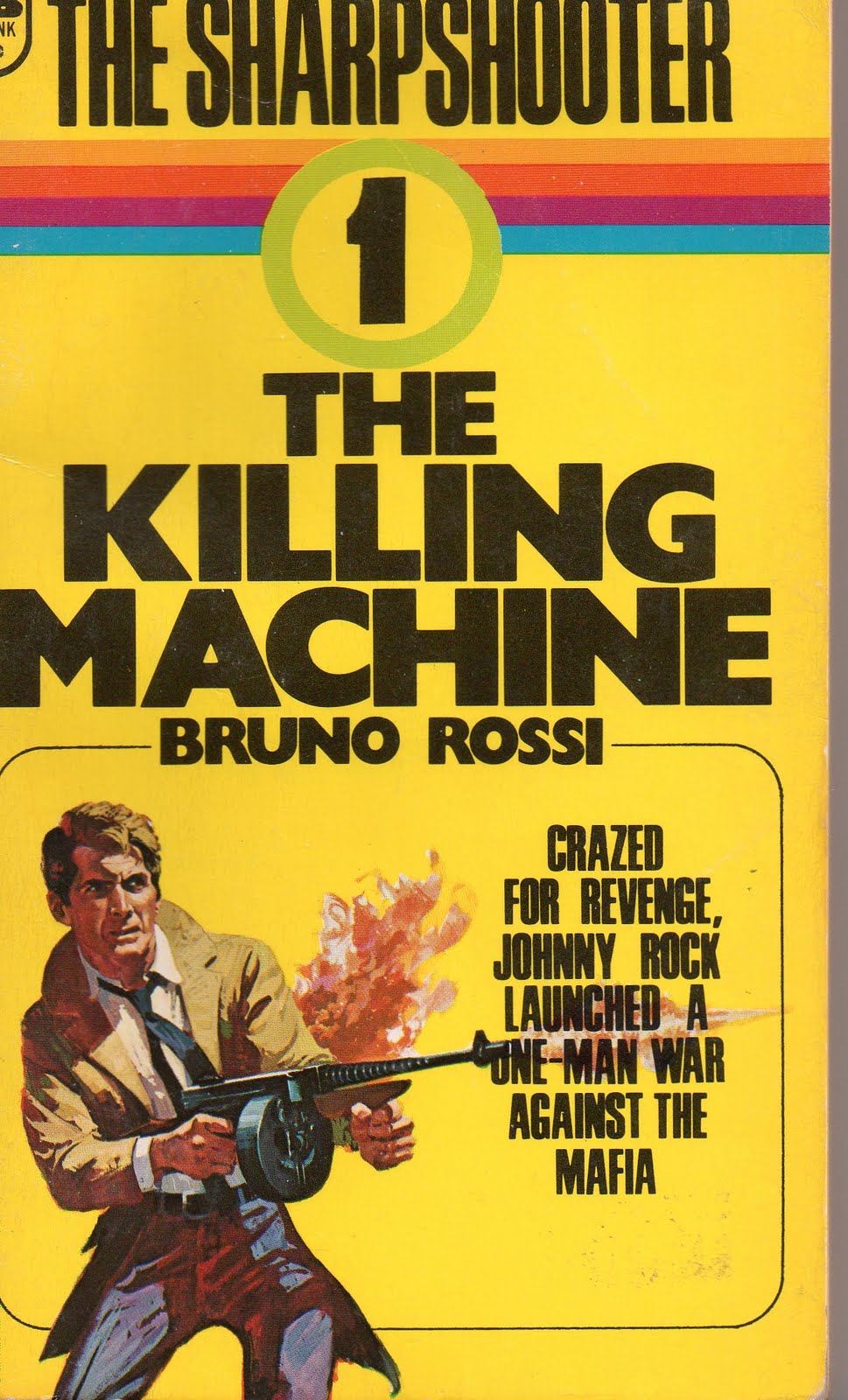
The Sharpshooter: The Killing Machine by Bruno Rossi

THE KILLING MACHINE is the first of sixteen explosive novels about the violent exploits of the Sharpshooter. Before he was the Sharpshooter, Johnny Rock was Johnny Rocetti, who ran a clothing-design firm with his family. In this 1973 Leisure Books story, we learn Rock's origin: how his family was killed by the Mafia when they refused to throw in with the Mob. Bad enough Rock's father and mother were bombed to death, but when his brother, nephew, and sister are shot down by gangsters while leaving their parents' funeral, that's when Johnny snaps.

Forgoing his former life as Rocetti, Rock now lives only to kill. He meets Iris Toscano, who would return in a later book. A Mafia widow, she also despises the Syndicate and volunteers to spy for Johnny, learning from other Mob wives the whens and wheres of illegal transactions, information she passes along to the Sharpshooter so he can be there to kill.

The author is Peter McCurtin, who wrote tons of trashy novels under several different names and even worked as an editor for Belmont Towers for awhile. Several men penned Sharpshooter novels using the Bruno Rossi name, but McCurtin could be considered the creator of the series. Rock is actually called the Enforcer a few times in this book, so perhaps that was to be the character's original nickname?

THE KILLING MACHINE is not as crazy as some Sharpshooters to come. In future installments, Rock would become downright psychotic, living only to kill mobsters. Later novels also boasted amazingly lurid titles, like HEAD CRUSHER, MUZZLE BLAST, and SAVAGE SLAUGHTER, and juicy cover art to match. THE KILLING MACHINE is worth reading, if only to see how it all began for the Sharpshooter, but it isn't among the series' best.

Tuesday, March 08, 2011

Keller: Death Squad by Nelson DeMille

As Bill Picard noted in a comment on an earlier post of mine, these early paperback originals written by (or just credited to) future bestselling author Nelson DeMille are a bibliographer's nightmare:

According to a note to the reader in the front of the late 80's reissues, DeMille wrote 6 books in the early 70's. The first 2 (The Sniper and The Hammer of God) were published by Norton and starred Ryker. The remaining 4 (The Smack Man, The Cannibal, Night of the Phoenix and Death Squad) were published by Manor Books and featured Detective Joe Keller. After Ryker's first two, the Ryker series continued: #3 The Terrorists, #4 The Agent of Death, #5 The Child Killer, #6 The Sadist. DeMille's name appears on #3 and #4, but DeMille has claimed he didn't write those and that he was paid to simply have his name kept on them. (#5 and #6 are credited to Edson T Hamill.) But here's where it gets confusing: Ryker #4, The Agent of Death, is almost a word-for-word rewrite of Night of the Phoenix, one of DeMille's Joe Keller books! It appears after in this case at least, he simply changed the names and sold the same book twice. So it wouldn't surprise me if Joe Blaze was yet another version of one of the books. A few final confusions: when the books were reissued in the early 90's by Pocket Books in the US and Grafton in the UK, they were rewritten yet again. Not only were the Keller ones changed to Ryker, but their locations were changed as well. The original books all took place around Columbus Circle and in midtown Manhattan, which at that time was seedy. By the early 90's it was tony, so they were rewritten to be in the East Village. DeMille's name appeared on the original books; it wasn't till the reissues that he became Jack Cannon so as not to confuse the fans of his popular stuff. I've read The Sniper, The Hammer of God (about a religious nut hacking up women he thinks are witches) and The Smack Man (about someone poisoning the heroin supply to kill junkies), and they've each gotten progressively worse.

DEATH SQUAD, #6 in Manor's Keller series, is actually pretty good, though still crude and rough around the edges. It isn't hard to ascertain where DeMille got the idea for the book, as MAGNUM FORCE, the second Clint Eastwood Dirty Harry movie, had been a hit just two years before and had already been ripped off for television in THE DEATH SQUAD.

Keller, the dirtiest (as in nasty and violent, if not necessarily corrupt) detective on the force, goes into action when a large group of cops turn judge, jury, and executioner and start assassinating bad guys. Keller actually wouldn't mind so much if they were just killing crooks, but liberal judges and nosy honest policeman are also targets off the death squad, and that pisses Keller off.

A ludicrously high number of Keller's colleagues are members of the underground assassination squad, leaving his young partner Reuter the only person he can trust. DeMille comes up with some fairly good setpieces once Keller figures out what's going on, and there's some good suspense in scenes in which Keller has to hide in plain sight from his buddies on the force to stay alive. The death squad itself operates in delightful pulp-novel style from an abandoned subway tunnel and is led by a mysterious hooded man known only as The Chief. The Chief's true identity is clever, though not as much is done with this as could have been.

If you want action, DeMille delivers plenty of bloody shootouts and fights, and the body count is quite high. Maybe because the author had more of these junky novels under his belt by this time and was already eager to break out into more respectable thriller writing, DEATH SQUAD is more sophisticated than the lunkheaded Ryker and Joe Blaze cop novels DeMille also churned out around this time.

I've read only one other Keller novel, NIGHT OF THE PHOENIX, but it was a Ryker novel titled THE ANGEL OF DEATH then. Yes, DeMille sold the same story twice to two separate publishers at the same time. Pretty sneaky, sis.

Saturday, March 05, 2011

Incubus (1982)

The director of Disney’s WITCH MOUNTAIN movies also made this sleazy Canadian horror movie based on a 1976 novel by Ray Russell, the screenwriter of X: THE MAN WITH X-RAY EYES. About a rapist demon with a phallus the size of a man’s arm that splits apart its victims and bathes them in semen, the film is, somehow, still less graphic and much less involving than Russell’s book.

Set in the small town of Galen, INCUBUS stars John Cassavetes (an Oscar nominee for THE DIRTY DOZEN), who must have needed the bread to bankroll another independent feature, as Sam Cordell, the local physician and coroner who is initially mystified by the brutal rapes and murders. So much discharge is left in and on the bodies that police chief Hank Walden (John Ireland, an Oscar nominee for ALL THE KING’S MEN) initially suspects a gang of rapists, although he can’t explain why the semen is colored red (nor can the movie).

Also curious is local teen Tim (Duncan McIntosh), the boyfriend of Sam’s daughter Jenny (Erin Flannery). Tim has been experiencing grotesque nightmares and claiming after each one that another rape has taken place. How do Tim’s dreams connect to the incubus—the monstrous supernatural creature that exists to impregnate human women while they sleep? Helping Sam get to the bottom of the mystery is Laura Kincaid (Kerrie Keane), the editor of the town newspaper. She’s also the spitting image of Cordell’s dead girlfriend, one of many story tangents inexplicably left undeveloped.

Most of the story is also present in Russell’s novel. Cassavetes’ character is an amalgamation of two men from the book, but original to the movie is his interest in very young women. Sam, a widower, is reeling from the death of an 18-year-old girlfriend, and his first scene finds him peeking at his daughter stepping out of the shower. Cassavetes’ quirky performance is not an asset to this film. Though I presume he and director John Hough (the two men previously worked together on BRASS TARGET) believed it would fit nicely into the skeezy atmosphere, his pervy personality makes Cordell a bit hard to take as the film’s hero.

INCUBUS is a somewhat entertaining if not completely fulfilling shocker. Hough, a horror vet (THE LEGEND OF HELL HOUSE), skillfully films the attacks as graphically as he can without going “too far” (attacks in a movie theater and a museum library are terrifically intense), and he wisely keeps the creature off camera until the end. Hough and Cassevetes basically threw out Sandor Stern’s screenplay during shooting (Stern is credited under a pen name) and just winged it on the set, which seems an unwise decision. Too many plot threads are left unresolved, as if they were forgotten during production, and the story is confusing. Likewise, Cassavetes’ improvisational acting choices are at odds with the competent and heroic character he’s supposed to be playing.

The monster suit by Les Edwards and Maureen Sweeney is pretty good and not used enough. Hough found some neat old locations in Toronto and Guelph, Ontario in which to shoot, but another of INCUBUS’ weaknesses is that we don’t get to see much of the town or its people, and thus it feels a bit claustrophobic.

Wednesday, March 02, 2011

And Soon The Darkness (1970) / And Soon the Darkness (2010)

Producer Albert Fennell, writers Terry Nation and Brian Clemens, composer Laurie Johnson, and director Robert Fuest, all of whom worked together on the television series THE AVENGERS, collaborated on 1970’s AND SOON THE DARKNESS, a big-screen chiller produced with teeth-chattering aplomb.

As much as the script and direction, the film creates a sense of dread through sound…or the lack thereof. Johnson’s score is terrific, but Fuest also uses silence and quiet sound effects to evoke a nihilistic mood, and presenting occasional dialogue in unsubtitled French puts the audience on the same edge as the English-speaking protagonists.

Two attractive young birds, Jane (Pamela Franklin, later in FOOD OF THE GODS and THE LEGEND OF HELL HOUSE) and Cathy (Michele Dotrice), embark on a bicycling trip across the back roads of France. The brunette, Jane, intends to keep her carefully planned schedule, while blond Cathy grows bored and wants to dawdle and work on her tan by the side of the road. They separate after a brief tiff, but when Cathy doesn’t show up at the next town, Jane grows worried and goes looking for her. She meets Paul (Sandor Eles), a detective who agrees to help her find Cathy, though he neglects to tell her about the pretty young tourist who was recently raped and murdered along the same road.

Fuest (THE ABOMINABLE DR. PHIBES) masterfully frames each shot for maximum tension, and Franklin, a former child star, is a marvelously vulnerable heroine. The climax isn’t perfect because of some deceptive acting I can’t get into here, but it’s exciting enough that you probably won’t think about it while it’s happening. AND SOON THE DARKNESS isn’t a Hammer movie, but could easily be mistaken for one. Clemens’ next two films were indeed for Hammer: DR. JEKYLL & SISTER HYDE and CAPTAIN KRONOS, VAMPIRE HUNTER.

Forty years later, Anchor Bay Films decided to remake AND SOON THE DARKNESS with Amber Heard (ALL THE BOYS LOVE MANDY LANE) and Odette Yustman (THE UNBORN) as the leads. Transplanting the terror from France to Argentina, the remake directed by Marcos Efron appears to go out of its way to undermine the suspense Clemens, Nation, and Fuest wrenched from the original premise.

Whereas the protagonists in the original film were alone on barren stretches of road populated only by a handful of people they couldn’t understand, the girls in Efron’s remake are in a town surrounded by solid citizens. Also deflating suspense is the opening shot, which graphically shows us a horrifying event Fuest was content to merely hint at later in his story.

Too lazy to bother with any mystery, the screenplay by Efron (making his feature debut) and Jennifer Derwingson features American teens Stephanie (Heard) and Ellie (Yustman) on a bicycling vacation in Argentina. After a night of drinking and flirting with men—well, it’s really vivacious Ellie doing the flirting while Stephanie frets—the two girls have an argument, resulting in the more responsible Stephanie leaving Ellie sunbathing near some woods. When Ellie doesn’t show up at a predetermined meeting place, Stephanie goes looking for her. The police aren’t interested in helping, but Michael (STAR TREK’s new Dr. McCoy, Karl Urban), another American, appears to be.

Efron has obviously seen the original film—he steals shots from it—but doesn’t understand why it works. Whereas Fuest plunged its Strangers into a Strange Land, Heard’s character comes across as falsely worldly (and able to beat up several men bigger and stronger than she), and Urban’s is just plumb unbelievable. The movie would like you to believe that Michael is involved in Ellie’s disappearance, but its insistence upon showing us Ellie’s kidnapping dispels that theory before Efron can even develop it. By revealing too much of its plot and falling back on standard xenophobic horror tropes, AND SOON THE DARKNESS is a thriller that doesn’t thrill.

Tuesday, March 01, 2011

Stunt Man's Holiday by John Whitlatch

The last time I wrote about author John Whitlatch, I noted that nobody seemed to know very much about him. He wrote eleven paperback originals for Pocket Books between 1969 and 1976, all of them rugged adventures about rugged, manly dudes doing rugged, manly things.

Since my post, blogger Paul Bishop was able to find and chat with an old friend of Whitlatch's. It appears Whitlatch died of a brain tumor in 1981, which is also the last year he was published. Please go to Bish's Beat here to learn more about the enigmatic author.

As for Whitlatch's work, I recently finished STUNT MAN'S HOLIDAY, which is a sequel of sorts to FRANK T.'S PLAN. It revolves a supporting character from that book, Hollywood stuntman and full-blooded Apache Max Besh. More or less one long chase, STUNT MAN'S HOLIDAY teams Besh with obnoxious standup comic Les Rick (an obvious double for Don Rickles) on a two-man trek across the desert in pursuit of robbers who have kidnapped Rick's wife and stolen $6000 of Besh's Vegas winnings.

It's structured similarly to FRANK T.'S PLAN, which had pretty much the same plot, and allows Whitlatch to get in plenty of snipes at women and hippies, which he seems to hate equally. STUNT MAN'S HOLIDAY isn't action-packed, but it's always interesting, as Whitlatch shares many helpful tips on camping, tracking, horseback riding, etc. That's one reason Rick is along--to give Besh someone to teach manliness to and give Whitlatch the excuse to show off what he knows.

STUNT MAN'S HOLIDAY is also a mystery of sorts, and if you're paying attention, Whitlatch scatters clues along the sandy path (I wasn't, but in retrospect, it all makes sense). If you're into macho adventuring, John Whitlatch is a good author to follow.

Friday, February 25, 2011

Strange Shadows In An Empty Room

Though it was marketed to American audiences as a horror film or thriller with horror elements, STRANGE SHADOWS IN AN EMPTY ROOM is a straight crime drama with an excellent cast and some amazing action scenes.

Filmed in Canada (and not trying to hide it) in 1975, this Italian/Canadian production showcases one of the best car chases ever performed, thanks to the nimble second-unit direction of driver extraordinaire Remy Julienne. STRANGE SHADOWS doesn’t show up in lists of great car chases, but Julienne smashes, jumps, crushes, and squeals these steel junkers in every way imaginable.

In the personage of burly star Stuart Whitman (RIO CONCHOS), police detective Tony Saitta is one of the most hilariously violent and single-minded lawmen this side of Maurizio Merli. The first time we see Saitta, he’s blasting away at bank robbers with the same obsession he feels for the murder of his much younger and much Frencher sister Louise (the gorgeous Carole Laure from THE SURROGATE). The initial target of his investigation is George Tracer (Martin Landau, possibly between seasons of SPACE: 1999), a middle-aged college physician who was having an extramarital affair with Louise.

Of course, more suspects, red herrings, and victims are in the mix in this whodunit penned by Vincenzo Mannino (GREAT WHITE) and Gianfranco Clerici (CANNIBAL HOLOCAUST). Gayle Hunnicutt (MARLOWE) plays a sexy teacher having an affair with Tracer's son, Tisa Farrow (ZOMBIE) is Louise’s blind roommate in an insanely dangerous dorm, and Jean LeClerc (THE UNCANNY) is Louise’s ex. With his colleague Ned Matthews (a what-the-hell-I’m-getting-paid John Saxon) in tow, Saitta — the world’s angriest cop — punches, kicks, shoots, and drives his way through every one of them before discovering Louise’s killer’s shocking identity. That nobody on the Montreal police force appears to be investigating the murders is just one of many holes in the story.

Not to be repetitive — and it’s fun to see the veteran stars bounce off each other — but the thrilling setpieces directed by Alberto de Martino (HOLOCAUST 2000) are delightful, even though they make no sense half the time. At least twice, Saitta puts himself into the middle of a dangerous situation, only to learn his opponent has nothing whatsoever to do with the case. While the car chase is the film’s most memorable scene, Saitta’s brutal punchout with a trio of razor-wielding transvestites is not far behind. The detective’s hilariously singleminded determination to smash his way through china shops is equaled only by director de Martino’s to put wild action on the screen, no matter how absurd it may be.

Tuesday, February 22, 2011

The Lone Wolf: Havana Hit by Mike Barry

Burt Wulff is back in the fifth of fourteen Lone Wolf novels penned by Barry Malzberg under the name Mike Barry. The Lone Wolf series is unusual for the men's adventure genre in that it actually comes to a definitive end, rather than just fading away. It's also one of the better written series in the genre.

Too bad HAVANA HIT isn't among the finer Lone Wolf entries. Very light on plot and action, this 1974 book from Berkley Medallion picks up with the valise of heroin Wulff picked up in Las Vegas in DESERT STALKER. The plane taking him back to New York is hijacked to Cuba, where the drugs fall into the hands of a psycho government official named Delgado, who hands them off to corrupt Intelligence head DiStasio, who plans to take the dope--a million bucks worth--to New York to sell.

Wulff, whose crusade against the mob stems from his fiance's death by overdose, enlists the reluctant aid of a 'Nam-vet helicopter pilot named Stevens to blast his way first into Delgado's office, then DiStasio's jungle estate. Although HAVANA HIT is not as exciting as previous Lone Wolf books, Malzberg creates an interesting relationship between the singleminded Wulff and the burned-out Stevens, who is a fully developed and sympathetic character whose fate is a powerful shock.

Wulff's first name was originally Burt, but was inexplicably changed to Martin in DESERT STALKER. Here, he's Martin on the inside, but still Burt on the back cover. Speaking of covers, the Lone Wolf books offer some of the most striking paperback covers, though this one painted by Mel Crair is incredibly misleading, since no women appear anywhere in the story.

Sunday, February 20, 2011

Steven Seagal Is A Dangerous Man

What the hell—a halfway decent DTV Steven Seagal movie? Hey, I’m just as surprised as you are.

That A DANGEROUS MAN is one of Seagal's most watchable films in years is despite the fact that Seagal is as disinterested as ever. Rarely has a movie star been so bored by his job that it shows up in her performances. Many shots of Seagal are actually a body double, and a lot of his dialogue is dubbed by another actor trying to sound like him. If he ever took a step during a fight scene, it would be a miracle. All he does is stand in a spot and wave his arms around in quick cuts that try and fail to disguise his girth.

That’s all par for the course in a Steven Seagal movie. What sets A DANGEROUS MAN apart from most of its competition within Seagal’s DTV oeuvre is that it appears some care was taken in other respects to deliver a watchable action movie. Put a more interested (and interesting) star in it, and A DANGEROUS MAN could have really been something.

Seagal is Shane Daniels, a former military man who served six years in prison for a murder he didn’t commit (we never learn who did). His first night on the street, he witnesses two Chinese gang members killing a cop. He kills the killers and rescues a young Asian woman, Tia (Marlaina Mah), and a Russian guy, Sergey (Jesse Hatch), who talks like a McKenzie brother (A DANGEROUS MAN was shot in British Columbia). Pretty soon, Chinese drug dealers, Russian gangsters, and corrupt cops are involved with Shane and Tia and Sergey in a complicated plot that I didn’t fully catch or care about really.

Director Keoni Waxman (THE KEEPER) appears to share Seagal’s fetishes for hot Asian girls and brutal violence, which is maybe why A DANGEROUS MAN turned out as well as it did. Few action heroes have ever been as nasty as Seagal in delivering the wet stuff, pounding and grinding and stabbing his opponents until their faces look like Robert Davi lost a fight with a cheese grater. The fights and explosions work well enough for a Friday night rental and make A DANGEROUS MAN look impressive indeed compared to the rest of its star’s recent work.

Wednesday, February 16, 2011

The Affair Of The Unhappy Hooker by David Toma

David Toma was a real undercover police detective who wore outlandish disguises to capture drug dealers in Newark, New Jersey. Like Frank Serpico and "supercops" Greenberg and Hantz in New York City, Toma became something of a folk hero for his unorthodox style and incredibly successful arrest and conviction rates. Virulently opposed to any type of drug, even alcohol, Toma's exploits became so well known that ABC created a primetime crime drama for him.

TOMA starred Tony Musante as Toma, and even though it was a hit, Musante became disillusioned with the series and left after just one season. Not to be deterred, ABC cast Robert Blake to replace Musante and continued the show as BARETTA. For all intents and purposes, TOMA and BARETTA are the same show.

Toma also spawned a trio of men's adventure novels that don't exactly seem to be TV tie-ins. In fact, TOMA was long gone from the public airwaves by the time Dell published the third and last Toma novel, THE AFFAIR OF THE UNHAPPY HOOKER. Credited to David Toma and Jack Pearl, I suspect Toma had little to do with the book's creation, and Jack Pearl seems to be a nom de plume for Donald Bain, who is still cranking out TV-based mystery novels at the age of 75 with another MURDER, SHE WROTE book coming this fall.

Strangely, AFFAIR has next to nothing to do with any unhappy hooker, though one does appear late in the story as a peripheral character. It's a well-written tale featuring Toma undercover as a Mafioso named Augie Mara who infiltrates the Newark mob to nail some bigshots running dope and prostitutes. His partner is a sexy FBI agent named Nancy Stroud who poses as his moll.

Written in first person, as though this actually happened to Toma, the book is entertaining, though Toma's rants against drinking and drugging occasionally veer off into self-righteousness that's hard to take. I'm sure Toma had a healthy ego--in fact, it was probably necessary for him to pull off his many guises--but the fact that his fellow cops gush over him and his new partner is dying to seduce the happily married hero is a bit much. It's common for men's adventure heroes to be supermen, but Toma is an actual person, and as such, his piousness can be hard to take.

Still, I liked THE AFFAIR OF THE UNHAPPY HOOKER, and it's interesting to note that the face painted on the Dell cover is not that of actor Musante, but of Dave Toma himself.

Monday, February 14, 2011

The Baroness: The Ecstasy Connection by Paul Kenyon

Based solely on this first novel, I proclaim Pocket Book's the Baroness series as one of my favorite paperback series of the 1970s. It's fast-moving, sexy, violent, and downright weird--just the way I like 'em!

The Baroness is Penelope St. John-Orsini, the widow of both a secret agent and a car-racing baron who was left wealthy and bored after the deaths of her husbands. As "Coin," she works for the National Security Agency as a spy, using her cover as an internationally famous model and actress to travel all over the world solving cases.

Unusually for these series, the Baroness works with a team, all of whom are either models or photographers, including ex-Green Beret Dan Wharton, sexy Fiona, tough guy Eric, bombmaker Paul, master of disguise Yvette, Cherokee Joe Skytop, and Japanese Tom Sumo. She takes her orders from John Farnsworth, whose codename is Key.

Seven of the eight Baroness novels were released by Pocket in 1974. All are credited to Paul Kenyon, obviously a pen name, because the books were "produced" by packager Lyle Kenyon Engel, who was also involved with the Chopper Cop and Blade series, to name a couple. According to Bradley Mengel's SERIAL VIGILANTES OF PAPERBACK FICTION, Engel founded Book Creations, Inc. in 1973, a company that conceived novels on spec, hired writers, then sold the books to various paperback publishers.

So. THE ECSTASY CONNECTION. Well, it's an odd duck. Basically, Penelope and her team are investigating some strange isolated incidents in which people are literally sexed to death. That is, one starves to death, because he was enjoying something so pleasurable that he wouldn't stop it to eat. A stage actress literally masturbates herself to death in front of a live audience.

It's all because of a drug created by Dr. Jolly, who works at the plush Hong Kong estate of the blubberous Petronius Sim, a gigantic and evil bastard who plans to addict the world's leaders to the drug so he can control them. In his employ are zombies with electric sockets in their heads into which Sim inserts plugs that stimulate their brains with uncontrollable pleasure or pain to keep them in line.

Kenyon's major setpiece is a real action doozy. The Baroness, investigating an orgy at a Mafia hangout in a loft, finds herself in the middle of a machine gun slaughter, because Sim has ordered the men to kill all witnesses to his drug's effects. After escaping immediate death by hiding in a pile of nude corpses, she manages to lead her pursuers through windows, over roofs, and all over the building sans weapons or even clothes, for that matter. It's an exciting action scene with an extra touch of oddball sleaze to put it over the top.

It should be said that the book's sex scenes are quite graphic--something of a "hard R" nature. Personally, I'm not turned on by sexy passages in a book and find these moments tedious. I usually skip over the 3- or 4-page sex scenes, but your mileage may vary. Just to warn you that you may be surprised by the Baroness' libido and Kenyon's lengthy descriptions of her many lovemaking marathons.

THE ECSTASY CONNECTION is a terrific adventure I can't recommend highly enough for readers interested in action of an unusual bent.

Thursday, February 10, 2011

Burt Reynolds in Stick

Elmore Leonard actually adapted his own novel for STICK, but was not happy with it after Universal demanded reshoots that pushed the release back several months (Leonard shares screenplay credit with SUDDEN IMPACT’s Joseph Stinson). I can’t say Universal deserves all the blame for STICK’s failure, because Burt Reynolds, who starred and also directed it, made several bad choices of his own, including allowing his own ego to demand that his character be smarter, worldlier, and handsomer than everyone else. And more egregiously, letting co-star Charles Durning wander around under a ridiculous orange wig.

Every time I see STICK, I really try to like it. Reynolds’ previous film as a director, SHARKY’S MACHINE, is an outstanding crime drama with crackling action scenes and several well-rounded characters. If only he had taken the same approach with STICK. Even though Reynolds is wearing his “serious” toupee in it, it still plays much more like CANNONBALL RUN II than SHARKY’S MACHINE. Scenes don’t hang together well, which could be the result of post-production finetuning. Alex Rocco pops in for one scene that doesn’t have anything to do with either the story or building Burt’s character, and Deanna Lund gets nice billing for a party scene, but doesn’t even get a line.

What’s most interesting about STICK is an astounding stunt by Dar Robinson that was one of the best ever filmed up to that time. Using a device he invented called a decelerator, Robinson, playing an albino assassin named Moke, did a freefall off a building ledge using wires to break his fall. This allowed Reynolds to aim the camera over the ledge and shoot Robinson’s fall without revealing an airbag on the ground. Today it wouldn’t matter, because any wires seen on camera can be removed digitally, but Robinson’s STICK fall was a big deal in 1985.

Ernest Stickney (Reynolds), just out of the pen after a seven-year sentence, accompanies his friend Rainy (Jose Perez) to deliver drug money from eccentric pusher Chucky (Durning) to nasty supplier Nestor (Castulo Guerra). It’s a setup, and Rainy is killed. Stick survives and gets in the middle of a struggle between Nestor, against whom Stick wants revenge for Rainy’s murder, and Chucky, who owes him $5000. He hides out as a chauffeur for wealthy Barry Braham (George Segal) and begins a romantic relationship with Barry’s financial advisor Kyle (Candice Bergen).

STICK starts out promisingly with some gritty photography, tough talk, and a good action piece in the swamp. Unfortunately, after that it falls into camp with Durning and Segal playing too far over the top and Reynolds doing some characteristic clowning. He probably felt that’s what his fans wanted, but the joking harms Stick’s integrity and waters down the suspense. Humor, of course, is fine in a thriller, but STICK’s is overly buffoonish.

The film isn’t a total disaster. It isn’t as good as it should have been, so it’s a disappointment, but Reynolds is talented enough in front of and behind the camera to keep it entertaining though awkward. It didn’t do much at the box office—in fact, Burt was already through as a marketable leading man, though he didn’t know it for a few more years.

Sunday, February 06, 2011

Dirty Harry: Massacre At Russian River by Dane Hartman

I'm not sure why, but the men who penned the twelve Dirty Harry novels for Warner Books took a delight in taking its leading man out of San Francisco, the city he patrolled as an Inspector for the SFPD with a .44 Magnum in his shoulder holster.

It wasn't a fish-out-of-water thing, because Harry Callahan was never much of a social being anyway and had little trouble fitting in. The one exception that I've read may be FAMILY SKELETONS, which sent Harry to Boston to visit relatives he never had time for before. Getting Callahan involved with a serial killer who may be targeting his niece was a nice way of giving a case a personal spin.

Which is not the case in Dirty Harry #7, MASSACRE AT RUSSIAN RIVER, published by Warner Books in July 1982. It's purely business as Harry is sent to a small town to help bust a ring of mountain men trafficking in marijuana. His distrust of authority is bad enough, but when he learns he's to work with a local narcotics officer named Turk who is vainglorious, incompetent, and maybe even crazy, Callahan starts to worry. Author Leslie Horvitz, using Warner's Dane Hartman pseudonym, creates some evocative action scenes--a mountaintop massacre staged in the mud and the rain and the wind of a major thunderstorm and a nighttime stalk through an old house with three murderous rednecks after Harry's ass are two of them.

At 220 pages, MASSACRE AT RUSSIAN RIVER seems padded--a sequence in which Harry trails someone back to San Francisco and ends up wanted by the DEA is extraneous and is, in fact, ignored at the end--but Horvitz has a good handle on the character, and it's easy to picture Clint Eastwood saying and doing the things Harry does in the book.

Boxoffice: February 13, 1978


Wednesday, February 02, 2011

The Forbidden Dance

Can you believe two films about the lambada were released the same day? While Cannon’s Yoram Globus was putting out LAMBADA by BREAKIN’ director Joel Silberg on March 16, 1990, his cousin and former partner, Menahem Golan, was rolling out THE FORBIDDEN DANCE for his new company 21st Century.

By the time both films came out, nobody in the U.S. gave a damn about the shortlived dance fad anyway, and they both vanished almost as quickly as the lambada did. If anything about them is noteworthy, it’s their female leads: LAMBADA’s Melora Hardin, who went on to prime-time prominence in THE OFFICE, and this film’s Laura Harring, more than a decade before she got a boob job and landed her breakthrough leading role in David Lynch’s MULHOLLAND DRIVE.

An Amazon princess named Nisa (Harring) and her hulking witchdoctor companion Joa (Sid Haig!) go to Los Angeles to prevent an evil oil company from bulldozing their native village in the Amazon. Joa gets tossed in the joint, and Nisa gets a job as a maid for wealthy racists. That gig doesn’t work out when the parents find out she went dancing with their layabout dance-obsessed son Jason (Jeff James), so she wanders over to cinema’s most ridiculous strip club/brothel. Billed as “Queen of the Amazon,” Nisa dances for about three people in this rinkydink joint until she gets into a hassle with Jason’s pals in paisley vests.

What it all boils down to is Jason and Nisa competing in a Kid Creole and the Coconuts dance contest so they can win first prize: an appearance on national television so they can preach a Save the Rain Forest message and, presumably, save Nisa’s village from getting torched by oil company mercenary Maxwell (Richard Lynch).

But THE FORBIDDEN DANCE is crazier than it sounds. Sid Haig playing air bongos. A bizarre safe-sex message. The pitiful acting and sets. Brazil portrayed like a 1950s Jungle Jim programmer. Gratuitous slo-mo window breaking. Jason’s hilarious fascination with dancing all night. And, Lord, Richard Lynch dancing the lambada.

Yes, it’s a terrible film, but perfectly watchable in the way only some dreadful films can be. Laura Harring is more than watchable—gorgeous and energetic even, though not exactly an acting powerhouse. She fares better than her blow-dried leading man, who’s unconvincing as a dancer and a lover. He appears as though THE FORBIDDEN DANCE was James’ only film—not a shocker. Also with Linden Chiles, Shannon Farnon, Angela Moya, Barbra Brighton, and the hit Kaoma song “Lambada,” which LAMBADA didn’t get the rights to.