Showing posts sorted by relevance for query mccurtin. Sort by date Show all posts

Tuesday, October 04, 2011

Kill For Peace

I recently reviewed Synapse's new Blu-ray of James Glickenhaus' 1980 urban thriller THE EXTERMINATOR for the Micro-Film News Blog. Now to review Manor Books' 1980 novelization of Glickenhaus' screenplay.

THE EXTERMINATOR, the book version, was penned by Peter McCurtin, a very prolific paperback author whose work I've written about many times. Unsurprisingly, McCurtin imbues THE EXTERMINATOR with the same blunt style he used when writing about the Marksman, the Assassin, the Sharpshooter, and other men's action antiheroes.

See my film review for background and plot information. McCurtin more or less follows Glickenhaus' film closely with a few notable exceptions. The most glaring is the scene in which the Exterminator, a New York City vigilante named John Eastland, has kidnapped a New Jersey mobster named Pontivini and bound him in chains about a meat grinder. In both the film and book, Pontivini lies about having an attack dog at his estate when he gives Eastland the safe combination so Eastland can rob him. This leads to a crowdpleasing moment in the film when Eastland returns, now pissed about being chewed up by Pontivini's snarling Doberman, and smacks the button lowering the mobster into the grinder, resulting in a closeup of Hamburger Pontivini. In the book, strangely, when Eastland returns, Pontivini is already dead of a heart attack. I'm not sure why McCurtin would do this.

One scene created by McCurtin finds Eastland kidnapping Shecky (!), a dealer of illegal weapons, and stealing a cache of weapons he plans to use in his armed war against crime. Granted, this scene could have been written but not filmed by Glickenhaus. It's unclear whether McCurtin had seen THE EXTERMINATOR when he wrote the book. It's very doubtful he had, and he was probably working from a script draft.

Like the film that spawned it, THE EXTERMINATOR is tough and brutal with terse dialogue and sleazy violence. Obviously, that's a recommendation, though if you're familiar with the movie, there isn't much in McCurtin's novel that will surprise you.

Friday, August 14, 2009

New Orleans On The Assassin's List

Whomever Peter McCurtin was, he surely was a crafty devil, churning out Assassin novels for Dell and Marksman books for Belmont/Tower, even though obviously both characters are exactly the same. Both antiheroes even have the same origin: New Orleans-based gun dealers who seek revenge against the Mafia after their families are murdered. I have no idea who McCurtin pulled it off, but my hat is off.

The second Assassin novel, NEW ORLEANS HOLOCAUST (Dell, 1973), sends Robert Briganti back to his hometown to find the brother of one of the hoods that killed his family prior to the first book. There isn't really any more to the plot than that. In fact, that story's payoff pales a bit next to some of the side jobs Briganti takes on before and after he arrives in New Orleans.

A nasty setpiece finds the Assassin on the prowl for two gay Mafia hitmen who tortured and killed a young stripper with whom he knew as a kid growing up in the carnival business. McCurtin briefly introduces a temporary new partner for Briganti: a retired corrupt police detective who helps the Assassin prowl the underworld for one of the fiends and dies heroically in an absurdly public shootout.

Little in the way of characterization or anything exuding realism, but blunt and entertaining. Briganti's gimmick of recording his exploits on cassette tape and sending them to the FBI is an interesting one.

Sunday, September 20, 2009

Torch Of Vengeance

Johnny Rock returns in STILETTO, Leisure's ninth Sharpshooter novel, and he has a supporting cast this time. Iris Toscano, Rock's lady friend from the first Sharpshooter book, is back to assist Johnny on his mission to murder as many mobsters as he can. Also, his uncle Vito joins the crusade after Vito's wife is killed in a barrage of bullets meant for her nephew.

The plot, which may have been written by Peter McCurtin, who introduced both Johnny and Iris in the first book, KILLING MACHINE, meanders for 215 pages, but still manages to be less sloppy than most previous entries. I wouldn't be surprised if STILETTO was intended to be two separate adventures, but Leisure and/or McCurtin decided to push them together. The fact that I don't think any actual stilettos appear in the book leave me wondering too.

Rock (formerly John Rocetti, who hunts the Mafia as revenge for the murders of his family) starts out by planning the destruction of one million gallons of stolen gasoline the Mob has stashed away in the woods of New Jersey. After several pretty cool chases and shootouts, some of which are quite graphic and approach Death Merchant levels, Rock and Vito end up pursing a Mafia gunrunning operation.

It's too long and feels padded in spots--particularly a few pages in which Rock and Vito talk about their shotgun shells and where they shot them--but STILETTO is one of the better Sharpshooter entries I've encountered so far. I recently managed to land the entire Sharpshooter series in one lot for a mere $1.00, so I'm looking forward to catching up with them.

Wednesday, December 12, 2012

A Savage World Without Mercy

BLOOD OATH is the second of Leisure Books' surprisingly long-running series of men's adventure novels about Mafia-killing madman Johnny Rock aka the Sharpshooter. Published in October 1973, it's also one of the sloppiest, and that's saying a helluva lot for one of literature's all-time sloppiest series.

Peter McCurtin wrote the initial book, THE KILLING MACHINE, under Leisure's "Bruno Rossi" house name. When Russell Smith came in to pen the sequel, he jettisoned all the established facts and open storylines McCurtin had created. John Rocetti is now named John Roccoletti (subsequent books would go back to Rocetti), and Iris Toscano is gone and replaced by a new character named Jane (more on her in a moment).

As with other books in the Sharpshooter series, BLOOD OATH is plagued with editorial mistakes due to having been intended as an entry in Belmont Tower's Marksman series. Rock is occasionally called "Magellan" (the name of the Marksman), and Jane is introduced twice as Terri White, the Marksman's romantic interest. Honestly, these characters exist only to be abused and raped, which happens to Jane near the end of BLOOD OATH and to Terri in HEADHUNTER.

It's pretty clear that Smith was just making shit up as he goes along. He has Rock kidnap a policeman and two journalists, strip them, photograph them, and bound in an attic, which is where they still are at the end of BLOOD OATH with no indication of what Rock plans to do with the photos. Smith builds up to a big violent climax, which takes place mainly off-page with the nastiest villain being dispatched in a throwaway sentence on the last of 156 pages.

Plot finds the Sharpshooter renting a country home near the small town of Xenia, New York, where he discovers Mafioso Attilio Fanzago has set up an estate. As mobsters go, Fanzago ain't bad. He deals only in merchandise like electric typewriters and eschews dope and prostitution. Still, he's Mobbed up, so Rock hates him and has to destroy him. Which he does in the most hamfisted and juvenile prose possible.

Did I enjoy BLOOD OATH? Well, yeah.

Friday, April 25, 2008

On The Assassin’s List

The Assassin is a character created by author Peter McCurtin, who wrote a lot of books. Besides three (at least) Assassin novels, he also wrote for the Marksman, Carmody and Soldier of Fortune paperback series, as well as a ton of westerns, crime dramas and even the novelization of James Glickenhaus' screenplay for the exploitation sickie THE EXTERMINATOR (I'd love to read that one). McCurtin doesn't seem to be very good, despite his busy resume. He has a blunt writing style…well, maybe "style" isn't the right word. He writes as though his routine is to sit down at his typewriter and punch keys until he hits his word count.

MANHATTAN MASSACRE, published in 1973, reads as though it could have been the Marksman's origin story, and Dell's attempt to copy the success of the Executioner and other similar paperback action heroes is obvious. Robert Briganti is a crack shot and gun dealer whose family is murdered as payback after he refuses to arm a Brooklyn mobster named Joe Coraldi. Feeling he has no reason to live, except to get revenge, Briganti rips off some weapons from the munitions company he used to work for, and sets to work knocking off Coraldi and his men. He makes audio tapes, describing his bloody mission, and sends them to the media and the FBI, hoping to make the public aware of how evil the Mafia really is.

It's really a pretty decent read, even though there isn't anything unusual or original about it. MANHATTAN MASSACRE even has a title reminiscent of an Executioner, Death Merchant or Butcher title, which is certainly no coincidence.

Sunday, May 03, 2009

Open Season On Rats

When Phillip Magellan was a boy, he toured with a carnival, where he learned everything he knows about firearms. How to clean and care for them, how to shoot them. As an adult, he married, had a son, and opened a gun store in New Orleans. When he refused to sell weapons to the local Mafia, they murdered his family. Now, Magellan is on the run, seeking vengeance against mobsters wherever he goes.

In DEATH HUNT (Belmont Tower, 1973), the second Marksman novel, author Peter McCurtin brings Magellan to New York, where he witnesses a mob hit on Don Vincent Paoli and reluctantly saves the old man's life. At the Paoli home, Magellan makes the acquaintance of the old Don's daughter, Antonia, and makes love to her while an assassin finishes the job on Vincent in the other room. Now emotionally involved in the dispute, Magellan reluctantly inserts himself into the war between the Paoli family and that of Vito Spazzi, who kidnaps Antonia for information.

Told in McCurtin's typically blunt style in just 146 pages, DEATH HUNT racks up a hefty body count, if not much story. The climax is kinda clever, as Magellan discovers a way of using the Coney Island attractions to plan his assault on Spazzi's estate, but wraps up the story much too quickly without a much-needed face-to-face standoff. You can read this thing in just a couple of hours, so take it to the DMV.

Friday, March 11, 2011

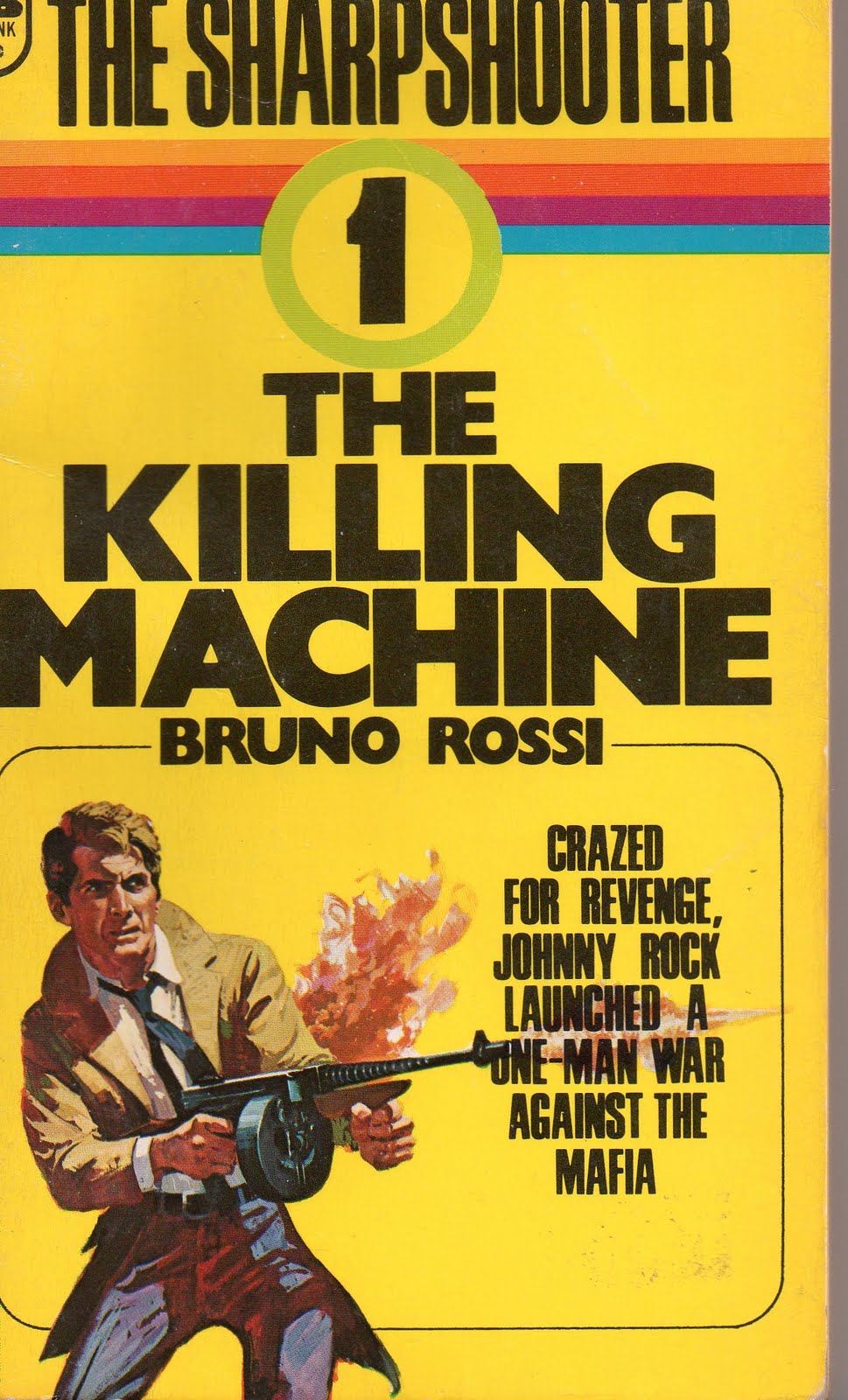
The Sharpshooter: The Killing Machine by Bruno Rossi

THE KILLING MACHINE is the first of sixteen explosive novels about the violent exploits of the Sharpshooter. Before he was the Sharpshooter, Johnny Rock was Johnny Rocetti, who ran a clothing-design firm with his family. In this 1973 Leisure Books story, we learn Rock's origin: how his family was killed by the Mafia when they refused to throw in with the Mob. Bad enough Rock's father and mother were bombed to death, but when his brother, nephew, and sister are shot down by gangsters while leaving their parents' funeral, that's when Johnny snaps.

Forgoing his former life as Rocetti, Rock now lives only to kill. He meets Iris Toscano, who would return in a later book. A Mafia widow, she also despises the Syndicate and volunteers to spy for Johnny, learning from other Mob wives the whens and wheres of illegal transactions, information she passes along to the Sharpshooter so he can be there to kill.

The author is Peter McCurtin, who wrote tons of trashy novels under several different names and even worked as an editor for Belmont Towers for awhile. Several men penned Sharpshooter novels using the Bruno Rossi name, but McCurtin could be considered the creator of the series. Rock is actually called the Enforcer a few times in this book, so perhaps that was to be the character's original nickname?

THE KILLING MACHINE is not as crazy as some Sharpshooters to come. In future installments, Rock would become downright psychotic, living only to kill mobsters. Later novels also boasted amazingly lurid titles, like HEAD CRUSHER, MUZZLE BLAST, and SAVAGE SLAUGHTER, and juicy cover art to match. THE KILLING MACHINE is worth reading, if only to see how it all began for the Sharpshooter, but it isn't among the series' best.

Saturday, February 16, 2008

Mafia Butcher

The Marksman is back in Frank Scarpetta's COUNTERATTACK, #11 in Belmont/Tower's series of rough paperback adventures. Although this one seems to be penned by a different author than VENDETTA (credited to Peter McCurtin), the writing style seems about the same. Blunt and barely functional, COUNTERATTACK feels as though Scarpetta were pounding the keys of his typewriter without ever looking up from the page, as if he had to get the whole damn thing done in a weekend.

Philip Magellan, aka The Marksman, enters New Orleans, where he aims to put an end to the tarpaulin of vice and corruption that covers the city, courtesy of Mafioso Benito Borghese and cop J.M. Baffrey. The Marksman draws first blood by heisting $650 million of heroin from Borghese, which he hides in a cabin in the woods.

Scarpetta's choppy plotting feels made up at the spur of the moment. Supporting characters, such as a pair of French sisters, are underdeveloped, and plot points that appear to head toward some sort of twist are forgotten as soon as they're introduced (why did one sister switch places with the other?). Borghese never meets the Marksman face-to-face, and I'm still scratching my head at Scarpetta's abrupt ending, which reads like he hit his maximum allotted word count and quit.

I enjoyed COUNTERATTACK to a certain extent, but its clumsy plotting and hamfisted style makes it second-tier paperback adventure at best.

Saturday, January 31, 2009

Orders to Kill!

Jonathan Trask's THE CAMP (Belmont Tower, 1977) is a patently absurd slice of post-Watergate paranoia that seems to have vanished off the cultural radar minutes after it arrived. A Google search turns up almost no information on the book or its author, who may of course have been a house name. I love the cover, however, which looks like it came from a '60s sweat mag. Maybe it did, as those companies tended to recycle art when possible. The illustration depicts an act of violence that actually occurs in THE CAMP, so maybe it was commissioned for the paperback.

Told in first person, THE CAMP is about Phil Gordon, a conservative, beer-drinking, skirt-chasing, joint-toking Vietnam vet who muckrakes as an investigative reporter for a NEWSWEEKesque weekly called TOMORROW. He enjoys taking down corrupt politicians and businessmen and is as handy with a Walther as he is with a Smith Corona.

On vacation in Maine, he visits a Native American friend, Jimmy Jacks, who tells Phil about a mysterious Army camp hidden deep in the woods where ghastly sounds emanate at night. Although the camp is surrounded by two waves of barbed wire so no one can get close enough to see anything, the moaning of what sounds like men being tortured carries past the fences. Jimmy's three sons sneaked into the forest to investigate, but none ever returned.

Phil and Jimmy pay a late-night visit to Camp Butler and discover the torn, ravaged bodies of tortured hippies tied to posts. Smelling a scoop, Phil arranges to go undercover as a recruit at Camp Butler, which he learns is operated under the radar by right-wing military extremists who are training American soldiers for an eventual government takeover, which includes a possible assassination of the U.S. President.

Trask didn't take long to pound out these 155 pages, and the plot and action don't fill out as well as they should. Gordon doesn't even face much opposition in his attempt to topple the Camp Butler bigwigs, which makes one wonder how they plan to conquer Washington if they can't even stop one out-of-shape ex-Green Beret.

A silly late-chapter twist and a pessimistic coda that indicates Trask/Gordon actually experienced THE CAMP and is hiding his facts in the form of a novel are consistent with the gloomy endings common to the 1970s. I had a good time in the hour or two it took to rip through Trask's blunt stylings, though I feel like the only man alive to have survived THE CAMP.

EDIT 2/28/2012: Big thanks to Joe Kenney at Glorious Trash for noting in the comments section that author Jonathan Trask is actually a combination of Leonard Levinson and Peter McCurtin!

Monday, February 08, 2010

Men Of Violence 2

Justin Marriott is back with another issue of MAN OF VIOLENCE. Like the first issue of his self-published fanzine, which I reviewed last July, it covers the lurid, often bloody men's adventure paperbacks of the 1970s, a genre of literature about which very little seems to be known or written.

#2 is very much like the first, including its deficits (lousy proofreading), but what's good is really good. I only wish the issue were longer, because I think Justin is beginning to scratch the surface with his articles.

Topics include Manor Books, a New York-based operation that published some of the genre's sleaziest series, including Kill Squad, Bronson (an incredibly obvious DEATH WISH ripoff), and Kung Fu starring Mace; Peter McCurtin's long running Marksman series; the western series Renegade starring Captain Gringo (!); a review of Bradley Mengel's new McFarland book SERIAL VIGILANTES OF PAPERBACK FICTION (which I'll also be reviewing soon); and more.

Best of all are all the (black-and-white) reproduced covers sprinkled across the pages. As good as the articles are, I think the best way to get a quick idea of what the men's adventure genre is all about is to glance at these action-packed covers, many of which were painted by comic book artists like Bob Larkin and Ken Barr.

You can learn more about MEN OF ACTION at Justin's Paperback Fanatic site.

Tuesday, December 25, 2007

Three The Hardman Way

Happy Holidays, folks. I trust everyone had a fun Christmas weekend. I did little besides eat, doze, watch NFL football, and read trashy novels. I have three to catch up on here, so I'll throw them up here in a hurry.

In Ralph Dennis' THE LAST OF THE ARMAGEDDON WARS, #11 in Popular Library's Hardman series, Jim Hardman is a non-licensed ex-cop who sorta does private investigation work on the side, assisted by his big, strong, black pal Hump Evans. Hardman finds himself trapped in a gang war when The Man--a black mobster named Warden Pike who runs all the black rackets in Atlanta--is under siege by assassins. The Man trusts Hardman enough to look into who wants to kill him, while the cops want Hardman's help working on the inside. Hardman loves to grill steaks and fight in this very short paperback, written in first person and published in 1977. Not bad, but nothing out of the ordinary, outside of the unusual Atlanta setting.

VENDETTA, Peter McCurtin's first novel in Belmont/Tower's Marksman series, published in 1973, is not an origin story and forces you to fill in some gaps yourself. Basically, Phillip Magellan--the Marksman--despises the Mafia and wants to kill everyone involved with the organization. The back of the book claims that Magellan was a teenage trick shot champion and that the Mafia murdered his family when he refused their invitation to become an armorer for them, but none of this is in the book. What is in the novel is a large body count, as the Marksman makes for San Francisco to bring down a high-ranking mobster named Dino Flavel. He also kills a bunch of hippies, cuts the head off of one and leaves it in the St. Georges Hotel's fountain.

The Butcher's second adventure, 1971's COME WATCH HIM DIE by Stuart Jason (Pinnacle, 1971), is pretty good stuff that really gets crazy down the stretch. The first half or so is typical bang-bang stuff, as Bucher, a former mobster who quit the Mafia and now works for a government agency called White Hat to bring down the organization, bounces from New Orleans to Holland to avoid the $100,000 bounty on his head, particularly when he learns a female assassin is on his trail. His mission is to investigate a former Nazi named Klaus von Rimer, who is rumored to have instigated a plot to substitute perfect doubles for American congressmen that will vote in favor of the Mafia's wishes. The wildness really kicks in when the Butcher comes face to face with von Rimer, who turns out to be a cannibalistic necrophiliac who keeps genetically mutated, giant-size anacondas in his cellar. While the climax was just as I predicted, it's still pretty gruesome and quite memorable, as is the rest of the book.

Thursday, December 06, 2007

Vengeance!

On some level, you have to admire a book titled HEADCRUSHER. There is certainly little doubt as to what kind of reading you'll be getting. And HEADCRUSHER, published by Leisure in 1974, lives up to its name, even though there's no head-crushing in it. Head-shooting, oh yes, but no heads are crushed.

The Sharpshooter is John Rocetti, whose father and mother were gunned down by mobsters when Mr. Rocetti refused to allow the Mafia to use his small family business as a front. At the Rocettis' funeral, the mob struck again, killing John's brother and sister and sending him to the hospital. During his lengthy healing process, John swore to avenge his family by killing as many Mafia bastards as he could before they eventually got to him.

Now known as Johnny Rock, the Sharpshooter is drinking in a Manhattan bar when he overhears a couple of mooks talking about how they were involved in the Rocetti killing years ago. I know, lucky, right? Rock blows them away, but not before learning the number-one guy in the hit was Mackie Malanga, owner of a massage parlor and porno theater on Times Square. Rock ends up undercover as Mackie's main henchman during a massive gang war, in which the Sharpshooter manages to kill dozens of "Mafia bastards" (as he puts it) while learning which don put out the contract on the Rocettis.

Tightly written and grimy as hell, HEADCRUSHER hits the spot if you're looking for violent urban thrills with an anti-hero that isn't difficult to root for, even though he's not always careful about keeping civilians out of harm's way. If an innocent bystander is killed while Rock is mowing down a bunch of mobsters, so be it.

Apparently, several staff writers were "Bruno Rossi", including Peter McCurtin, Russell Smith, Leonard Levinson, John Stevenson and Paul Hofrichter. I don't know if any of them wrote HEADCRUSHER, but I was impressed by the author's lean pulp style.

Thursday, June 30, 2011

Mafia Death Trap

So here Robert Briganti is, just minding his own business, relaxing in the Maine woods with his elderly new friend Lem Perkins, when a couple of Mafia "pigs" take a potshot at him and accidentally kill Perkins instead. This makes Briganti, known among Mob circles as the Assassin, mad. Really mad. Mad enough to go to Boston and wipe out the local capo, Franco Toriello, and his entire organization.

So goes BOSTON BUST-OUT, the third and final Assassin paperback, all published by Dell in 1973. 1973 was also the year author Peter McCurtin began writing novels about the Marksman for Belmont Tower, and it's clear that the Assassin books were intended for the Marksman, as both characters have the same origin and the same bloody concept.

BOSTON is practically plotless: just a series of kidnaps, beatings, and shootings as Briganti kills his way through Toriello's entire family. Barely a hero by this point, Briganti even snatches the old man's young girlfriend, sleeps with her, and sends her back to Toriello with false information that he knows will kill her. Coldblooded mofo, that Assassin.

As these things go, BOSTON BUST-OUT isn't bad. It's maybe a little long at 192 pages, but it ain't exactly packed with a lot of big words. As entertaining as it is, it's easy to see why the Assassin didn't last. He isn't an original or terribly interesting character, and there's nothing about him that stands out among the Sharpshooters and the Marksmen and the Liquidators that were competing for eyeballs. Pretty good cover though, especially the blue background that makes the illustration really pop.

Tuesday, August 02, 2011

Blood Justice

I'm frequently amazed at how sloppy the editors of Belmont Tower's Marksman paperbacks were. In some of them, author Frank Scarpetta (most likely either Peter McCurtin or Aaron Fletcher) actually calls leading man Phillip Magellan by the wrong name. In book #5, HEADHUNTER, published in 1973, the story appears to pick up right at the conclusion of #4. Since Scarpetta makes little attempt to catch the reader up with the events of that story, you can be forgiven for spending the first few chapters of HEADHUNTER wondering what the hell is going on.

Magellan, having wiped out a bunch of Mafioso in St. Thomas, arrives in Puerto Rico with several suitcases full of drugs and weapons. I think he's planning to stay just temporarily on his way back to the United States, but he's mugged by some crooks on the lookout for naive tourists, then his romantic relationship with Terri White, who seems to have been introduced in the previous book, hits a snag when she is raped.

By this point, the Marksman figures, "What the hell, I'm here anyway, I might as well kill all the Mafia here too." The rest of HEADHUNTER's 159 pages is Magellan kidnapping, torturing, and killing bad guys in Scarpetta's blunt-nosed style that involves the heavy use of exclamation points outside of dialogue. I think I read HEADHUNTER in about two hours, which is meant to be a compliment, I think.